Strong advocate of just having a normal job and give to effective charities.
Doctor in Australia giving 10% forever
Henry Howard🔸
Karma: 1,520
Not familiar with this paper so sunk to using Claude to give myself a summary. The misalignment “blind audit game” seems a bit sus
“Three auditing teams played this game under conditions mimicking those of AI developers conducting real pre-deployment alignment audits, including access to model weights and training data”They had access to the training documents? That doesn’t seem like detecting alignment, that’s just a search through files to find one with malicious instructions“A fourth team was given affordances that a lab-external auditors would have—namely, only API access to sample from the model—and failed to discover its hidden objective despite it being possible in principle to do so.”🤔 when they don’t have the training documents they can’t detect the misalignment?If they’re claiming that finding a file with malicious instructions is detecting misalignment then this would update me further against AI Safety research.Edit: Actually it looks like the teams were using some clever auto-encoder method rather than just a search through documents. In any case this seems all pretty artificial. This method might detect misalignment if it is due to a few malicious documents mixed-in with the training data and where the malicious behaviour is easy to detect. This feels like killing cancer cells in a petri dish—easy and doesn’t tell you much.
Yes but my point is that whether the AI Safety community has moved the dial on interpretability or government interest is unclear and worth being skeptical of
That’s a fair point. At either end of the extreme of outcomes: “ASI kills us all” or “ASI quickly uplifts everyone out of poverty” almost all decisions/actions we make today are pretty meaningless.
But if the next few decades fall somewhere between those two extremes, which I think they probably will, the impact of improving people’s lives remains substantial.
(NOTE: Coming at this from a place of: a. ignorance of what the AI Safety community actually does and b. not wanting to take the ego hit of admitting that I have been wrong about my long-held skepticism of AI Safety)
I think it was and is fair to be skeptical of the shift to AI Safety in EA on the basis that it’s not that tractable, and that there’s there’s not clear evidence that the AI Safety movement has had a positive effect on the trajectory of AI.
“But it brought the ideas into the mainstream”
I think the AI Safety community will be tempted to think they’ve normalised in the zeitgeist ideas about superintelligent AIs and the philosphical questions and risks that arise from them, but 2001: A Space Odyssey came out in 1968, Terminator in 1984 and The Matrix in 1999 etc.. The ideas of superintelligant AIs and the existential risks of them are diffused through modern culture and it’s possible that The Pope and The UN would have made the same statements about them given the recent progress of LLMs regardless of the AI Safety movement.
Are there many ideas in If Anyone Builds It, Everyone Dies that weren’t broadly covered in Terminator/The Matrix/2001 a Space Odyssey/Dune etc.?
“But the work they’ve done has set us on the right path”
I haven’t seen strong evidence for the direct work of the AI Safety movement reducing existential risks from AI:
Amanda Askell’s involvement with shaping the character of Claude sounds good. Has it made much difference or is it just putting a nice and brittle mask on the beast?
AI Safety organisations like MIRI an Redwood Research have been operating for 25 and 5 years respectively. As an outsider I coudn’t point to any particular breakthrough they’ve made in AI alignment. Redwood seems to do some kinda interesting work on measuring rogue behaviour and creating checks. I dunno. Seems like any organisation trying to make a reliable AI product would be heavily incentivised to do this stuff regardless.
In Australia Good Ancestors has probably contributed in some way to the government’s decision to potentially open an AI Safety Institute here. The statements the government puts out about them seem to mostly emphasise deepfake porn and the threat to people’s jobs rather than existential risks, which makes me think that this decision might have just happened anyway regardless of the AI Safety movement.
Interpretability research seems far from being able to understand more than a few components at a time. And also the companies making AI would likely have been incentivised to do this work regardless of the AI Safety movement because customers don’t want a black box.
From the outside it seems there’s a good argument that the AI situation would have evolved pretty similarly regardless of EA/AI Safety input.
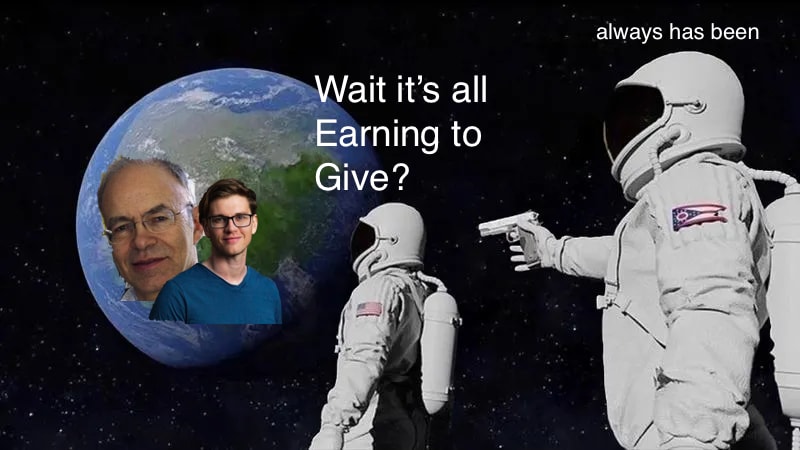
From that position, it’s easy to believe that if EA had just stuck to Earning To Give and malaria nets and decaging chickens then the impact would have been greater, both directly and because the movement might not have lost as much momentum when AI Safety alienated people.

I agree that the depth of the evidence conversations doesn’t lend itself to amateur discussion on the forum and I also feel like there’s not much I have to add to the GHD discussions here because of that.
Don’t think it’s fair to say it’s not prioritised among the orgs. My understanding is that Coefficient Giving still gives huge amounts to GiveWell charities and grants.
“direct altruistic focus strategically so as to be of positive utility”
Vague and evasive. Say what you mean. If you want to keep poor people poor until some new technology comes out, you should say that. If you don’t think further development will ever be justified, you should say that (so that your contention can be discarded as absurd and impractical)
“From the sumatriptan RCT: 3% were pain-free at 10 minutes after placebo.”
This is an irrational comparison. You’re comparing your best case scenario anecdote to the results of an RCT.
It’s possible that one of those 3% of people would have an anecdote for sumatriptan as convincing as yours: causing rapid resolution of their headache. That anecdote would not be representative.
I’m not saying you’re wrong about psychedelics and cluster headache. I desperately hope you’re right and there is an easy fix. Anecdote leads people astray constantly and we have to have a high suspicion of it.
“The effect size is incredible and the percentage of people for whom it’s effective for is very large”—What’s the source for this?
Impressive anectodes, but we see a lot of those in medicine. Trial or it didn’t happen.
Because development has been the human project for the last 10,000 years and if we accept that it has been and continues to be a mistake then the conclusion is… what? anarcho-primitivism/regressing to pre-industrial hunter-gather life/Return to Monke. That doesn’t seem very practical.
Fair, I really mean pessimism rather than nihilism. On what basis can you reject philosophical pessimism—a self-consistent and valid belief that is seemingly impossible to prove/disprove—other than that it is just not pragmatic or constructive at all.
None of that suggested work seems very clarifying
The welfare ranges are extremely broad for the animals they do cover, and that’s with questionable assumptions. I don’t see how extending these to microbes would clarify anything.
Doing “more research” on the day-to-day experience of nematodes and how they respond to noxious stimuli or calculating their neural energy consumption as a proxy for their ability to suffer also doesn’t seem clarifying. Imagine you knew all this information about nematodes. Still the fundamental question will remain how their “suffering” or “joy” compares to ours and how morally important it is. A lot of animal ethics is driven by our ability to relate to animals (“I can relate somewhat to a chicken and I wouldn’t want to be a chicken in a cage”) but this falls apart by the time we get to nematodes, so you have to rely solely on your numbers, which will be extremely uncertain.
I remain very puzzled how you ever see us getting low enough error bars on the joy/suffering of microscopic worms that we could make decision based on it.
How would you get the “Further human economic development” “necessary to build the knowledge and resources” to build a better world without supporting the development of developing countries?
Are you talking a top-heavy approach where we keep poor countries poor until fake/cultured meat is cheap enough to supplant farmed animals?
I guess. Can you formulate an argument against nihilism that’s any more substantial than that?
The theory that human development has been evil is nihilistic and could well be true, much like the nihilistic theory that the existence of biological life itself could is net evil. On what basis do you reject this other than: “we can’t do anything with that”.
It will probably lead to increased suffering of animals (at least for a time) and this is necessary for the greater good of technological development. We’re forced to consider the technological development a greater good because the alternative is to accept that the last 10,000 years of development was a mistake, which is not a viable belief.
This was named the Meat-Eater Problem in this article in the Journal Of Controversial Ideas by @MichaelPlant (as comments point out, there are many earlier examples).
I think we need to be extremely suspicious of the conclusion that development is bad because of animal suffering. Development has given us everything that makes life better (as most would see it) than in pre-industrial times: antibiotics, vaccines, surgery, food security, shelter, cheap and plentiful access to knowledge and entertainment.
I don’t see how you can accept the Meat-Eater Problem without also concluding that all human development in the last 10,000 years has been a mistake in light of the horrible toll we’ve demanded of the workhorses and mulesed sheep and caged chickens that we tortured along the way. The Ted Kaczynskiist view that the development of society has been overall bad is internally consistent and valid but also crazy and just not compatible with any sort of continued functioning of society.
To avoid this absurd conclusion that would lead us all to nihilism or posting explosive letters, I think we have to accept that development so far has been worth the costs, and that further development, for similar benefits, will be worth the additional costs.
Can you give some examples of what research you could do to improve our understanding about either 1. whether soil microbes are sentient, or 2. whether their average life experience is net positive or negative?
These both seem completely unanswerable. with a billion dollars and no other interests I wouldn’t know where to begin answering these questions.
This report from 2006 has similarly high numbers of surveyed people saying that psilocybin or LSD aborted their headaches https://pubmed.ncbi.nlm.nih.gov/16801660/
That’s 19 years for someone to do a controlled trial of cessation of cluster headaches using psilocybin or LSD vs placebo or triptan control. Wouldn’t have to very big numbers either if the anecdotes are to be believed.I guess your theory is that there have been too many funding and legal blocks to get this done in that 19 years. Seems hard to believe. Terrible if true.
If it is true, would recommend you focus on this as your core advocacy point: we need a placebo-controlled cluster cessation trial of psychedelics (rather than just prophylaxis). Saying “The Best Treatment for the Most Painful Medical Condition Is Illegal” is an unproven statement and makes you seem unserious
Inspiring
Thanks Ben. I actually suggested both in my original comment: both
(a) that there is market incentive for the companies to do this themselves so ?did AI Safety movement really move the dial on this?,
and also
(b) that I’m skeptical of the value of interpretability research (based only on not having seen anything impressive come from it, but I’m very ignorant of the field)