Damon Binder recently wrote up an argument for prioritizing air filtration over far-UVC for pathogen control:
UVC and filtration are close substitutes—both deliver effective air changes per hour, both reduce airborne pathogen concentrations by the same amount per eACH—and on current pricing, filtration is cheaper.
There’s a lot of good stuff in his analysis, but I see [1] three considerations that really change the bottom line:
Cost is actually much lower.
Noise is a serious issue.
Performance is dramatically higher in larger rooms.
Cost is straightforward. Binder priced far-UVC based on the high-quality Care222 lamp with the Krypton-11 at $2,500, but there’s a much cheaper option, the Aerolamp at $500. It’s also moderately higher output.
Binder analyzes a 30m2 room with a 2.5m ceiling. I’ll assume this means 6x5x2.5. If I configure Illuminate with an Aerolamp in one corner pointed 0.5m above the far corner the installation is within TLVs and I get a median effective number of hourly air changes (eACH) of 11.6. The lamp degrades approximately linearly over Binder’s 11,000 hour evaluation period down to 70% capacity, so we’re averaging an eACH of 9.8. Over that time you’re paying $500 for the lamp and $16.50 for the electricity (0.01kW * 11,000hr * 0.15 $/kWh) for a 5-year $/eACH of $53. Adding this to the best-performers from Binder’s table, the Aerolamp is now the same cost as the cheapest filter:
| Technology | 5-year $/eACH |
| AirFanta 3Pro | $53 |
| Aerolamp | $53 |
| Box fan + MERV-13 | $79 |
| Corsi-Rosenthal box | $95 |
Now let’s consider noise. I have an AirFanta 3Pro, and it absolutely works. On high, it clears cooking smoke from my kitchen very quickly. But, like all commercial air purifiers that clean significant amounts of air, when you put it on high it’s very noisy. As in, “hard to have a conversation in the same room” noisy. Binder describes this as “audible fans”, but that’s a huge understatement when you’re talking about running them on high. When filters are too noisy, people unplug them. Here’s one I saw this weekend, just before I took the initiative to plug it back in:
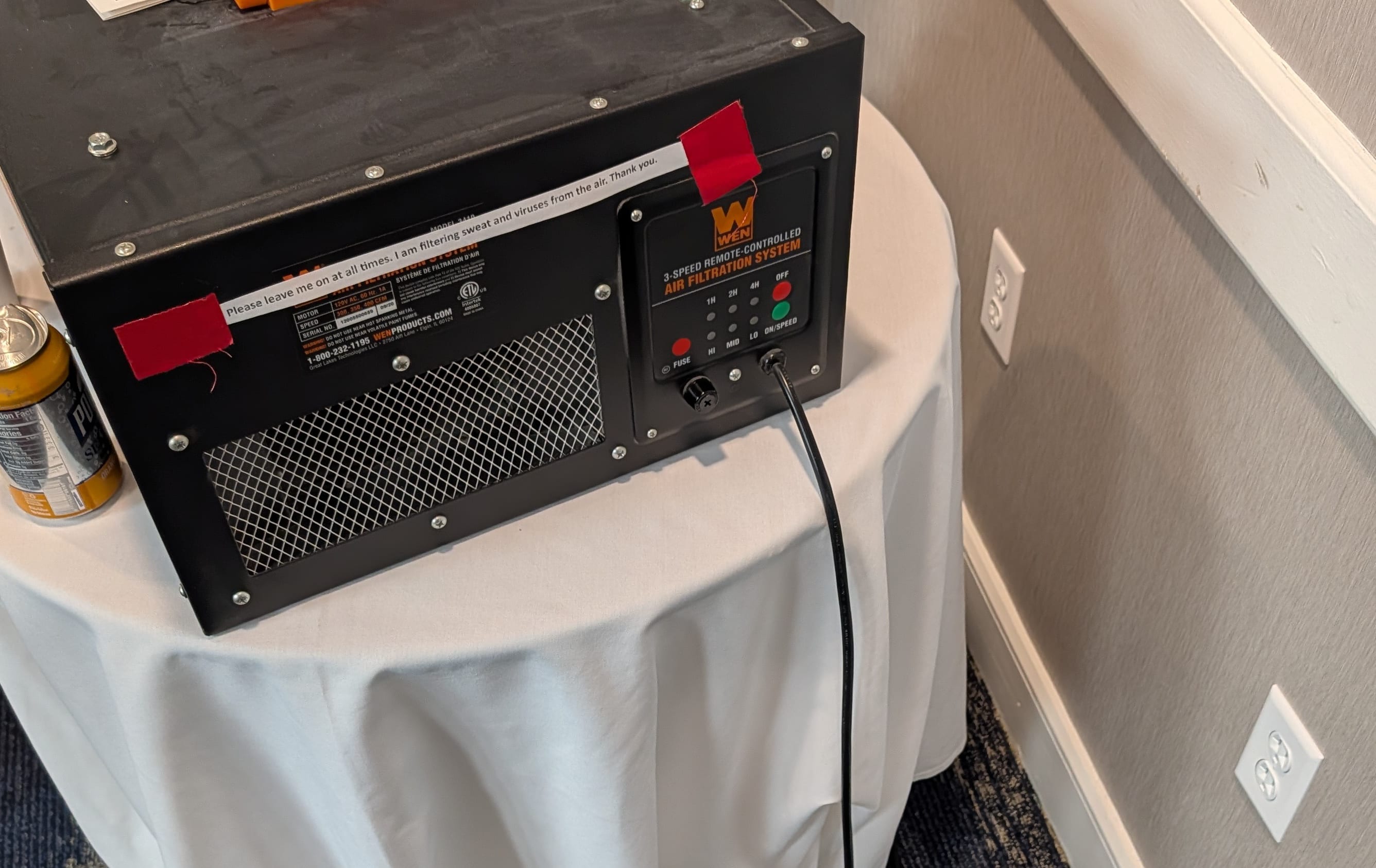
So lets say we we model running these filters at half speed, which cuts filtration by about half and noise by a lot more:
| Technology | 5-year $/eACH |
| AirFanta 3Pro | $106 |
| Aerolamp | $53 |
| Box fan + MERV-13 | $158 |
| Corsi-Rosenthal box | $190 |
Now the filters are significantly more expensive per ACH than the Aerolamp. And they’re still moderately noisy while far-UVC is silent.
The advantage grows for larger rooms. Consider one that’s 20m by 12m, with the same 2.5m ceiling. This room has 8x the volume, and how much air you need to clean to “change out” the whole room is proportional to volume, so an eACH now represents 8x more cleaning. Modeling filters is simple, since they clean air at a constant rate, so their $/eACH values are now 8x higher. For UVC, however, the lamp cleans more air because it’s light: it can go further in a larger room. Modeling with Illuminate and pointing the lamp from a ceiling corner to a spot in the middle of the floor I get a median eACH of 2.2 (1.9 with degradation), compared to the 1.4 you’d expect if it was linear with volume. Here’s the same table for this 8x bigger room:
| Technology | 5-year $/eACH |
| AirFanta 3Pro | $848 |
| Aerolamp | $230 |
| Box fan + MERV-13 | $1,264 |
| Corsi-Rosenthal box | $1,520 |
Getting to somewhat uncommon room shapes, if the room is also taller, say 6m (20ft), as large gathering places can be, we’ve added another factor of 2.4 to the room’s volume. The filter costs go up by 2.4x, but modeling with Illuminate I get a median eACH of 1.6 (1.4 with degradation). Costs are now:
| Technology | 5-year $/eACH |
| AirFanta 3Pro | $2,035 |
| Aerolamp | $316 |
| Box fan + MERV-13 | $3,033 |
| Corsi-Rosenthal box | $3,648 |
In this large room, for a given level of filtration the Aerolamp is 1/6th the cost of the next cheapest option. Far-UVC really shines here. This is why I’ve advocated for it in dance halls, and why the dance I helped organize until very recently decided to deploy far-UVC (youtube; see the stand with four lights on stage).
In the other direction, while Binder is right that fans are commodity items, fans that move large volumes of air extremely quietly are not. No one makes a commercial air purifier that approaches the limits of what’s possible if you design for maximum air cleaning at minimum noise. So while the best far-UVC options outperform the best filter options in medium to large rooms today, future improvements in air purifier design might change that.
Despite the critical tone, I’m very happy Binder shared this, and there’s a lot of good thinking in the piece. The point that filters are useful for a lot more scenarios, including pollen and smoke (I couldn’t replace my kitchen AirFanta with an Aerolamp!) is an important one, especially as we push for everyday clean air. But I do hope he’ll reconsider the potential for far-UVC to produce much more clean air for a given budget in dollars and noise.
[1] After drafting this I asked Opus 4.7 “What are the errors Jeff Kaufman would point out on https://defensesindepth.bio/on-far-uvc-and-air-filtration-2/ ?” It found (1) and (2) but not (3).
Thanks Jeff for the post! I completely missed the Aerolamp and have now updated my post to include it. I agree that UVC lamps scale better at larger rooms and that noise can be an issue for air filtration devices (though I think you may also somewhat overestimate the CADR decline for these devices when not operating at full power).
Thanks for updating the post! Some minor comments:
Good point! This is definitely an issue I’ve run into in talking to people about whether installing Aerolamps makes sense, and I was excited to learn they’re working on a new version that should both cost less and be certified.
Not exactly: I used the median eACH value I got from Illuminate:
This gave me a median of 11.55 eACH, across 25 bacteria and viruses with a range from 0.442 to 44.06.
Why use bench-measured
k? Isn’t that less realistic for real-world use? This isn’t something I know much about, though, and I’m just going with Illuminate’s defaults.Certainly possible, and I’d be happy to yield to lab testing on this, but in my DIY testing turning a AP-1512 from “high” to “medium” dropped CADR by 50%, and this AirFanta review found going from 56 dB to 45 dB dropped CADR by 40%.
Meta comment: It’s fantastic to see some technical biosecurity discussion on the forum—I feel like that’s been relatively rare the last 1-2 years.
I’m trying to understand what it would cost to install far-UVC in Nigeria, if a high-quality Care222 lamp is about ₦3.25 million and even a cheaper Aerolamp is around ₦650,000 (about 9–46 times the ₦70,000 monthly minimum wage), then unless there is external funding, this technology is simply too expensive for most people here.
I’m not very familiar with the situation in Nigeria, but my understanding is there’s a lot of dust in the air much of the year from the Sahara, plus in Lagos and other cities there’s a lot of pollution, is that right? In that case I wouldn’t recommend UVC at all (since it inactivates pathogens but doesn’t touch dust or pollution). Instead, something filter-based would have much broader benefits: dust and pollution in addition to pathogen control.
In the US the cheapest filter option is generally as Corsi-Rosenthal box (a box fan plus HVAC filters, both commodity items here). In Nigeria, something commercial would probably be cheaper since those aren’t everyday items. Looking online a bit, maybe the Acerpure Pro P2 at ~₦120,000 for 191 CFM CADR is best? While that’s a lot cheaper than the Aerolamp, though, that’s still out of reach for someone at ₦70,000 / month.
(Minor: the Aerolamp also uses Care222)
Would love to hear thoughts on this which I also posted on lesswrong. Thanks.
Far UVC holds little interest for me when the vastly more effective, cost-efficient, and problem-free method of UV in ductwork (Near UV) gets pretty much zero attention, as far as I can find in my research. I’m flummoxed by this and would love to have people show me that I’m wrong about it. Cheers.
The big problem is that ducts are relatively rare, something like 10% globally. While ducts are common in the US, Canada, and Australia, they’re rare elsewhere including Europe and Asia. [1]
You also need to tune your HVAC to recirculate a lot of air even when the system isn’t calling for heat or cooling, which people usually don’t.
And then if you do have ducts and are moving a lot of air you don’t need UV: if you’re running MERV-13 (typically the most the blower is able to handle) that’s removing worst case 50% of particles, and you can generally put out enough air to hit targets with the existing system. And then consider that in-duct UV systems fail invisibly and fail open.
[1] Around here the old houses are mostly radiators, new ones are mostly mini-splits, and only ones built or renovated in between have ducts. Older commercial buildings are also generally radiators, though that’s becoming less common. I asked Claude Opus 4.7, ChatGPT 5.5 Thinking, and Gemini 3.1 Pro “Approximately what fraction of indoor hours spent by humans around the world are in spaces with a ducted HVAC system? What’s your 50% confidence interval?” and got 9-13%, 10-20%, and 6-11%. The big factor here is that while ducts are common in the US, Canada, and Australia, they’re rare elsewhere including Europe and Asia.
Wrote this up as a full post: https://www.jefftk.com/p/against-in-duct-uv
Oh to add, on the “intermittent fan” issue. Here’s Claude on how frequently HVAC systems turn over all the air in a building (and so would sanitize all the building air with UV in ductwork):
Key Variable: Air Changes per Hour (ACH)
HVAC systems are typically sized and rated in ACH — how many times per hour the system moves a volume of air equal to the total space it serves.
Typical ACH Ranges
Thanks for this meaty reply. Good info, much appreciated. But my basic reply, short form:
”X doesn’t solve everything (globally) and is not perfect” is never and nowhere a valid argument against doing X [as opposed to Y]. Or at least discussing X!
There’s a massive space where Near UV in ductwork could deliver very large and positive results, very efficiently relative to installation cost, energy use, maintenance and attention required, and probably other dimensions of “efficiency.” (Compared to not doing it, OR compared to doing Far UVC where ductwork UV is feasible.)
So I’m still just really curious, stuck with the same Q: why do I never find people talking about it?
Thanks,
Steve
My external post probably would have been better with some explicit comparisons, but my claim is that in-duct UVC (a) isn’t widely applicable, and so the overall potential benefit of pushing for it is low and (b) isn’t cost effective even where it’s applicable.
I think (b) is the more important one and where we most disagree. I’ve now added the cost-effectiveness calculation to the end of https://www.jefftk.com/p/against-in-duct-uv and it looks to me like even in the best case in-duct is much more expensive per CADR than filters or far-uvc.
I finally found some time to study your longer reply and study/research more. Main thing I didn’t know is how effective MERV-13 filters are (@ ~50%). (I built a box-fan filter as soon as I learned about it back when summer wildfire smoke started hitting Seattle some years back. Works great!) Given the high air-turnover in ducted systems, seems like that alone can do (almost?) all the necessary. Thanks.