Getting started (the easy part)
When I first encountered the biosecurity space in 2023, after reading former Soviet scientist Ken Alibek’s memoir, I was immediately drawn to the idea of fighting infectious disease threats that had tormented human civilization for years. I had barely any experience with biology (I had taken one pandemic-era class and skipped taking AP Bio) and would consider myself more of a policy wonk than a STEM nerd. But compelling arguments about the neglectedness, tractability, and impact that biosecurity work could have on the world convinced me that it was critical for many people to be working on this issue. Over time, I began to see myself as one of those people.
Today, there are more resources than ever before to introduce people to biosecurity and give them context over the problems and solutions in the field. Many people I know have started with BlueDot Impact’s Biosecurity course, resources from 80,000 Hours, and a number of great books and articles that can help students as young as high school tackle these concepts confidently.
After browsing the biosecurity ‘curriculum’, there are a number of ways to get involved and start to work on concrete projects. Programs such as ERA’s AI x Bio fellowship, the Non-Trivial Fellowship, and Pivotal Research offer students ways to test their fit for the field by embarking on an 8-to-12 week research endeavor without needing years of prior experience. And this great post on the EA forum encourages people to enter the field through self-driven research, reading, and starting side projects, which can be done on your own or in conjunction with existing biosecurity-focused organizations.
All of these are excellent ways to 1) get introduced to biosecurity (what is it? why does it matter to the world?) and 2) start working on these issues. The third step–landing a full-time position where you’re directly shaping policy, research, or technological progress in biosecurity–should be the natural next move. Yet there’s a wider gap between 2) and 3) than we expect.
Most biosecurity career advice engages mid- to late-career civil servants, scientists, and engineers to pivot their careers into working on technical biosafety or biosecurity/biotechnology policy. But this leaves behind a critical demographic in the space–young people.
A reality check
How does a young person get their first job in biosecurity? The answer is often difficult and murky. While there are a myriad of ways to participate and build short-term experiences, formulating and pursuing a career is harder in biosecurity compared to other fields, both well-established (e.g. medicine, law) and novel (e.g. AI, cybersecurity).
Take the AI safety field as a comparison. Within a year, undergrads can intensely self-study technical knowledge, complete one of many early-career fellowships, work at an AI safety nonprofit, and even drop out of school to pursue impactful work. AI safety student groups have popped up at universities around the country, sharing ideas, resources, and even funding for students to pursue this type of work. The combination of urgency in the AI field and the vastness of the resource landscape encourages young people to jump into the AI safety world headfirst.
It’s important to build similar traction for biosecurity work among talented college students and early-career professionals. Unfortunately, it’s often not as easy to jump right in. Even after immersing yourself in learning and researching, trying to work in biosecurity often feels more like fighting against a tide to score a coveted position, rather than joining a group of swimmers working towards the same goal as you.
That’s not to say that talented, promising people aren’t joining in to work on pandemic prevention and biological threat reduction every year. But most of the people we’re excited to invest in tend to carry with them years of experience, formal training, and/or research credentials. Think former Hill staffers, recent microbiology PhDs, ex-Google engineers, and more. Among such established talent, it can be difficult, perhaps disheartening, for a young and relatively inexperienced undergrad to join in the mix.
Take existing opportunities in the field. The Emerging Leaders in Biosecurity (ELBI) fellowship requires applicants to “have graduated from a masters or doctoral program, be currently enrolled in a doctoral program, OR have at least 3 years of professional experience in national security, public health…or a related field.” The Fellowship for Ending Bioweapons states that all eligible participants must have “a graduate degree or enrolled in a doctoral program in a related field”.
Even programs designed to place people in biosecurity roles maintain high bars. The Horizon Fellowship, which places fully-funded fellows at host organizations working on emerging technologies, has successfully placed dozens of people in biosecurity and biotechnology-based offices. Although it offers a think tank junior fellow track, it is ‘strongly preferred’ for applicants who want to pursue executive branch or Congressional tracks to have a graduate degree and/or several years of professional experience. No substantive similar options exist today for early-career professionals without these credentials.
The pattern is clear: biosecurity often selects for people who already have a wealth of experience in their respective fields, and then trains them to become the best version of themselves. Rarely do we take the time to invest in the long-term potential of young, inexperienced people who want to build out their skills and are excited about contributing to the field over the course of their careers.
The problem is that instead of being honest with undergraduates that they need more experience before they can land themselves a full-time role in biosecurity, we suggest that they pursue opportunities where they are currently. We idealize agency and short-term project work over supporting direct training and long-term career projection. We tell them flippantly that they don’t need another degree, ignoring the reality of existing biosecurity leaders in the field.
The bar for impact is high
Most young people entering the field want to work on the problems that matter most. They want to shape policy that prevents pandemics. They want to work at mission-driven organizations like SecureBio, CEPI, IBBIS, or 1Day Sooner, small nonprofits led by incredible, dedicated people doing genuinely impactful work. They want roles in Congress or think tanks or the executive branch where they can influence decisions that protect millions of lives.
These are high-impact positions. And high-impact positions are often high-demand, requiring rare and valuable skills and experience to stand out.
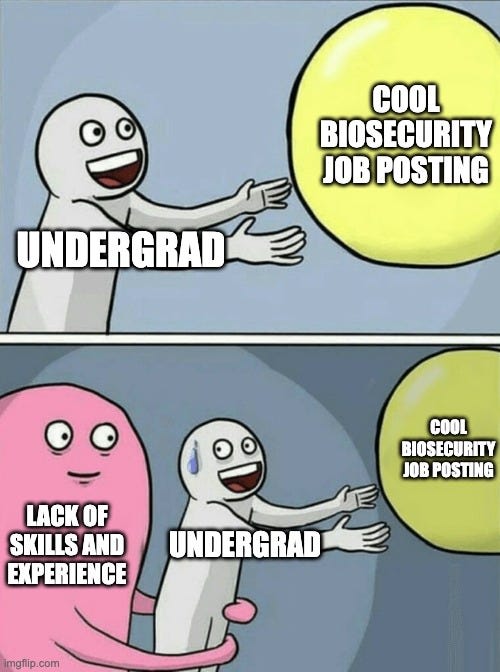
Unfortunately, these organizations are often too busy working on the problems themselves to invest in younger, inexperienced trainees. They need people who can contribute immediately. Landing a specialized role in biosecurity policy, whether in a member office, at a think tank, or in the executive branch, usually requires credentials and expertise that signal that you can handle the work.
The truth is that it’s easier and more efficient to take someone with a decade of career capital and redirect them toward biosecurity work than it is to train someone from scratch. A former Hill staffer already knows how Congress works. A microbiology PhD already understands the science behind the policy. An ex-Google engineer already has technical chops. These people can jump in and start contributing immediately, which matters when the problems are urgent and the organizations are small. The biosecurity field doesn’t only value people who pivot from other careers, but proven skills are the most reliable metric we have for predicting future impact.
It’s true that some young people possess a rare combination of skills and experience to break into biosecurity work immediately. But many may not, and that’s normal.
This creates confusion. The advice that I receive says one thing, but the things I see say another:
I hear people telling me not to waste time going to law or med school; I see successful lawyers and doctors that pivoted into senior policy roles.
I hear that a master’s or PhD is too long and not worth it; I see that many opportunities (e.g. AAAS) require this additional credential to transition.
I hear that I can work at an impact-driven nonprofit; I see that they mainly hire senior roles and positions become more competitive with time.
It’s true that biosecurity work feels urgent, now more than ever due to AI. Timelines are short. We want people working on these problems now, not in five or ten years! And there’s genuine value in encouraging young people to take initiative, to start projects, to build skills independently rather than waiting for permission. That impulse comes from a good place.
But when that advice doesn’t match the reality of what it takes to land a meaningful role, we’re not helping anyone. Young people are left bouncing from one research assistant position to the next, accumulating ideas and experience without an outlet for impact.
What (most) young people actually need to hear
So what should we be telling young people who want to work on biosecurity?
We need to be honest about what it takes. If high-impact biosecurity work requires advanced credentials or years of experience, we should say that clearly. If the most reliable path is to spend five years getting a PhD in a relevant field, or three years building policy experience on the Hill, or a decade becoming an expert engineer, then maybe that’s what we should tell them.
This may sound discouraging at first, but I don’t think it is. Honesty is (in this case) the best policy–it’ll help young people make informed decisions about their careers. It means they can plan strategically instead of wandering from one short-term opportunity to the next, hoping something clicks.
Maybe the answer is to specialize: get an MD, a JD, or a PhD in a field relevant to biosecurity, then pivot back. Maybe it’s to build career capital elsewhere first, becoming excellent at something valuable, and then redirecting that expertise toward pandemic prevention. Maybe for some people, there are faster paths to impact right out of undergrad through self-driven projects and exceptional agency.
But whatever the answer is, we need to stop putting the burden on 22-year-olds to figure it out themselves through trial and error. The biosecurity community needs a coherent strategy for young people. Right now, we don’t have one.
Moving forward
I wrote this piece because I care about young people entering the biosecurity field. That includes me, but it also includes the dozens of undergrads and early-career professionals I’ve met who are smart, motivated, and genuinely want to contribute to solving problems that matter.
The biosecurity world is wonderful. It brings together people from all sorts of skillsets and backgrounds to contribute to impactful work. You don’t need to have a strong technical background to shape policy. You don’t need to have lengthy policy experience to do groundbreaking think tank research. But we need to be clear about what you do need, and how long it takes to get there.
Young people deserve honest guidance about what it takes to contribute meaningfully to biosecurity. If that means spending five to ten years building expertise first, let’s say that. If there are quicker routes for people with specific skills or circumstances, let’s map them clearly. Either way, let’s stop leaving talented, motivated people to navigate a confusing landscape alone.
The field has finally started to build traction among students as young as high school and college. That’s exciting! But if we want to keep that momentum, we need to get serious about providing them with accurate, actionable advice about how to actually build a career in this space.
The stakes are too high to keep getting this wrong.
This was originally a post on my Substack. Shoutout to Matt Beard who left comments on the first draft of this essay.
The claim that “biosecurity often selects for people who already have a wealth of experience in their respective fields” doesn’t seem that obvious to me. Looking at the number of biosecurity roles we’ve posted on the 80,000 Hours job board in 2025, broken down by experience tag, I see:
Entry-level: 32
Entry-level + Junior (1-4 yrs): 12
Junior (1-4 yrs): 69
Junior (1-4 yrs) + Mid (5-9 yrs): 31
Mid (5-9 yrs): 73
Mid (5-9 yrs) + Senior (10+ yrs): 20
Senior (10+ yrs): 40
Multiple experience levels: 10
I agree with you that there aren’t a ton of opportunities for junior people, but I think the above data indicates it isn’t because of orgs focusing more on people with more experience. This seems like an important part of your claims, though I think some of your recommendations are robustly good (specializing can be the right call, building career capital elsewhere can be the right call).
Obvious caveats apply: We aren’t perfect at finding every biosecurity opportunity on the 80,000 Hours org, what we post is shaped by our own values.
Seems important to check whether the people hired actually fit into those experience requirements or have more experience. If the roles are very competitive then it could be much higher.
Hi Conor, thanks for your comment! Appreciate all the work you do on the 80k job board.
I will caveat by saying 1) my perspective is based on a job search in the US/Western biosecurity landscape, not a global one and 2) I drew on my own personal experiences and that of my friends’ in attempting to find a credible full-time position (e.g. summer internship) in biosecurity.
During this job search, many of the entry-level and junior opportunities I scouted on biosecurity job boards tended to (and still do) fall into one of two categories:
Part-time projects/ ‘test your fit’/Expression of Interest (EOI) forms; or
Full-time roles that are tagged as open to Junior (1-4 yrs) professionals, but are also open to senior-level candidates, and/or state a PhD or master’s degree requirement.
Obviously, there are some exceptions and I would love to see someone do an analysis of entry-level biosecurity job postings over time. However, I would point out that it is still difficult to find jobs when moving from category #1 to #2, and if you go down the list of entry level positions today, it would be hard to find more than 5-10 positions that a young person without a PhD could be competitive for. I also think EA jobs are often competitive and agree with Peter’s comment that this higher competitiveness lends itself to selecting more senior, experienced candidates (even when a junior position is available). I would love to see both more orgs (both established and new) run more summer internship/RA/entry-level positions and advertise them here more.
Great points. I would love to see more of this too!
Shameless plug for ALLFED: Four of our former volunteers moved into paid work in biosecurity, and they were volunteers before we did much direct work in biosecurity. Now we are doing more directly. Since ALLFED has had to shrink, the contribution from volunteers has become relatively more important. So I think ALLFED is a good place for young people to skill up in biosecurity and have impact.
Flagging that while SecureBio has hired mostly senior people, we do have a relatively junior job posting open at the Nucleic Acid Observatory for a Bioinformatics Engineer. We’d love to see more applicants, and we’re offering a significant referral bonus if you know anyone who might be a good fit!
We’re not currently looking for engineers right out of undergrad (“2+ years of professional experience in industry or academia”) but it’s also not five to ten years skill building first. And in our case it’s true that they “don’t need another degree”.
Thanks Jeff! This looks like an awesome role and I hope you find a great candidate- huge fan of the work you guys do.
Out of curiosity, has SecureBio ever considered taking on in-person summer interns? I wouldn’t be qualified, but I know some undergrads who might be :)
I’m not an expert in this space; @Grace B, who I’ve spoken to a bit about this, runs the AIxBio fellowship and probably has much better takes than I do. Fwiw, I think I have a different perspective to the post.
My rough view is:
1. Historically, we have done a bad job at fieldbuilding in biosecurity (for nuanced reasons, but I guess that we made some bad calls).
2. As of a few months ago, we have started to do a much better job at fieldbuilding e.g. the AIxBio fellowship that you mentioned is ~the first of it’s kind. The other fellowships you mentioned iiuc aren’t focused on biosecurity.
3. Most people who want to enter the space are already doing sensible things—not that many people are leaving their undergrad degrees to start PPE companies, many people are doing PhDs and are figuring out what to do—seems good to focus resources on PhDs/postdocs etc. or other people with more experience, whilst that’s extremely undertapped
4. AI safety has done an extremely good job at field building over the past ~4 years. Most of it was the result of the hard work of a bunch of great people fighting hard—rather than being particularly overdetermined by ChatGPT or whatever.
5. There are, in fact, a bunch of great things that one can do in biosecurity at various levels of experience, and outside of sustained 1:1 conversations, it’s really hard for more experienced people to figure out what some specific person should do [1]. My impression is that most users of the EA Forum, based on their current skills, “could” very quickly make useful contributions to the biosecurity space, but will likely get bottlenecked on motivation, strategy, grit etc. [2] I don’t think we should have that expectation of everyone. Still, I speak to people on approximately a weekly basis who I believe could make ambitious contributions, but psych themselves out or have standards that are too low for themselves and idk whether it’s helpful to act more conservatively.
6. I’m not sure where the dishonesty is really coming from, I don’t think there is much in the way of resources/community etc. pushing people to enter the space (yet).
I’ve occasionally wondered whether someone entreprenurial should try being a “career strategist” and charge people say $1000/hour (paid back over a few years once they start a role they think is particularly useful) to help them figure out how to have an outsized impact. This might look a little like a cross between 80k career coaching/AIM (charity entrepreneurship)/exec coaching with sustained engagement over a few weeks and a lot of time outside of sessions spent researching and hustling (from both the coach and user). Part of the reason to have a large charge is (1) you want to attract people taking impact extremely seriously, and (2) this kind of coaching is probably really hard and you’d need someone great. @Nina Friedrich🔸 you come to mind as someone that could do this!
Standard disclaimer of optimising hard for impact straight away is not the same as optimising hard for impact over the course of your career. Often it is better to build skills and become insanely leveraged before going hard at the most important problems.
You make some great points!
For 4), I agree that the AI safety world has done a really good job field-building, both because of funders in/out of the EA space, and I wonder how much of it truly is transferable to biosecurity/climate/other x-risk fields. Perhaps someone should write a piece on that.
1 & 6) I don’t mean to say that people are intentionally giving bad advice or that it’s dishonest on purpose. However, when it comes to asking people for advice, I agree that 5) that it’s hard for experienced folks to know exactly how to help young people without a ton of context. Regardless, I don’t think there’s a consensus on how the average young person should navigate the field. (And interesting idea about the ‘career strategist’! I wonder who would be the best audience for this sort of coaching?)
I don’t think there’s a consensus on how the average young person should navigate the field
Yeah that sounds right, I agree that people should have a vibe “here is a take, it may work for some and not others—we’re still figuring this out” when they are giving career advice (if they aren’t already. Though I think I’d give that advice for most fieldbuilding, including AI safety so maybe that’s too low a bar.
Great point. This is is also a perennial issue with science journalism or journalism in general. When I first spoke to a science journalist in 2019, while working as a technical writer, wondering if I should try to switch careers, they gave me a lot of encouragement. But in retrospect, after spending a few years making efforts to work in the area, I came to realize I would’ve much rather wished for a much franker and more brutal take on the lack of opportunity in the industry.
In journalism, in general, there’s kind of a tendency to just stay totally silent about the fact that it’s so difficult to find funding for public interest writing or public interest work in general. Perhaps because the broader media space often mixes public interest work with more generic, non-public interest content that sells (eg TikTok, etc), and thereby does obtain financial backing; I don’t know.
Thanks for this post! The best advice I got was to: look through job descriptions for the specific jobs in biosecurity that YOU want, and identify the experience/skills needed.
The skills and experiences needed to develop technical DNA synthesis screening standards at IBBIS can be very different from those needed to work on advocacy for BWC verification mechanisms.
Thanks for initiating a valuable discussion!
Executive summary: Reflective argument that early-career entrants face steep, credential-heavy barriers in biosecurity and should get candid guidance that many impactful roles require several years of training and experience, alongside clearly mapped faster paths for exceptional cases.
Key points:
Intro resources and short projects abound (e.g., BlueDot Impact, 80,000 Hours, ERA’s AI x Bio, Non-Trivial Fellowship, Pivotal Research), including 8-to-12 week research stints.
The step from learning/projects to full-time roles is harder than expected, with advice and opportunities skewed toward mid- to late-career people.
Competitive programs and placements often require or prefer graduate degrees or years of experience (e.g., ELBI, Fellowship for Ending Bioweapons, Horizon).
Small, high-impact orgs and policy roles prioritize immediate contribution and thus select for proven skills and prior career capital.
Common advice to skip additional degrees or jump straight to impact conflicts with observed hiring patterns, producing confusion and short-term role churn.
The author calls for honesty and a coherent strategy: many should build expertise first (e.g., 3 years on the Hill, 5–10 years for MD/JD/PhD or engineering), while clearly mapping quicker routes for rare high-agency cases.
This comment was auto-generated by the EA Forum Team. Feel free to point out issues with this summary by replying to the comment, and contact us if you have feedback.
I also think that many of the most tractable biosecurity opportunities sit on the policy and governance side rather than in primary research. I agree that the bar to entry is exceptionally high: the space is tightly regulated, heavily relationship-driven, and often inaccessible without sustained exposure to elite networks. This structure systematically disadvantages capable researchers from resource-constrained settings, even when they have relevant technical expertise and on-the-ground insight.
I’m curious which other fields are impacted by this issue. I have heard similar things about biomedical engineering, which I am currently studying. I’d love to discuss what colleges can do to help their students effectively enter the workforce.