Is shrimp eyestalk ablation a red herring?
Saw this post by @Henri Thunberg 🔸 on Twitter:
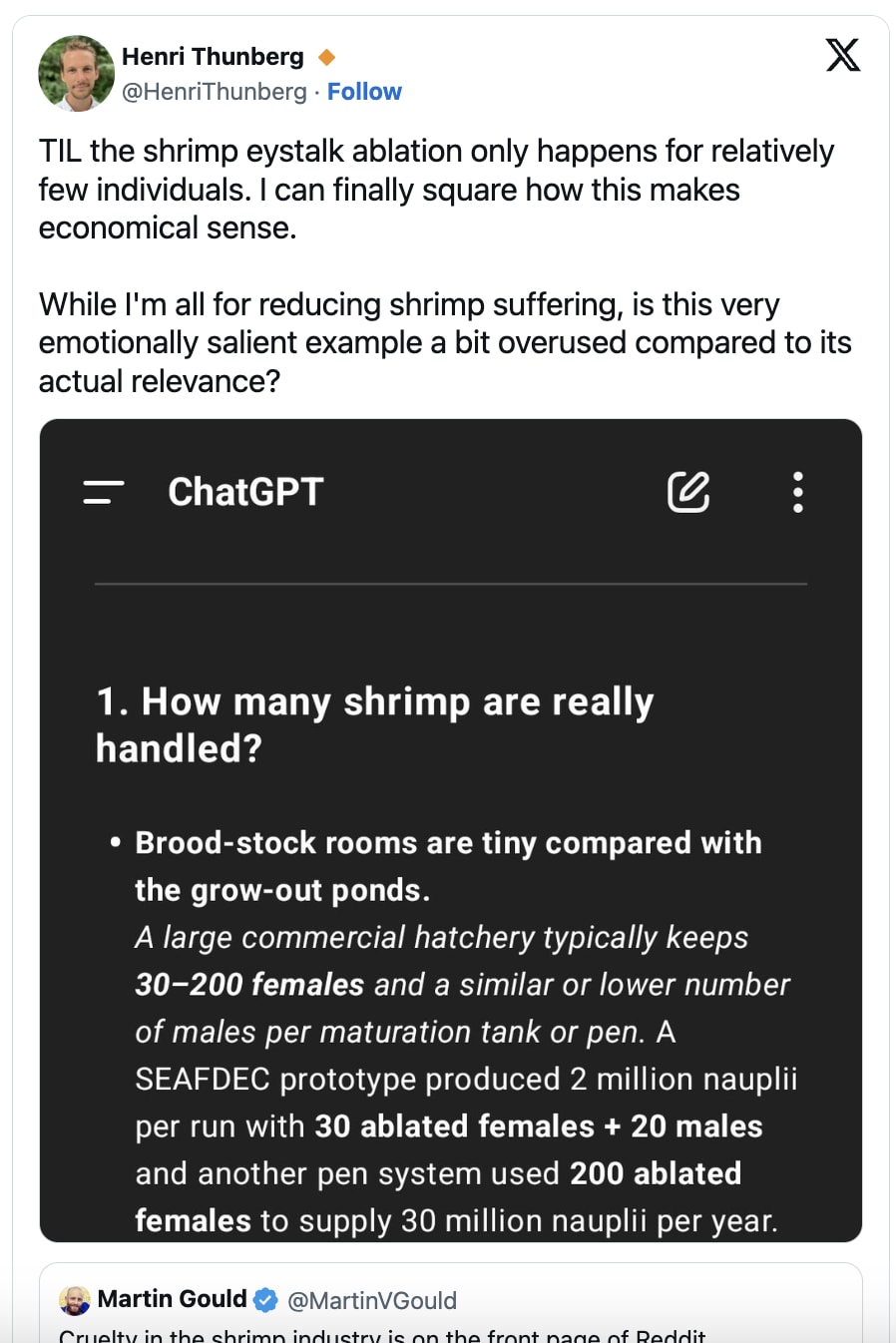
If true, these numbers are suprisingly low to me. Eyestalk ablation gets quite a bit of attention on the forum. Shrimp Welfare Project focuses on it and it forms part of their Shrimp Welfare Index. It gets attention from various animal welfare groups (Mercy For Animals, Animals Australia). A post on Reddit about it from a couple of days ago has 35 k upvotes and 2000 comments. An Australian politician recently posted about it. A lot of this attention, I suspect, is based on the false impression that this is happening to most or all of the shrimp.
The numbers of animals involved seems like pertinent information but I can’t see the number mentioned on the Shrimp Welfare Project website, nor on any of their forum posts. Rethink Priorities wrote a report here that on page 13 seems to estimate that there are ~2 million female broodstock shrimp in the world (compared to 600 billion farmed shrimp per year). They seem to estimate this going backwards from the total number of shrimp and the number of eggs produced per female.
Any other numbers/sources?
That is an worthwhile hypothesis to investigate. My speculation is that scope-sensitive people who have heard a bit about shrimp farming may share this misconception, while others simply feel that ablation resonates with them at a gut level. My overall sense of what people specifically find engaging about the most “egregious” practices on industrial farms is not that they represent the largest source of suffering that the species in question endures, but rather they capture in a nutshell the low intrinsic moral value that humans are assigning to that species. A breeder undergoing eyestalk ablation might be likened to an “identifiable victim,” standing in for a larger number of “statistical victims” that endure a variety of chronic issues in ponds and tanks, which are logistically difficult to depict in an evocative way.
Other potentially relevant considerations:
There is some indication that ablated breeders produce offspring that are more susceptible to disease. If true, the amount of aggregate suffering caused by eyestalk ablation may well be much greater than just the direct effects on breeders.
Much advocacy on behalf of shrimp pairs the ask to phase out eyestalk ablation along with other addressing other issues (e.g., slaughter) that affect a larger percentage of shrimp.
Tractability often plays some role in which specific issues are highlighted, at least early on in a movement that is looking for momentum. Slaughter is also a small issue relative to chronic issues on ongrowing farms (though still much larger issue than eyestalk ablation in terms of the number of individuals directly affected). But, so long as advocacy doesn’t start and end with reforming slaughter, it is consistent with a scope-sensitive long-term strategy. (Plus, reforming slaughter may be directly cost-effective in its own right.)
It’s contrary to the philosophy of Effective Altruism to be relying on or supporting people’s “gut level” vibes.
I can think of many examples of ineffective charities that you could justify in the same way because they “capture in a nutshell the low intrinsic moral value that [people] are assigning to...” some neglected group:
Soccer balls for village kids in rural Uganda
GoFundMes for peoples’ sick and injured pets
Knitted vests for penguins
Free iPads for kids in low-performing schools
Drama therapy for prisoners
The risk with playing into people’s gut feelings is that down the line when they find out that you’re actually talking about fewer shrimp than would feed a whale for a week, they’re going to feel duped, trust is lost, reputation ruined. So on.
I think it’s quite important to remember the difference between a charity focusing on something because of gut level vibes and a charity using gut level vibes to inspire action. Most people are not EAs. If only EAs were inspired by my careful analytical report of which things cause the most suffering in farmed shrimp, my report would not achieve anything. But if I know that X is the most important thing, and Y gets people to care, I can use Y to get people in the door in order to solve X.
Also, because most people are not EAs, I actually think you’re wrong that most people will feel duped if they find out it’s not many shrimp. My parents, for example, are not vegan but were horrified by the eyestalk ablation thing. I told them honestly that it didn’t involve many shrimp, but they aren’t utilitarians: the number of individuals affected doesn’t have as much of a visceral impact to them as that it is happening at all. Despite my father knowing full well how many chickens die in horrible conditions, he still eats chicken, and yet the eyestalk ablation thing got him to stop eating shrimp. Remembering that people are broadly motivated by different things, and being able to speak to different kinds of motivation, seems to me to be a critical aspect of effective advocacy.
Sounds like a recipe for:
Reinforcing the stereotype of vegans/vegetarians as “bleeding hearts” who don’t think about practicalities.
Misguided regulations/legislation in the style of bee bricks that contribute to society’s red tape fatigue without having positive impact.
Reduced trust in the effective animal welfare movement (I’ll now be more skeptical, less trusting that I’m being told all relevant info)
My vibe is that you aren’t genuinely interested in exploring the right messaging strategy for animal advocacy; if I’m wrong feel free to message me.
A separate nitpick of your post: it doesn’t seem fair to say that “Shrimp Welfare Project focuses on” ablation, if by that you meant “primarily works on.” Perhaps that’s not what you meant, but since other people might interpret it the same way I did, I’ll just share a few points in the interest of spreading an accurate impression of what the shrimp welfare movement is up to:
SWP primarily works on changing how shrimp are killed, not ablation. Their Humane Slaughter Initiative is listed first on their list of interventions.
In fact, they don’t list anything related to eyestalk ablation on their interventions list at all; it appears they just write up a profile when a company reports phasing out eyestalk ablation, but it doesn’t seem like they are actively campaigning on it.
In support of that theory, SWP’s guesstimate model on their impact doesn’t include eyestalk ablation reforms; it only counts their shrimp stunning work.
Recent campaign wins in the UK were for eyestalk ablation and stunning (e.g., item 4 on the Tesco welfare policy), not just ablation, and that the Mercy For Animals announcement on it is clear that ablation only happens to breeding females. As far as I am aware, all shrimp welfare campaigning that includes eyestalk ablation also includes other higher-impact reforms in their ask.
The right messaging strategy long-term is to be transparent, honest and rational. Shortcutting this is risky, through the three mechanisms I mentioned in last comment.
SWP doesn’t primarily focus on ablation. Where they do, they should keep in mind and make it clear that they’re talking about <0.1% of farmed shrimp.
This is why I thought your idea was an interesting hypothesis to investigate, as it applies to areas beyond shrimp (e.g., do people sympathetic to pig welfare initiatives think that all pigs are raised in gestation crates? do they have understand that most pigs are not sows?, etc.). If there is widespread misunderstanding, then I agree it would be worth being more proactive to preempt misconceptions. I say “proactive” because I don’t there think is an intentional effort to deceive people (I am one of the authors of the report you cited about how eyestalk ablation probably causes the least aggregate pain of the welfare issues that are commonly talked about). Given the highly abbreviated nature of most moral and political communication, it seems like one message, “breeders are ablated,” and another, “there are a lot of farmed shrimp,” could be integrated together in a naive way without there being any conspiracy to confuse people.
At least for me, it won’t feel productive to litigate what is and isn’t consistent with EA in this thread, so I’ll personally refrain. I’ll instead comment from two other perspectives below, one more intellectual and one more personal. You/others can have the last word.
As a psychologist, my read of the literature is that eliciting sympathy is often the critical ingredient to endorsing and consistently applying broader moral principles based in reason (e.g., Martin Hoffman’s work). If that’s true, then starting with a more relatable issue seems consistent with a broader goal of getting people to think about whether the moral revulsion they experience has implications for the principles that underlie their moral compass. I personally see this goal of facilitating “moral circle expansion” as distinct from the goal to get people to be more scope-sensitive (even though there are unique implications of both endorsing scope-sensitivity and granting moral consideration to shrimp), and call for different communication strategies.
By analogy, I initially got interested in animal issues from working at a seafood counter and handling live lobsters. After personally feeling uncomfortable with it for a while but having mostly inchoate thoughts about it, I read David Foster Wallace’s piece Consider the Lobster. I can’t prove it, but it seems to me that the personal experience with what was being described in the essay had a major impact in opening my mind to its arguments. When I later learned about scope-sensitivity, it was less counterintuitive for me to extend it to animals because of these aforementioned experiences. Even though I’ve never thought that prioritizing lobsters is cost-effective (not that I have well-developed thoughts on the topic either way), the highly personal nature of seeing them languish in crowded tanks and boiled alive was formative to the trajectory of my moral sensibilities.
When I learned more about eyestalk ablation reviewing the Rethink Priorities report, I was surprised how little it seemed to bother the shrimp, and I did downgrade my concern about welfare from that particular practice. However, I think what people are reacting to is more the barbarity of it than the level or amount of harm. (After all, they already knew the shrimp get killed at the end.) I think it’s just so bizarre and gross and exploitative-feeling that it shocks them out of complacency in how they view the shrimp. I think they helplessly imagine themselves losing their own eye and they empathize with the shrimp in a powerful, gut-level way, and that this is why it has been impactful to talk about.
I didn’t know that eyestalk ablation affected a relatively small number of individuals before reading this post, and found that a useful note (has already come up once). Thank you for sharing!
Personally, I think the broader point on what this looks like / how it actually impacts the world was covered best by Dr. Greger back in 2005.
That was (basically) before EA. But much of EA suffers from “I’m so smart” syndrome.
At least this isn’t calling for us to stop washing our faces.
Regardless of my personal opinion, I wish you all the best in trying to reduce suffering.