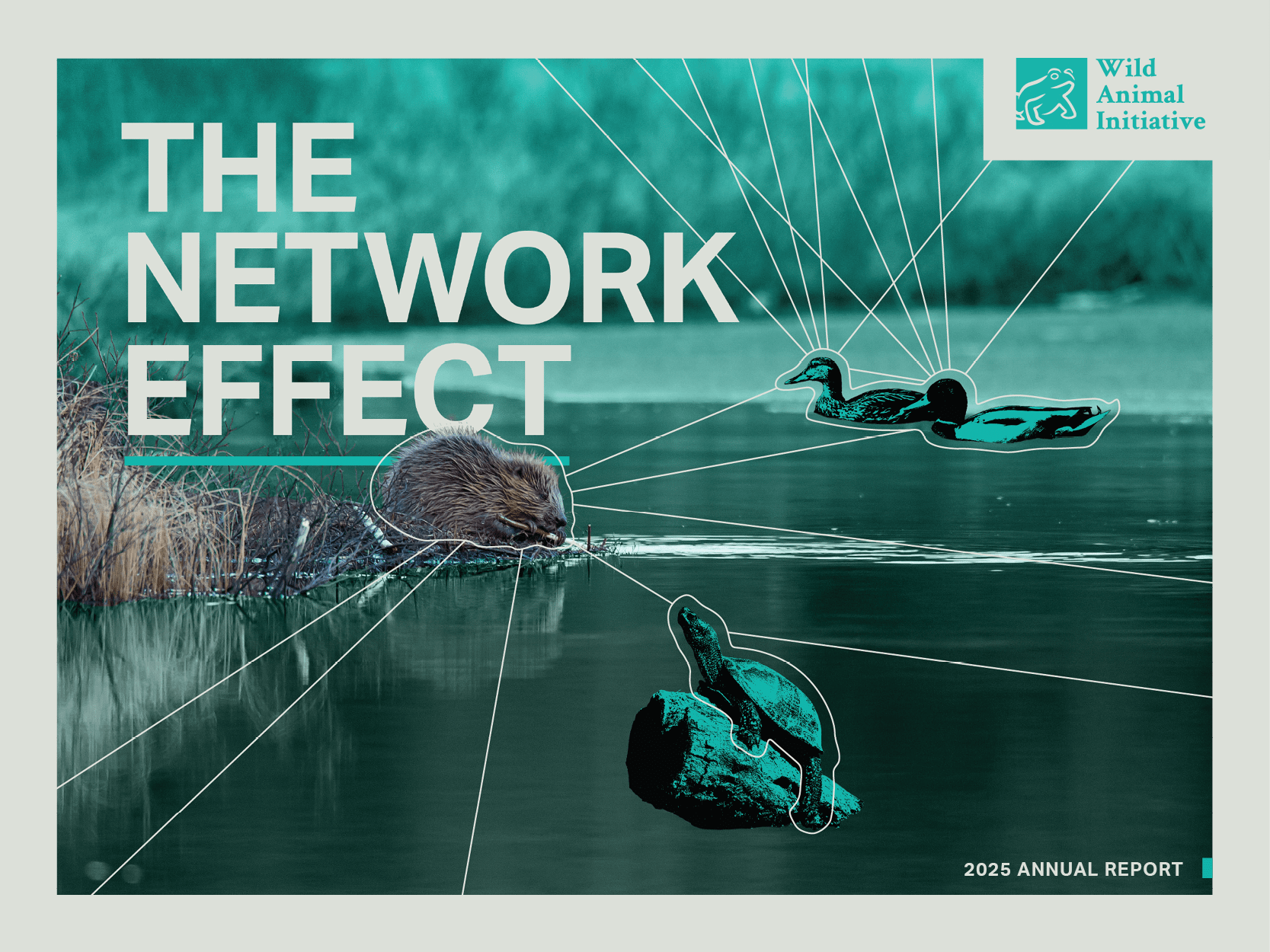
Wild Animal Initiative has published its 2025 annual report.
Building a scientific field for wild animal welfare science isn’t just about publishing papers or funding research (though we did plenty of both last year). It’s about the connections that form when scientists meet, collaborate, and champion a shared vision. In 2025, we watched those connections multiply in exciting ways.
Here’s a glimpse of what supporters in the EA community helped make possible:
15 research grants awarded across 26 countries — including our first projects in Costa Rica, Italy, Serbia, and Tanzania
12 scientific conferences attended, sparking new collaborations and introducing more researchers to wild animal welfare science
Completion of fieldwork on our house sparrow project and first associated paper published
Events spotlighting wild animal welfare organized independently by our collaborators — a sign that the field is taking on a life of its own
Inside the report, you’ll find data, narratives, and visualizations that provide further insight on our field-building strategy and success so far.
Wild Animal Initiative’s latest research on the representation of veterinarians in wildlife research, with a special focus on wild animal welfare science, was published in Research in Veterinary Science. The lead author is WAI Research Manager Michaël Beaulieu.
The paper first establishes a baseline for the representation of veterinarians in wildlife research. Along with Michaël, 14 students from the UniLaSalle Veterinary College in France examined the educational backgrounds of the authors of more than 5,000 articles published in animal behavior, conservation, ecology, and physiology over the last 10 years. They found that the representation of veterinarians was modest in well-established wildlife research disciplines, with only 3% of articles having at least one author with veterinary training.
Following the same procedure, they also examined the representation of veterinarians in the emerging field of wild animal welfare science. They found that almost half of wild animal welfare articles in animal welfare journals included at least one veterinary author. This high representation may be a reflection of veterinary students’ early interests in animal welfare and wildlife, of the role of animal welfare in veterinary education, and of veterinarians’ belief that wild animal welfare research has practical applicability. (Note that these findings and interpretations should be read cautiously, though, since the number of wild animal welfare articles found was relatively low.)
Michael says he would have been delighted to come across a paper like this when he was a young veterinary student interested in both research and wild animals. Seeing how feasible it is for veterinarians to get involved in wildlife research would have given him confidence to take my career in an unconventional direction, which is a key part of field-building.
Despite some limitations, the article also suggests that veterinarians may be better prepared to conduct research in wild animal welfare than in any other wildlife research discipline. But if veterinarians are to come to view wild animal welfare research as a safe professional pathway, the emerging field of wild animal welfare science will need to offer them more career opportunities. And that will require growth in the field — in its community, in its activities, in its recognition, and in the resources at its disposal.