it’s up for me, not sure why the host would have gone down then up again, is it still looking down for you?
plex
Karma: 587
Mostly like the post, but;
I mostly view the 10% pledge as a social commitment device rather than a sensible rule for how much to donate.
strikes me as missing the fact that small donors can spend much more cognition evaluating per unit dollar and are less heavily optimized against, so there are many high EV opportunities which can ~only be picked up by small-scale donors. Especially within-network donations to support projects that are too early stage or speculative to pass grantmaker bars.
ops, yup, fixed link.
And wouldn’t you expect those fitness defects to evolve away over time reasonably well? Seems like the kind of thing that would be a ton of individually minor distributional shifts which would have normal selection gradients over them, if you had a decent population running for a while?
Plus now they don’t have to maintain their usual set of anti-viral defenses, which probably frees up a lot of novel design options, plus some genetic space and metabolic resources? I’d mostly expect that within a year or two of large-population (say a large scale commercial bioreactor) they strongly out-compete normal bacteria.
we’re 10–30 years away, but: Only $500 million to $1 billion could potentially be sufficient and accelerate this timeline
This is not great. However, the virus immunity is a huge part, maybe the majority of, the issue for getting competitive advantage for wrecking the biosphere and unlike mirror life, virus immunity is very commercially valuable. And it’s not a future projection, this was made in 2024 and the containment strategy seems kinda not the thing you want to bet the biosphere on.
I think the people concerned about mirror life have a much more urgent warm up, right now: New Synthetic E. coli Is Immune to Bacteriophage Infection
Changelog
New Features:
Added Ctrl+Z/Ctrl+Y undo/redo—experiment freely and roll back mistakes
🚀 Set ambition level—rescales % so you can extend a project[1]
📸 Copy graph to clipboard—Easy grabbing the image
Dotted reference lines drop from each point to show exact dollar amounts and to the left for exact % amounts[2]
Clear notification—Shows “Points cleared—press Ctrl+Z to undo” when you clear all points
🧲 Snap to Grid—Enable magnetic snapping to round numbers (off by default)
Right click to add text to breakpoints[3]
Smart currency input—type “90k” or “1.5M” and it auto-converts
Input validation with helpful error messages
Touch scrolling fixed—Dragging points on mobile doesn’t scroll the page anymore
Language Updates:
Guide describes all features properly
Changed “Utility” → “Impact” throughout (less jargon!)
New title: “Plot Your Impact at Different Funding Levels”
Clearer subtitle mentions sharing with funders
Added watermark with stable URL
Accessibility
Keyboard navigation—Can focus and navigate the graph with keyboard
Screen reader support—All buttons labeled, status messages announced
Modal focus trap—Can’t accidentally tab outside modal dialog
The actual logistics of donating stock are a pain.
If they set up an every.org page it looks straightforward? e.g. select stock on this
I’ve been doing this self-funded for quite a few years[1] and would be enthusiastic to talk to anyone who gets this position, to swap models and contacts.
- ^
This has produced https://www.aisafety.com/ (including the map of AI Safety, list of funders, and the events&training newsletter) https://aisafety.info/ (including a RAG chatbot powered by the Alignment Research Dataset we maintain) https://alignment.dev/ https://www.affi.ne/ plus lots of minor projects and a couple more major ones upcoming.
- ^
I vouch for Severin being highly skilled at mediating conflicts.
Also, smouldering conflicts provide more drag to cohesion execution than most people realize until it’s resolved. Try this out if you have even a slight suspicion it might help.
Also we’re currently working with an artist to make a much upgraded background image. Happy to connect you if you’re able to collect up some funding and would like a nice professional map.
Nice to see this idea spreading! I bet Hamish would be happy to share the code we use for aisafety.world if that’s helpful. There’s a version on this github, but I’m not certain that’s the latest code. Drop by AED if you’d like to talk.
I don’t claim it’s impossible that nature survives an AI apocalypse which kills off humanity, but I do think it’s an extremely thin sliver of the outcome space (<0.1%). What odds would you assign to this?
Thanks! Feel free to leave comments or suggestions on the google docs which make up our backend.
Whether AI would wipe out humans entirely is a separate question (and one which has been debated extensively, to the point where I don’t think I have much to add to that conversation, even if I have opinions)
What I’m arguing for here is narrowly: Would AI which wipes out humans leave nature intact? I think the answer to that is pretty clearly no by default.
(cross posting my reply to your cross-posted comment)
I’m not arguing about p(total human extinction|superintelligence), but p(nature survives|total human extinction from superintelligence), as this conditional probability I see people getting very wrong sometimes.It’s not implausible to me that we survive due to decision theoretic reasons, this seems possible though not my default expectation (I mostly expect Decision theory does not imply we get nice things, unless we manually win a decent chunk more timelines than I expect).
My confidence is in the claim “if AI wipes out humans, it will wipe out nature”. I don’t engage with counterarguments to a separate claim, as that is beyond the scope of this post and I don’t have much to add over existing literature like the other posts you linked.
AI Safety Support has been for a long time a remarkably active in-the-trenches group patching the many otherwise gaping holes in the ecosystem (someone who’s available to talk and help people get a basic understanding of the lie of the land from a friendly face, resources to keep people informed in ways which were otherwise neglected, support around fiscal sponsorship and coaching), especially for people trying to join the effort who don’t have a close connection to the inner circles where it’s less obvious that these are needed.
I’m sad to see the supporters not having been adequately supported to keep up this part of the mission, but excited by JJ’s new project: Ashgro.
I’m also excited by AI Safety Quest stepping up as a distributed, scalable, grassroots version of several of the main duties of AI Safety Support, which are ever more keenly needed with the flood of people who want to help as awareness spreads.
running a big AI Alignment conference
Would you like the domain aisafety.global for this? It’s one of the ones I collected on ea.domains which I’m hoping someone will make use of one day.
Disagree with example. Human teenagers spend quite a few years learning object recognition and other skills necessary for driving before driving, and I’d bet at good odds that a end-to-end training run of a self-driving car network is shorter than even the driving lessons a teenager goes through to become proficient at a similar level to the car. Designing the training framework, no, but the comparator there is evolution’s millions of years so that doesn’t buy you much.
Your probabilities are not independent, your estimates mostly flow from a world model which seem to me to be flatly and clearly wrong.
The plainest examples seem to be assigning
We invent a way for AGIs to learn faster than humans 40% AGI inference costs drop below $25/hr (per human equivalent) 16% despite current models learning vastly faster than humans (training time of LLMs is not a human lifetime, and covers vastly more data) and the current nearing AGI and inference being dramatically cheaper and plummeting with algorithmic improvements. There is a general factor of progress, where progress leads to more progress, which you seem to be missing in the positive factors. For the negative, derailment that delays enough to push us out that far needs to be extreme, on the order of a full-out nuclear exchange, given more reasonable models of progress.
I’ll leave you with Yud’s preemptive reply:
Taking a bunch of number and multiplying them together causes errors to stack, especially when those errors are correlated.
Nice! Glad to see more funders entering the space, and excited to see the S-process rolled out to more grantmakers.
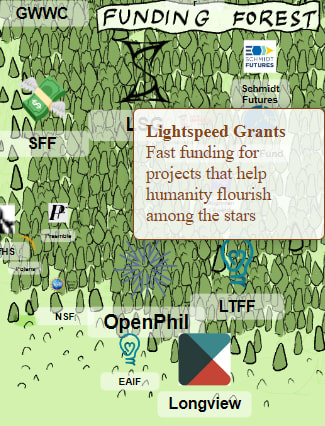
Added you to the map of AI existential safety:
Canary for whether I have been threatened with legal action over this post, and I guarantee that I will post any attempted threats in the comments.