As members of the EA community in India, we feel compelled to register our concern about the timing & location of EAGxIndia 2025, scheduled for 13–14 December in New Delhi [1]. December is peak smog season in Delhi—a time when the city’s air quality predictably descends into hazardous territory. The average reading breaches 400 (‘Severe’ category per the CPCB), with ambient PM2.5 concentration up to 30 times higher than the WHO’s recommended safety threshold. As of this drafting, the National Capital Region has logged three consecutive days of sustained “Severe” air quality: with the overall AQI readings of 428 on Nov 11, 418 on Nov 12, and 404 on Nov 13,2025.
The decision to convene a major conference during this peak pollution period necessitates at least some direct exposure of participants to ambient PM2.5 levels that constitute a Class 1 carcinogen, inherently elevating the health-risk profile for all attendees.
Detailed Notes on Delhi’s Winter Air-Quality Crisis:
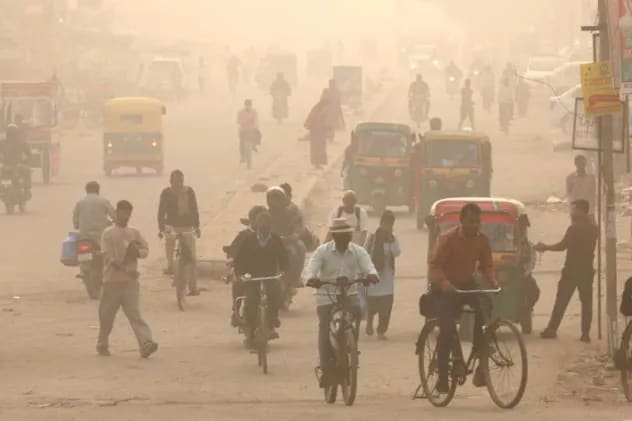
Photo: EPA/Rajat Gupta
Every winter—especially after the late‑October Diwali festival—Delhi’s Air Quality Index (AQI) drops from “moderate” or “poor” into “very poor” and “severe” ranges. Historical data reveal how extreme this can be: in November 2021, Delhi recorded 11 days of “severe” pollution (AQI > 400) and zero “good” days, with a monthly average AQI of 376 [2]. In mid‑November 2024, the national AQI touched “severe plus” at around 484, prompting closures and emergency measures [3]. On such days, physicians and analysts often illustrate risk by noting that exposure can be roughly equivalent to about 50 cigarettes in a day when AQI exceeds 500 [4].
This toxic smog is not just a local aberration but a regional crisis. The northern Indian subcontinent becomes a pollution trap each winter, affecting roughly 17 million people across northern India [5]. Delhi, the largest metropolis in this belt, often tops global pollution charts from late October–December. A key driver during this period is post‑harvest stubble burning[6], which in combination with temperature inversions, low wind speeds, urban emissions and dust—regularly pushes AQI into dangerous territory.
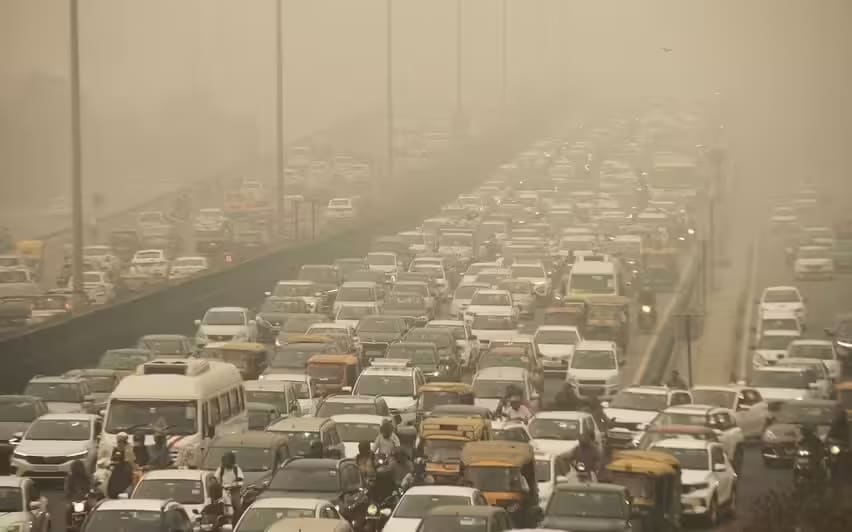
Following Diwali 2025, citywide AQI briefly averaged about 451 at 7 am—well into the “severe” category—triggering GRAP emergency steps [7].
Source : PTI
Authorities routinely respond with school closures, construction restrictions, and travel limits during such episodes [3]. Even India’s Supreme Court has remarked that “Delhi has become worse than hell,” underscoring the gravity of winter pollution in the capital [8].
Health impacts are severe and well‑documented. Fine particulate matter (PM2.5) in “very poor” to “severe” air causes acute respiratory distress and exacerbates chronic illnesses; pediatric clinics report spikes on bad‑air days and long‑term lung damage among Delhi’s children [8a] / [8b]. At a population level, chronic exposure has a large cumulative toll: according to the AQLI 2025, Delhi residents lose about 8.2 years of life expectancy, while the average Indian loses about 3.5 years [9].
These grim statistics recur every year. Public outcry begins in early November; citizens don masks and air purifiers; and authorities scramble with short‑term measures—yet long‑term fixes remain elusive.
EAGxIndia 2025: Information Gap and Contradictory Protocols
The official webpage for EAGxDelhi 2025 fails to adequately address the winter pollution crisis, creating a crucial information asymmetry for external participants. Without sufficient disclosure, attendees cannot make informed risk assessments or take appropriate self-protective measures. This is compounded by a logical contradiction in the health advisory under the event’s FAQs: generic protocols emphasizing natural ventilation (presumably, COVID guidance sans update) are counterproductive in high-AQI environments. During ‘Severe’ conditions, medical necessity dictates sealed indoor spaces and HEPA filtration instead of open-air exchange.
The organization hosting an international event assumes responsibility for participant safety. Given the proximity to the event date, comprehensive structural corrective actions are likely unfeasible. This communication chiefly serves to formally register feedback on the environmental risk, with the intent of facilitating improved planning for future events. Going forward, may our events be uplifting, inclusive and caring of its participants. It is our hope that attendees appropriately assess personal risk and implement self-protection measures. Above all, we sincerely hope that all participants remain safe and are spared the worst health effects of this crisis.
(This post is written in the spirit of shared concern and accountability. We welcome further discussion and encourage members of the community, especially those in India, to add their perspectives. By learning from this experience, we can create a safer and more empathetic approach to organizing EA events worldwide.)
This post is cosigned and reviewed by TJ, Saksham, Chinmayee, Kartik Akileswaran and Aditya Prasad.
Sources
[1] EAGxIndia 2025 — official event page (dates, location).
[4] The Indian Express (Nov 19, 2024): “50 cigarettes! That’s what you are inhaling in Delhi today.”
[5] SciDev.Net (Dec 13, 2021): “Toxic air endangers 600 million people in South Asia.”
Hey Nishit,
Thank you for writing this post and voicing your concern for the attendees. I’m the CEA Coordinator in charge of the event, and was one of the core decision-makers for having this event in New Delhi in December this year.
Before choosing this city and date, we consulted with many local senior EAs and tried our best to weigh the trade-offs. Some of the considerations included:
Attendee data from both EAGxIndia 2023 (Jaipur) and 2024 (Bangalore) showed that a large majority of attendees are from the Delhi and New Delhi area.
The team had many other projects this year, and it turned out that with our constraints, the next nearest date would be March 2026, which would mean no event in 2025.
And as you discussed, the poorer air quality during the winter months. We recognised this would have some negative effects on attendees (especially if the weather conditions are particularly unfavourable during that weekend), and would mean that some potential attendees would choose not to come.
Based on feedback from local community members, there was a significantly stronger preference for an India event in Delhi this year rather than waiting until March.
We are implementing several mitigation measures:
The venue spaces will be fully air-conditioned and indoors.
Sourcing for additional air purifiers (supplementing what the venue already provides)
Free N95 masks for attendees
Clear pre-event communication about air quality risks so attendees can make informed decisions about whether to attend
We acknowledge that these measures reduce but don’t eliminate health risks, and some people—particularly those with respiratory conditions—may need to opt out of this event.
We recognize that we could have also highlighted the air quality risks on the EAGxIndia website and when reaching out to speakers.
We hope that overall our decision turned out to be okay overall and feedback from the community will help us assess that. For future events, we are already planning to move the 2026 events to earlier months with hopefully better air quality, and exploring options to expand to multiple cities in India.
Hello Dion,
As somebody with reasonable familiarity with EA India community, and somebody who still spends significant time as a Delhi resident every year, I have a few things to add.
While I cannot divine which reference class is being denoted by “many local senior EAs” (or for that matter, what constitutes ‘seniority’ in a largely diffused community), nor do I have access the teleological specifics at play (what are the specific motivations to even hold an EAGx in this instance), I do feel compelled to point out that I personally know several active community members have held strong concerns for a Delhi Winter conference for air quality reasons for a long time.
Of course such a view is not consensus, but I’d be really surprised if the local feedback was received as ‘strong preference for Delhi (over other venues)’.
Certainly different cities provide different profile densities—I can imagine that policy-inclined people might prefer New Delhi, tech-inclined people might prefer Bangalore, and tourist-y destinations like Jaipur or even Goa might make it more appealing to those who have to take long flights across world to attend. And there is some merit to rotate potential venues across the cities. But it is less clear to me that more people being from Delhi NCR should be—or even can be—a stronger consideration than those factors.
Furthermore, Delhi NCR is a large, populous (comparable to entire countries) and a very busy city (esp traffic-wise). Note that the conference venue is in Lutyen’s—an area where paying for hotel accommodation out of your own pocket can be significantly more expensive in my experience. I personally, would have preferred to take a domestic flight once to another city and then live closer to the conference than commute for three days from the part of Delhi I live in to the venue for three consecutive days (and I don’t even live that far compared to overall diameter of NCR). Especially when daily local commute will have to be in hours of day when air quality is worst. So I would certainly caution against drawing interpretations from “I live in X” to “I’d prefer the event to be in X”.
I’m sure there are significant good reasons to hold a conference in Delhi (especially in this season) that dominate the countervailing reasons, and would hope that the organizing team finds validating feedback on those reasons, but for “overall our decision turned out to be okay overall”—I’d say too soon to tell, lest one may not notice the feedback at all.
It kind of seems that the current coordinating team has already decided (on behalf of the attendees) that their “overall decision turned out to be okay” instead of actually putting up some facts and figures as to who/how many people were reached out to and what were their feedback.
Hi Dion! Just read this and since you’re exploring other cities, I’m willing to coordinate future events in Kolkata, India. As per our group mentor’s (CEA fall OSP′25) suggestion we’re also looking forward to filing to host an EA Summit in Kolkata next year. I’m unable to attend this year.
Just to add additional context from the email attendees received last week (I am refraining from passing judgment either way, only to note that the organising team are taking additional precautions):
And on the linked FAQ in that email:
Thanks for sharing, however receiving this note after registration is part of the information asymmetry issue being named. Also several of these proposed mitigations seem technically problematic:
taxis in Delhi generally do not come with air filtration, making the exposure risk difference negligible between taking a bike/auto versus a taxi.
Official health guidelines mandate complete exposure avoidance for vulnerable attendees (respiratory issues), which is contradictory to the encouragement “to bring N95 masks… if you have pre-existing medical or respiratory conditions” on the linked FAQ you have posted.
The offer to “help make arrangements” lacks specificity. What resources might that refer to—Is it access to sealed, filtered recovery space? Or something else?
Do note that, our intention is not to be pedantic, it is merely to restore an appropriate degree of concern and expectation of responsibility that is proportional to the severity of the crisis.
Thanks a lot for this post! I was not planning on going to EAGx India for unrelated reasons, but if I had been, this would probably have been enough to convince me to cancel
This was very helpful Nishit!
On an slightly unrelated note, i had no idea there were this many super engaged EAs in India which is awesome, and i love that you are all taking the health and safety issues around this event so seriously.
Thanks for writing this Nishit!
The discussion around this prompted me to take additional precautions such as to ensure my masks are well fitted, even if it’s a N99 mask if it’s poorly sealed then it’s functionality is compromised.
So I’m looking to get a mask that has adjustable straps and nose seal so that I can adjust it to suit my face shape.
Another issue I’d noticed is that wearing masks makes it hard to communicate with others, the lack of facial expressions and muffled voices makes me rather suffer the pollution for a few days.
I used to live in Delhi (for a year) and wore a N95 mask religiously because of the pollution and I remember feeling helpless, afraid to even work out because I would breathe more air.
Air Quality is a cause area that I think deserves more prioritization. It is such an intimate part of our lived experience, we breathe it in daily and it has a compounding effect over time.
It really breaks my heart to consider all our friends who are suffering chronic effects due to their environment being this polluted
One way to communicate our preferences can be to let that inform our decision, the location where we live, we work, hold our conferences are all choices we make. If enough of us decide we will not tolerate pollution in our cities and accept the tradeoffs that entails it can be a powerful signal of how strongly we demand clean air.
One potential benefit of having it in Delhi is that maybe we can expect more attendees from the policy side of things, it might help build bridges for AI governance if we get to have conversations with other organizations planning the pre summit events (before the AI summit planned in India in Feb). I’m sure others who have more experience can chip in about the other benefits.
Overall I think this is an important discussion to have.