AI Safety Career Fair & Builders Summit SF—Retrospective
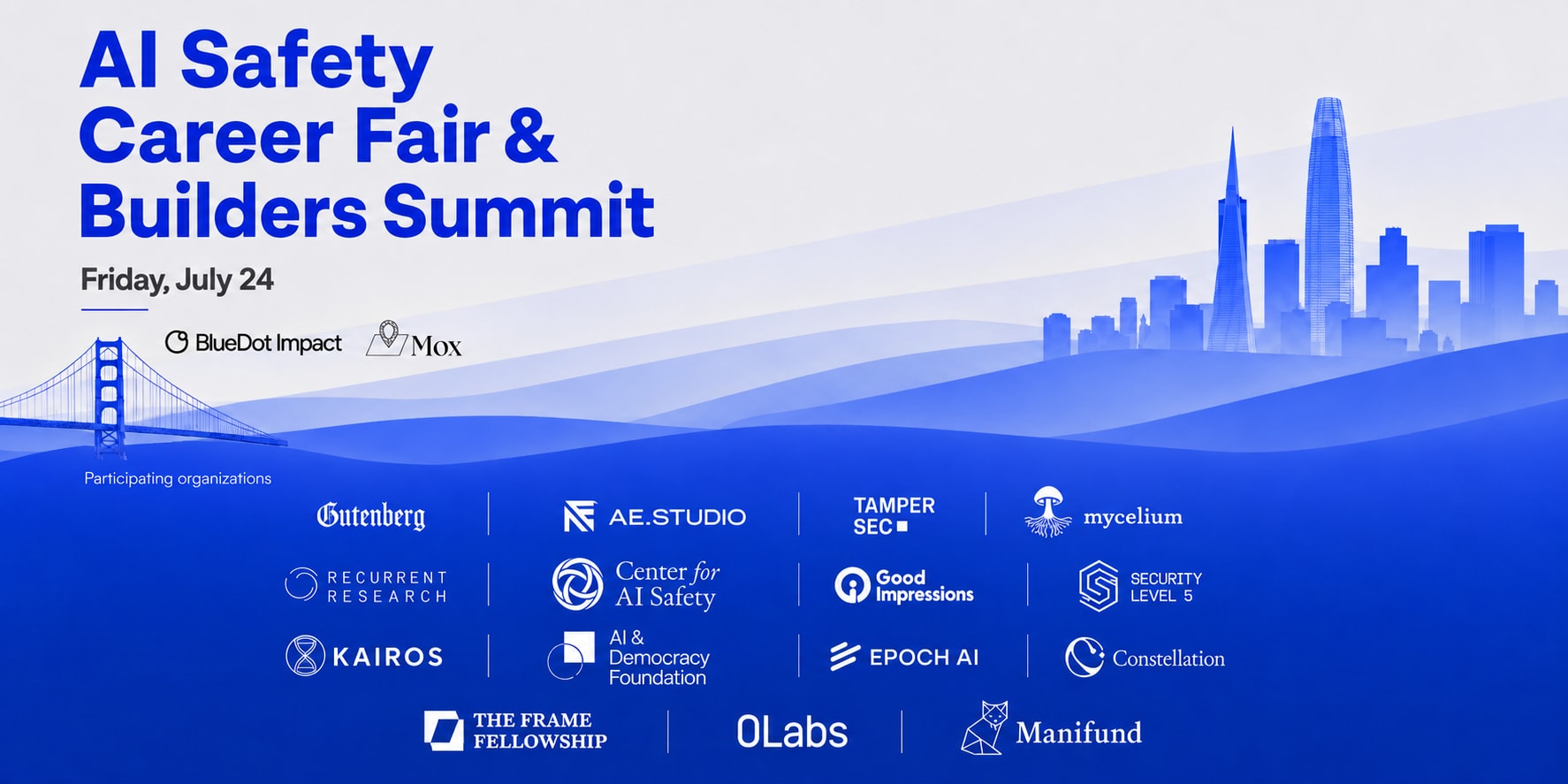
In July, I organized a 2-part event series: 1) AI Safety Hackathon and 2) Career Fair & Builders Summit to help bridge the field-building gap of professionals newly navigating the AIS ecosystem, sponsored by Mox and BlueDot. Here’s the rundown.
Background
After a boosted Linkedin post about navigating the AI Safety Career Pivot, I had ~50+ coaching chats—both in-person & virtual with my in-person Office Hours constantly full.
As a coach, I don’t offer something supremely novel and insightful: my main role has been guiding someone through this ecosystem, weeding the signal from noise of what is most relevant to them & their background.
Some conclusions
Professionals across levels of context do not know how to navigate the AI Safety ecosystem. Sending someone an 80k article with a slew of links is like giving someone a map of a foreign country and expecting them to figure out where they need to go. Something about the existing advising/coaching infrastructure either doesn’t fully satisfy a unique/locale-specific needs or is oversubscribed.
I am a bottleneck. I can only make so many introductions and relay so many resources while attempting to have recurring check ins of talent. Learning from others is exponentially more powerful than a 15 min conversation with me.
Conferences are sparse. I send them to 80k or AISafety.com’s collection of conferences & events, but many are far in location and time. Sending people to the upcoming EAGxBerkeley doesn’t quite make sense if they aren’t necessarily EA-aligned albeit AIS-aligned. I can & do organize EA SF events, but a 30 person event of low-context people does not yield much beyond connection.
A Hackathon is better than just another Summit. Conversations & connections can only go so far to show skill capability + AIS context. A Project or Hackathon provides the value akin to a work-trial.
The field lacks specific mid-career talent (and does not make it easy for them to break in). In a casual partnership with AE Studio’s Recruiter (as well as other conversations), I’m seeing that organizations are having a hard time finding talent with industry experience that isn’t in the typical vetted talent pools (MATS, Constellation, etc.). This is validated in many EA forum analyses.
Solution, Vision & Intentions
LISA’s Breaking Barriers Hackathon fell from the sky & I decided to replicate that in SF in addition to a career fair, which I felt was a core need in the ecosystem.
The hackathon’s purpose would be to feed into the career fair: participants would create an artifact to bring to the fair along with their résumé, demonstrating context and ecosystem knowledge, something AI safety organizations value highly.
Who we were trying to attract
Talent outside the EA ecosystem—provide ecosystem value outside of an existing EAGx Summit.
Candidates who fit roles such as chief of staff, head of operations, communications lead.
Hard-to-find, mid-career professionals with tech industry experience who may have less context/ecosystem knowledge
Many interested participants were technical researchers (software engineers, etc.), but we prioritized not catering to them.
Timeline
All timings relative to the career fair on July 24.
| When | What |
|---|---|
| T-60 | Started seriously thinking about the event after AI safety career coaching calls |
| T-50 | Submitted the BlueDot grant for an AI Safety Career Fair & Summit |
| T-39 | BlueDot grant confirmed. Pivoted the event idea to instead replicate LISA’s Breaking Barriers hackathon and add a career fair |
| Personal Break: Out of Town | |
| T-25 | Mox sponsorship & venue confirmed. Luma event published. |
| T-18-16 | Marketing + Org outreach: Slacks, Discords, and Cold emails Talent outreach: BlueDot graduates, Manifest directory, Consultants for Impact directory |
| T-13 | CAIS attendance confirmed—turning point for organization certainty + validated ecosystem need |
| T-11-9 | Conference app confirmed + onboarded + communicated to attendees. |
| T-8 | 3rd & final Judge for Hackathon Confirmed |
| T-6 (July 18) | Breaking Barriers SF Hackathon |
| T-4 | Career fair & event details sent to tabling organizations |
| T-3 | 5th & final Summit Speaker confirmed |
| T-2 | Volunteer coordination emails sentDecided to add the Post-Fair Happy Hour. Event published & added to conference agenda. |
| T-1 | Venue Setup: Signage, Tables, Chairs, Etc. |
| T-0 (July 24) | AI Safety Career Fair & Builders Summit |
Budget
Note: EA SF is currently not funded due to the EA IF freeze & other grant delays. My time as an organizer is supported by Manifund until around end of Sept.
Hackathon
| Item | Cost |
|---|---|
| Food (breakfast, lunch, dinner), stickers, judges’ gifts | $2,000 |
| Compute (34 teams, $50/team allocated) | <$1,700 |
| Prizes | $2,250 |
Career Fair
| Item | Cost |
|---|---|
| Lunch, drinks, happy hour, stickers, speaker gifts, conference app | $2,800 |
Notes on cost
Mox donated their venue, which took the single biggest line item off the table
I charged BlueDot for my time that is not included here
Results & Feedback
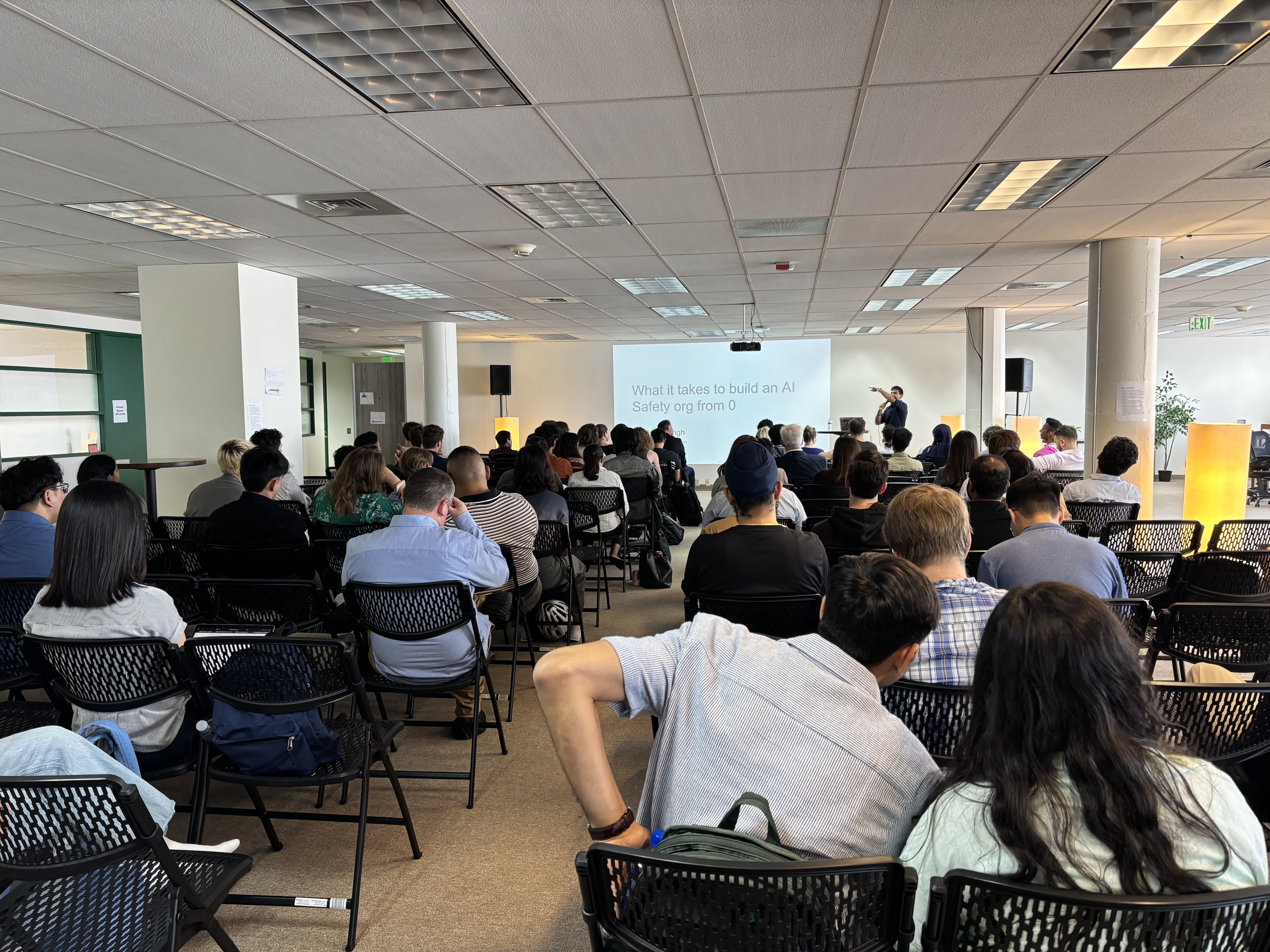
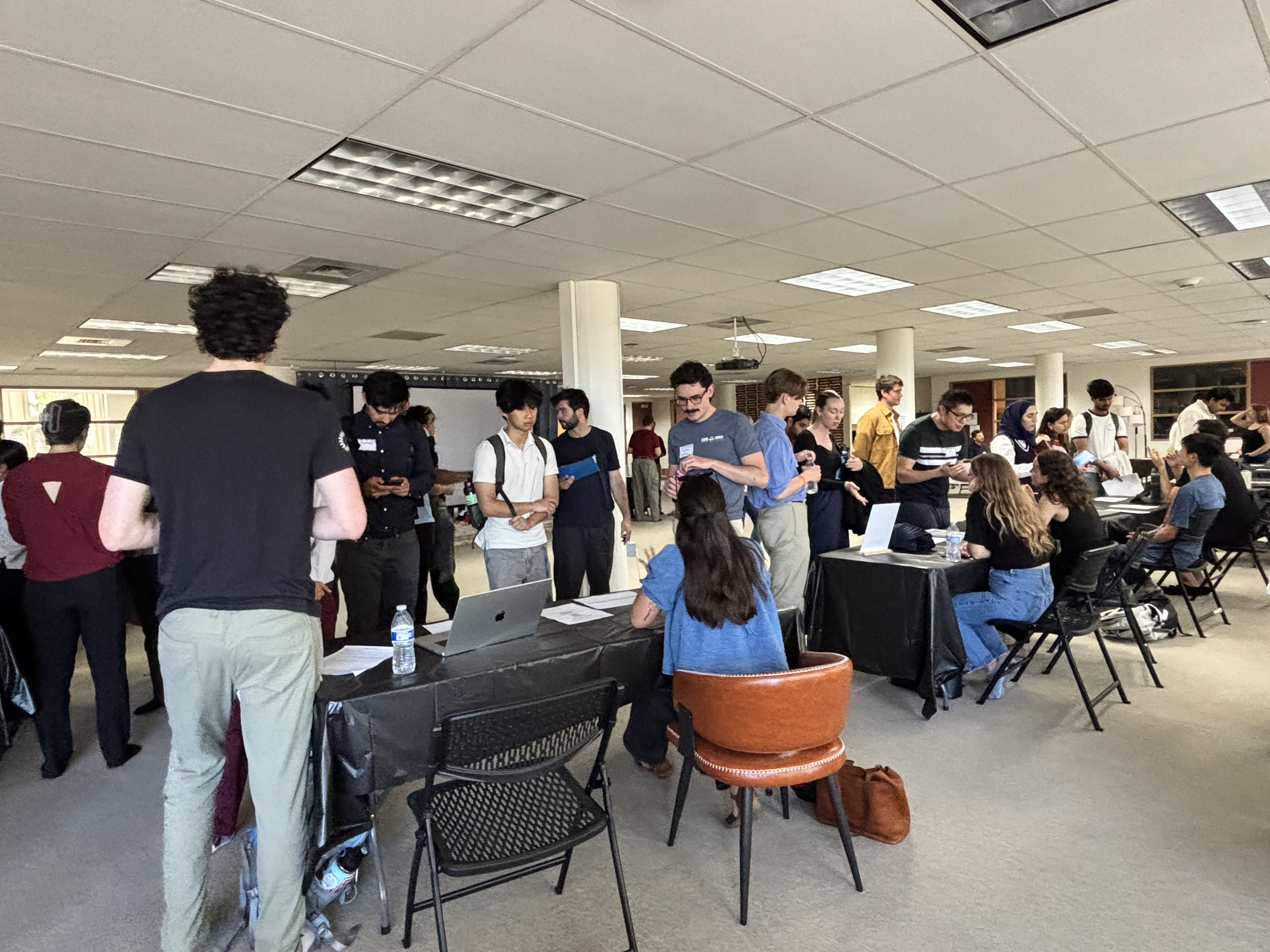
Attendees: 322 Applied → 228 Accepted and Going → ~130 Attended
Organizations: 21 interested → 16 in-person tabling
Attendee Feedback (n=32):
Average rating: 4.19/5, no one rated below a 3
72% reported some positive impact in their AI safety plans: 56% new leads/connections, 16% are pursuing something they weren’t considering before
Counterfactual | The average attendee left with ~3 new orgs they are excited to pursue and did not know about prior. Most mentioned include: Center for AI Safety, SapiensFirst, and Gutenberg.
What people remembered:
Career fair (88%), 1-on-1s/networking (59%), happy hour (31%)
Structured talks and workshops were appreciated but consistently ranked below the unstructured, connective parts of the day: “chatting,” “connecting,” “the other attendees” dominated the open-ended responses.
Org Feedback (n=10):
Average rating: 3.74/5 | Recommend to a peer org: 7.87/10
Clear split: most orgs clustered in a solid 4-5 range across every metric; a smaller subset (2 of 10) consistently scored lower across the board.
My read: a Career Fair is less beneficial to orgs that are hyper-specific about talent, require significantly high AIS context, or already are well known in the ecosystem.
Quotes:
“Feeling inspired after the event.”
“Thank you so much for creating this opportunity for people to get involved in ensuring a good future.”
“There’s not enough roles for the number of people in the room. There seems to be a disconnect in what the community is asking for—generalists, operators—and what is actually available.”
Reflections & Surprises
Hackathon
~65 attendees → 34 project submissions
LISA’s team provided a backbone & playbook, including proposed projects, discord matching bot & the Luma event copy. This was incredibly helpful!
I got pretty sick the day before and put out a call & was really lucky that someone experienced was able to step up and facilitate, but otherwise, it would’ve had to have been postponed. #single-organizer-failure-mode
Katia, the in-person facilitator, took fantastic notes throughout the day. Main difficulties were team-matching (time + providing extra facilitation support) and demos running quite long!
Career Fair
About 2x heavier lift than the hackathon: uncertainty around which organizations would show up (if any), coordinating with orgs, greater stakes with talent/attendee marketing & filtering, speaker sessions & programming.
1. Reaching beyond the EA bubble worked
Pleasant surprise for value proposition: around 40% (guesstimate) of the attendees were outside the EAG fold or the EA ecosystem—we had people from Trust & Safety, Cybersecurity, and other niches.
A handful of people even flew in for the event (amongst other Bay Area commitments), which was fascinating. I wasn’t expecting that.
It wasn’t just a career fair, but also a summit: people attended who weren’t necessarily looking for a job; they were already employed, but wanted to talk to other AI safety people and were thinking about this topic.
The bigger takeaway: there is a lack of a large AI safety community summit for everyone, a mega conference is missing outside of EAG.
2. Partnerships matter—Mox + BlueDot
An email from Mox carried more weight than a cold one from me, meaning organizations were more likely to sign up. A bridge solution to the chicken-egg problem: talent will show up if there are interesting orgs, orgs will show up if there is promising talent.
BlueDot and Mox’s branding added credibility to the event’s profile
3. The Power of Community + Stewardship
I love and admire my species, living and dead, and am totally dependent on them for my life and well being. -Steve Jobs
Being plugged into various newsletters, Slack channels, and Discord servers helps with marketing & outreach.
For the hackathon, I was able to find my in-person replacement through a community signal group.
All the speakers and judges were members of the community I had met & knew personally, although to varying degrees of closeness: some personal friends and others brief chats & encounters.
Learning: Speakers & Judges rarely come to you from broad outreach. Most of them were personally invited by me.
AConference.app was built by a friend in the community, who has been working on a Swapcard alternative for a while. I signal messaged them on using it for the Career Fair
The biggest crux to: can anyone just run this? You need partnerships, be connected in the ecosystem, and be surrounded by helpful people
Solo-organizing means you need to lean on people.
For initial guidance & problem validation, I asked @Finn Metz, @Akshyae Singh, and my EA SF predecessor to help me talk through my idea and craft the best solution. @Austin offered further confirmation along the lines of “this is a good idea”. These interactions were absolutely critical.
I had a volunteer form on the invite, but did not have any incentive to offer (it’s a free event). 13 people signed up, showed up, and constantly took initiative. The day-of programming was a collective lift.
4. The shot that didn’t pan out: invite-only interviews
I spent significant cognitive effort + execution to ensure the process of invite-only interviews after the fair where organizations could personally invite interested candidates for a brief interview. I had high expectations that this would reduce recruitment timelines from the emailing back-and-forth for a virtual screen.
Ultimately, no organizations used this option because they wanted to evaluate candidates further & within an application in their system.
What I’d do differently: I would still offer the option, but without a formal process outside of the normal requesting a 1-1 chat with someone.
5. The post-fair happy hour was worth it
Due to already significant cognitive load, I wasn’t planning on hosting it, but thought it would be pretty valuable for this event.
It was tremendously valuable, considering that a lot of feedback mentioned the lack of unstructured time
It was open to the broader community: people who weren’t accepted into the summit or couldn’t make it.
What I’d change: I was incredibly cautious about not overloading the venue, so I didn’t advertise it as much as I would have liked.
6. On being an organizer who isn’t a super-extrovert
Being someone who is definitely an ambivert, I was running with essentially half a brain at this career fair.
A lot of people wanted to talk to me, as some point person in the community to bridge connections or provide guidance on their journey. I wish I had the unlimited energy to talk to every single attendee.
But also there is power in introverts, and I know many event & community organizers can be introverted; it’s pretty agnostic.
Post-Fair Email
Thank you everyone for your eagerness to tackle AI Safety! I underscore what an honor it is to serve this community. Some feedback we’re seeing is the amazing. people & connections made—from all walks of life, the field, and even outside of the Bay Area. This event is just the start. Here are ways to keep going. 🗓️ Upcoming EventsFrom us:
Recurring / community series: Conferences & major gatherings:
Find more: 📚 ResourcesCareer advising & job boards:
Courses & accelerators: Community & space:
Orientation: |
Thank you
This took a community of individuals to come to fruition.
Thank you to Mox for providing the venue and community infrastructure to make this happen. Thank you to BlueDot (@Joshua Landes & Mmachukwu) for funding and event support.
Thank you to @Finn Metz & @Akshyae Singh for being my brainstorming buddies. Thank you to @Austin & the Mox team (Robin, Jake, Whit) for the continued affirmation & venue support. Thank you to the LISA team (Oliver, Yash, Nina) for generously offering Hackathon resources. Thank you to Katia for magically stepping in with 24 hours notice. Thank you to the Hackathon judges (@chan tzu kit, Arunim, and Josh) for taking the time to assess and cultivate our budding AIS Builders. Thank you to the Career Fair & Summit speakers (@Vaidehi Agarwalla 🔸, @Rohan Prasad, @Allen Lu 🔸, Jonathan) for your receptiveness to being pulled in to share your passion to a crowd. Thank you to the phenomenal crew of volunteers: Michelle, Dmitrii , Fajar, Uche, Ann, @Mike Mantell, Kunal, Anthony, Ian, @Jack Wittmayer, John, @DC, and @Samuel Chen for your selfless acts of service.
Thank you to the orgs that showed up for your partnership: Gutenberg, AE Studio, MATS Research, TamperSec, Evitable, Recurrent Research, Center for AI Safety, Inc, Good Impressions, Security Level 5, Kairos, AI & Democracy Foundation, Epoch AI, Constellation Institute, 0Labs, Frame Fellowship, and Manifund.
Hey Jen,
Just thought I’d share my essay, which won a runner-up prize in the Manifund Essay Competition on Building the EA/AI Safety Scene in San Francisco with you in case it is of any use (I tried to PM you, but I ran into a bug).
Obviously, take it with a massive grain of salt: 1) I don’t live in SF 2) you’ve actually been running things in SF which is much more informative than just theorising about what should be done like I did with my post 3) The best strategy for you to pursue is highly contingent on your own individual skills and fit.
Best,
Chris