I Spent 167 Hours Mapping the AIxAnimals Ecosystem so You Don’t Have To
It’s my belief that the intersection of AI x Animals represents one of the most pressing current opportunities for the prevention of suffering.
It’s also a very new area, with information spread across lots of locations, making it hard to get your bearings and know where to consider taking action.
To help with that this post includes:
A literature review table summarising 96 papers, youtube videos, articles and other sources. The table includes links to the papers, brief summaries of each, and is organised into sub-themes for navigation.
A quadrant map and table visualising alignment and influence of various key orgs
A network map visualising relationships between various key orgs
For Context
This post summarises the findings of a research project I completed in early-mid 2026 mapping the intersection of Artificial Intelligence and Animal Welfare. I used AI to help with early drafting, but the current version is very much in my own voice and tone—as should be quite obvious from what my friends call my “unique” sense of humour.
I am treating this as a working document and welcome pushback, feedback, updates etc
Also, whilst the project was completed as part of an Effective Thesis Fellowship, with mentorship from Zuzana Šperlová at Animal Charity Evaluators. This is not taken to mean that they officially endorse the findings.
Key Takeaways
The default trajectory is negative. Absent deliberate intervention, AI systems are likely to entrench speciesist biases, accelerate harms in factory farming, and concentrate power in the hands of actors with little incentive to consider animal welfare.
Animals are almost entirely absent from AI governance. An empirical survey of major AI ethics guidelines from governments, companies, and standards bodies confirms that nonhuman animals are virtually never mentioned—despite AI having massive, direct impacts on their lives.
The field is still highly siloed. There is remarkably little cross-pollination between researchers working on AI alignment, precision livestock farming (PLF), conservation AI, animal testing alternatives, and alternative proteins. Bridging these gaps is a significant and neglected opportunity.
High-influence actors remain misaligned. The quadrant analysis reveals that the organisations with the most structural power over AI development, i.e. frontier labs, major regulators, and standards bodies, currently exhibit low alignment with animal welfare goals. This is a major obstacle to overcome.
There are a good amount of tractable intervention paths. For example, near-term opportunities include engaging with standard-setting bodies (OECD, IEEE), supporting AI-driven animal testing alternatives, auditing AI models for speciesist biases, leveraging the “Anthropic anomaly” as a proof of concept for animal-inclusive AI governance, work aimed at “un-siloing” the field, and many more (these are just examples off the top of my head)
Why This Intersection Deserves (More) Serious Attention
The AI x Animals theme week here on the forum was phenomenal to see, and having facilitated a discussion cohort for Sentient Futures’ AIxAnimals fellowship, I know that there are good people doing promising work in the area. However, I’m still strongly inclined to believe that the intersection requires more time, attention and resources:
Massive scale. The numbers are almost incomprehensible. Approximately 80-90 billion land animals are farmed annually, and AI is already being deployed at scale in the systems that manage their lives—from computer vision welfare monitoring to automated feeding and slaughter. One Rethink Priorities forecast projects a potential fourfold increase in the number of animals slaughtered by 2033, with insect farming growing by over 900%, driven in part by AI-enabled intensification [0] (Yes, I just used a 0 as a citation number because I did not want to renumber and reorder mine—I’m a scoundrel and a rogue)
Widely neglected. Outside of EA circles AIxAnimals conversations are almost non-existent in the AI space. Owe and Baum (2021) surveyed 77 AI ethics courses, over 200 academic papers, and 73 AI ethics principles and statements, and found that nonhuman animals receive minimal, inconsistent moral consideration across the board [1]. Coghlan, Parker, and Lederman (2026) updated this finding with a more recent corpus and reached the same conclusion: the major AI ethics guidelines produced by governments, companies, and standards bodies virtually never mention animals [2]. In essence, the current status quo reinforces animals’ “moral and social invisibility” in the institutions shaping the most powerful technology in human history.
Highly leveraged and Potentially Persistent. The decisions being made right now about how AI systems are designed, trained, and governed will shape the conditions of animal life for decades, potentially locking in negative states for hundreds or thousands of years. Actions taken now may therefore have disproportionate leverage on outcomes for future animals. If you’re at all interested in suffering reduction or suffering focused ethics, this may be one of the most significant possible uses of your time.
The Research Process
If you just want to read the findings feel free to jump ahead, the academic in me couldn’t quite bring myself not to include a methodology section. I think it’s good for transparency and replication, and it helps to ground everything.
Literature Review. I conducted a (somewhat) comprehensive review of the academic and grey literature at the AI × Animals intersection, covering 2008-2026. The review spanned nine sub-domains: AI ethics and alignment (animals), AI in animal agriculture and PLF, AI for conservation and wildlife, AI for animal testing alternatives, AI for interspecies communication, AI as an advocacy tool, genetic welfare, long-term futures and wild animal welfare, and AI’s interaction with alt proteins. I began by assessing a set of 12 papers on their main findings, the strength of their evidence, and their strategic relevance for advocates, and then created an assessment logic document utilising these as examples to allow an AI deep research tool to assess the others. Upon completion I conducted manual checks of a separate batch of 16 papers to ensure that the assessment logic had held sound and was confident that it had.
Actor Table & Quadrant Map. I originally identified around 65 organisations operating at this intersection and rated each on two dimensions: their influence on AI development and governance (1–10), and their alignment with animal welfare goals (1–10). These scores were assigned by providing a deep research AI tool a document of judgement criteria, and aimed to draw upon based on publicly available information (policy documents, funding flows, stated missions, and model specifications etc) where possible. Following feedback from and discussions with an Zuzana I then added around 15 more organisations (bringing the total to 80) and manually adjusted influence and alignment scores for 17 of the organisations based on existing additional knowledge, current updates, or out of attempting to balance influence scores across domains (i.e. AI lab influence vs funder influence vs governing body influence) I also aimed to be more transparent about the uncertainty in each score and opted to include uncertainty bands on the visual to reflect this. Importantly, whilst the map is designed to identify overall trends at the field-mapping level, and potentially lead towards high-leverage intervention points, it is not intended to be read as providing ultra-precise empirical measurements.
Network Relationship Map. I also attempted to map the relationships between these organisations, for example funding flows, collaborations, structural influences, and rivalries, in order to better understand how power and information move through the ecosystem. To do so I created a document of criteria and used an AI deep research tool to create the visualisation, adjusting and editing versions for visibility, as well as adding different line styles to reflect confidence in relationship claims. I also manually checked a small selection of relationships in areas I was more familiar, and these seemed accurate. In full transparency these types of data visualisations are not my area of expertise, so this is the area of my work I feel the least confident on. With that said, I do think the visual could be useful, and I’m hopeful it could provide a jumping off point for people far more data-inclined than I.
Both visual maps are included below. I would encourage you to spend time with them, because they communicate things about the structure of this field that are genuinely hard to convey in prose, and you may be able to draw out your own unique conclusions. I’m also super open to feedback and updates (including 1:1’s/DMs if you prefer to do so in private)
Analysis and Synthesis. I used a 3 step approach to analysis of the literature, actor map and relationship map. First, I manually reviewed them, looking for themes, trends, commonalities, tensions etc. After that, I asked two LLM’s (Chat GPT and Claude) to review the same data, alongside my analysis, commenting on what they agreed and disagreed with, as well as what I may have missed or overlooked. I used this feedback to make a handful of adjustments.
The Actor Landscape: Mapping Influence and Alignment
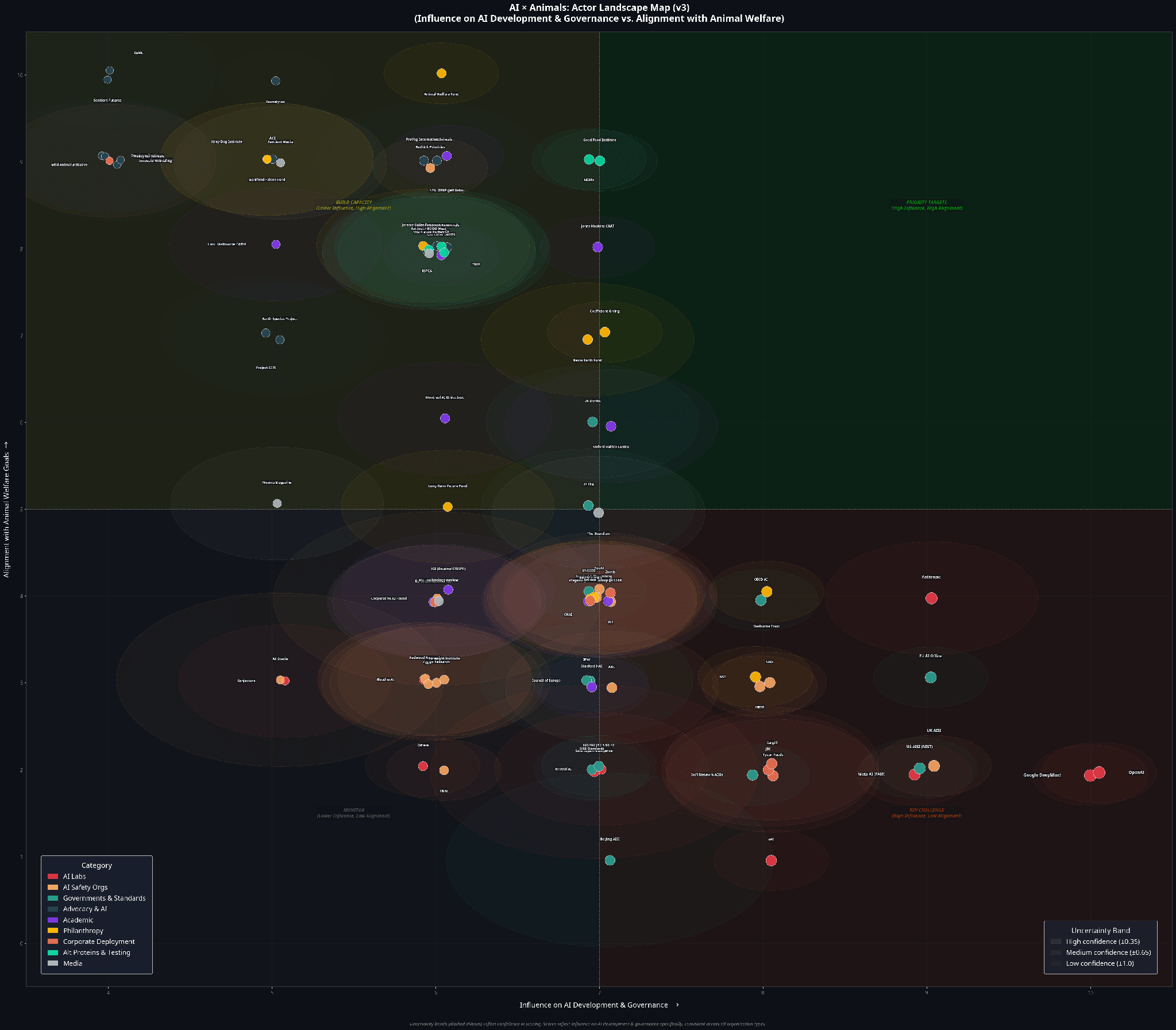
The quadrant map below plots over 80 organisations across two axes: influence on AI development and governance (horizontal) and alignment with animal welfare goals (vertical). Node size reflects influence score; colour reflects organisational category; dashed ellipses reflect confidence in the scoring. I’ve also included keys within the image.
“That Damned Diagonal”
The map makes the central challenge of the AI × Animals field visible in a single image, which is to say that the vast majority of high-influence actors (frontier AI labs, major governments, and standards bodies) sit in the lower-right quadrant, i.e. high influence, low animal alignment. These are the organisations that most need to change, and where change would have the largest impact. Conversely, the actors most aligned with animal welfare (Think places like Faunalytics, the Earth Species Project, Sentient Futures, Rethink Priorities’ animal welfare team) are clustered in the upper-left quadrant: high alignment, but currently limited influence over the broader trajectory of AI development.
The Missing Middle
Another notable feature of the map is what I have called the “missing middle.” Organisations tend to be either highly focused on animal welfare (scoring 8–10 on alignment) or largely uninterested in it (scoring 2–4). Very few organisations sit in the middle (5-7) range. This bifurcation directly links to the central challenge I mentioned above, i.e. bridging the gap between the animal advocacy movement and the mainstream AI development and governance ecosystem.
The Anthropic Anomaly
Within the high-influence, low-alignment quadrant, Anthropic stands out. While still scoring relatively low on overall animal welfare alignment (4/10), it scores notably higher than its peers. OpenAI, DeepMind, and Meta all score 2⁄10 (and that’s me being generous) This is because Claude’s Model Spec explicitly mentions animal welfare, making Anthropic the only frontier lab with any formal acknowledgement of nonhuman interests in its core governance documents.
I’m torn, because I don’t want to risk overstating Anthropic’s position. Anthropic does not have a dedicated animal welfare research agenda, and the mention in the Model Spec does not translate into systematic policy. But it does at least potentially make Anthropic less anthropocentric than its competitors, and it suggests a strategic opportunity: using Claude’s Model Spec as a baseline demand when engaging with other frontier labs. If one of the world’s leading AI labs can do it, the others may have less justification for refusing.
The Network of Influence
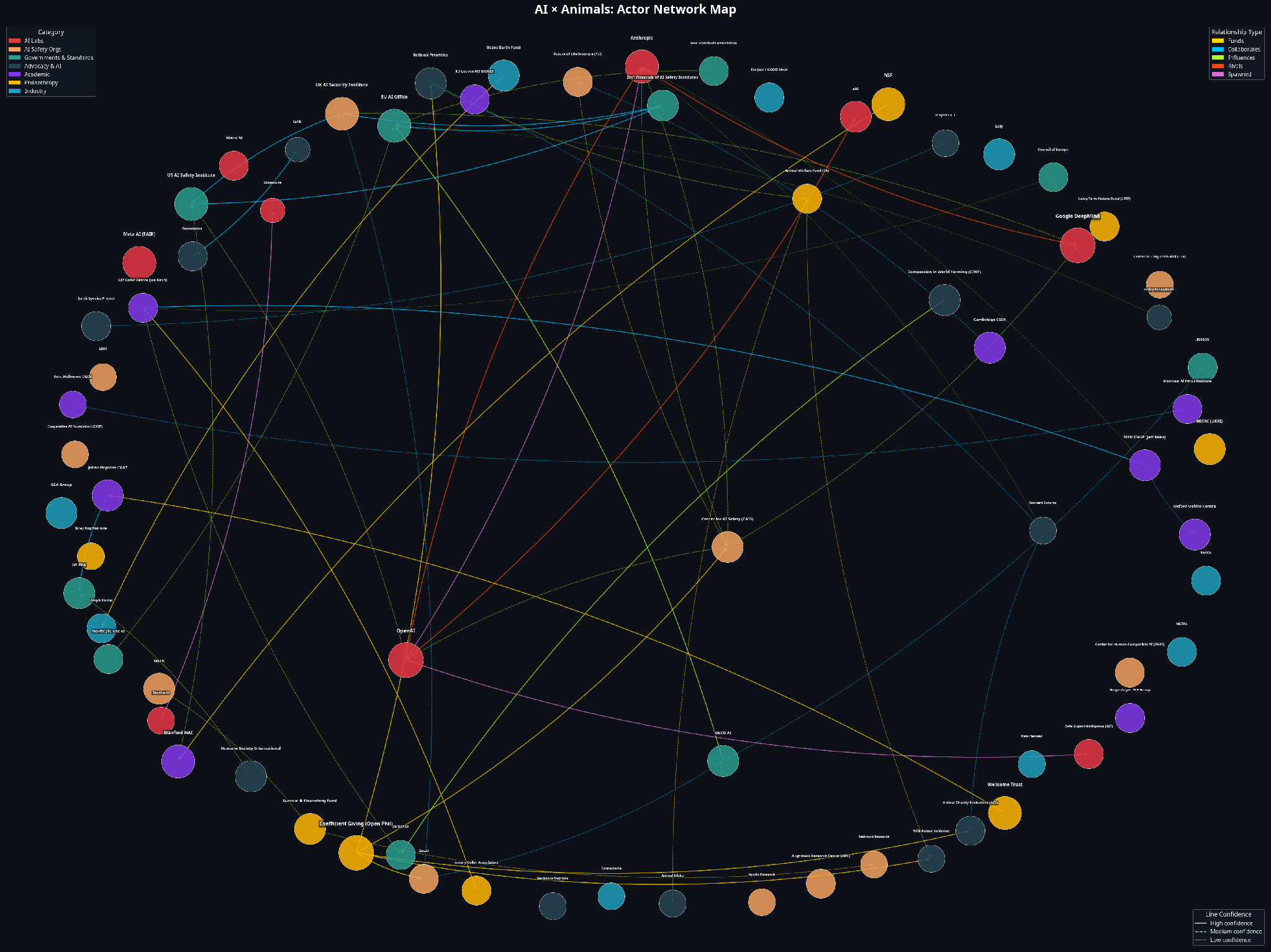
The network map below visualises the relationships between organisations—funding flows (gold), collaborations (blue), structural influences (green), rivalries (red), and genealogical relationships (purple). Node size reflects influence score; line style reflects confidence in the relationship. As with the Actor map, a key is included in the image.
Disconnected AI Safety and Animal Advocacy Orgs
The network map shows somewhat of a separation between the AI safety “establishment” and the animal advocacy community. You’ve got this dense, highly interconnected cluster existing between major safety organisations (CAIS, ARC), national AI institutes (UK AISI, US AISI), and key funders (Coefficient Giving). This cluster represents the “establishment” of AI safety, i.e. the organisations that set the agenda, train the researchers, and advise the policymakers. Animal advocacy organisations and academic ethics centres, by contrast, tend to cluster together on the periphery. They have relatively few direct edges connecting them to the frontier AI labs or the national safety institutes. Remember though, that I could only create this from publicly available information, so it’s likely there are angles/relationships I’ve missed, please do feel free to update me if you have useful info on specific areas.
The Potential Utility of Bridge Nodes
The map also suggests the importance of the bridge nodes, the organisations that connect the periphery to the core. Rethink Priorities, for example, connects the EA/philanthropy cluster to the animal advocacy cluster. Major funding orgs such as Coefficient Giving also occupy spaces which intersect both worlds. Anthropic, as noted above, is the only frontier lab with inbound influence edges from the safety/ethics periphery. Strengthening these bridge nodes, using these bridge nodes to launch new AIxAnimals initiatives, and building new bridge notes is, I think, a high potential structural intervention.
What the Literature Tells Us: Eight Sub-Domains
1. AI Ethics and Alignment
This sub-area seemed to be the most intellectually active strand of the field, and the one with the most direct/obvious link to EA’s existing work on AI safety. The foundational empirical finding, i.e. that animals are almost entirely absent from AI ethics frameworks, has now been established by multiple independent research teams [1] [2]. From what I can see there is (or at least was) somewhat of a debate emerging between two positions.
The first position, articulated by Tse, Moret, Ziesche, and Singer (2025), argues for a “basic alignment” standard: AI systems should, at minimum, avoid causing unnecessary harm to animals when this can be achieved at low cost [6]. This is framed as a pragmatic starting point that is widely acceptable and does not require resolving contested questions about the relative weight of animal versus human interests.
The second position, articulated by Coghlan and Parker (2026) in direct response, argues that basic alignment is sometimes insufficient and that more ambitious, contextually differentiated standards are both feasible and morally required, particularly for AI systems deployed in farming, conservation, and animal research [7]. The subsequent reply by Moret et al. (2026) moves toward synthesis, clarifying that the emphasis on “basic” alignment reflected pragmatic constraints rather than principled limits, and arguing for a collaborative approach to building animal-inclusive AI alignment [8].
My own view is that both positions are correct in their respective domains. Basic alignment is probably the right target for general-purpose AI systems and governance frameworks, where the goal is to shift the (pretty crappy) default from anthropocentric indifference to minimal consideration. More ambitious standards are appropriate for specific high-stakes applications. The practical implication is that advocates should pursue both tracks simultaneously rather than treating them as alternatives.
A further crux, crystallised by the AGI and Animals Debate Week on this forum in March 2026, is whether AI going well for humans will automatically benefit animals. The emerging consensus (which I’m strongly inclined to agree with at this point) is that it will not. The mechanisms by which AGI could benefit animals, for example by accelerating alternative protein development, by enabling better welfare monitoring or by shifting human values, are all contingent on deliberate choices that are not guaranteed by default. This seems to me like a strong argument for the EA community to invest in targeted work at this intersection, rather than assuming that animal welfare will be carried along by the broader AI safety agenda.
2. AI in Animal Agriculture and Precision Livestock Farming
The PLF literature is probably the chonkiest, or rather most voluminous strand of the AI × Animals field, and it is characterised by a fundamental tension that I found genuinely difficult to resolve (as did most of the fellows in my SF AIxAnimals cohort discussion for this topic)
The optimistic case holds that AI-enabled welfare monitoring tools (computer vision, biometric sensors, behavioural analysis) can detect suffering earlier and more reliably than human observation, creating a genuine pathway to welfare improvement at scale. The sceptical case holds that the primary driver of AI adoption in animal agriculture is efficiency and productivity, not welfare, and that welfare-labelled applications frequently amount to “welfare theatre”: the appearance of monitoring without genuine improvement. Berckmans et al.’s (2022) twelve-threat framework made this case pretty strongly.
The evidence, as I read it, supports both positions simultaneously. AI is being deployed for welfare purposes, but these applications are secondary to and often in tension with the productivity applications that drive commercial adoption. A further concern is that AI welfare tools are being developed primarily by engineers with limited animal welfare expertise, creating a risk that the tools measure the wrong indicators.
What makes this particularly urgent is the scale of the expansion underway. AI is enabling a scale of animal farming that dwarfs anything previously possible, and the welfare implications of this expansion are largely unaddressed in current governance frameworks.
3. AI for Conservation and Wildlife
This definitely wasn’t a familiar area for me, but the conservation strand seemed like the most technically mature and maybe the most optimistic (though this may be due to my lack of familiarity). AI is now routinely used in anti-poaching, habitat mapping, invasive species detection, and biodiversity monitoring, and has been framed as potentially “our best hope” for meeting the 2030 targets of the Global Biodiversity Framework. Work by Norouzzadeh et al. (2018) on deep learning for camera trap analysis and Tuia et al. (2022) on machine learning for wildlife conservation demonstrated that AI can automate species identification and population counting at a scale impossible for human researchers alone [12] [13]. When I spoke to Zuzana (my advisor/research mentor) about this area, she felt optimistic about the tractability of interventions around modelling ecosystems, and in detecting and preventing harms that natural disasters or human made issues cause animals.
The key gaps are worth noting, however. Conservation AI focuses primarily on species and ecosystems, not on the welfare of individual sentient animals. The energy costs of AI contribute to climate change, which threatens the biodiversity it is trying to protect. Interestingly the most-cited paper in the entire literature review (Rolnick et al. (2022) on AI and climate change) talked about exactly this tension: AI is simultaneously a tool for addressing the drivers of biodiversity loss and a contributor to them [10].
4. AI for Animal Testing Alternatives
This looked to be one of the few sub-domains where regulatory momentum, technological progress, and animal welfare advocacy might actually be genuinely aligned. The US EPA’s commitment to eliminate mammalian testing by 2035, reaffirmed in January 2026, creates a clear policy target and a significant market for AI-driven new approach methodologies (NAMs). The actor map identifies the NC3Rs, Johns Hopkins CAAT, and the EPA as the key institutional actors in this space, all with relatively high alignment scores.
From my look at the sub-area, perhaps a major challenge is the gap between regulatory commitment and scientific validation. AI-driven NAMs must demonstrate sufficient predictive validity to replace animal tests in regulatory submissions, and this validation process is apparently slow and resource-intensive. This seems like an area where targeted funding could have significant leverage, though I stand have low context here so would be keen for people in the space to weigh in.
5. AI for Interspecies Communication
I almost didn’t include this one, but looking more closely the sub-theme has undergone a pretty wild transformation in the past three years, moving from speculative to empirical. The Earth Species Project’s NatureLM-audio (2024), the first large audio-language model tailored for animal sounds, and Project CETI’s peer-reviewed finding (2025) that sperm whale codas have combinatorial properties similar to human language represent genuine scientific milestones. There are also some really well put together youtube videos that make the topic quite intriguing and accessible, even for some of my non animal-welfare-pilled friends.
There was also the Earth Species Project’s global survey (2025) which added an interesting advocacy dimension: 94% of respondents believe animals have emotions, 91% believe animals have language, and 60% believe animals should participate in human democracy. These findings suggest that AI-enabled interspecies communication has the potential to reshape public attitudes to animals in ways that could have significant downstream effects on welfare policy. With all that said, I do feel I should be a bit careful about overstating, at least as I see it, the current state of the science, which still has to make what seems like a pretty big jump from “combinatorial properties similar to human language” to “we can understand what whales are saying.” It is pretty exciting though, and the data on public attitudes I found interesting/encouraging.
6. AI as an Advocacy Tool
A bit more of a practical and logistical angle, the question of how animal advocates can use AI in their own work seems pretty important for the field. On the more complex end of things, the Faunalytics/CaML research programme has produced two concrete tools, the Animal Harm Benchmark (AHB) and CompassionBench, that allow advocates to audit AI models for speciesist biases and measure their compassion for animals. These tools are directly actionable: they provide a standardised basis for pressuring AI companies to address animal welfare biases in their models. On the simpler end, though, there are likely a lot of very tractable ways for animal welfare organisations to utilise AI tools to increase their output and amplify their efforts. I’m actually pretty sure Sofia Balderson of Hive (at least for now) seems to be quite adept at utilising AI for her workflows, so if this area interests you she might be a good person to talk with.
With that said, a risk identified in this literature is that AI tools may embed speciesist biases that undermine advocacy work if not carefully managed. This is a real concern, but it seems to me like a reason to engage carefully with AI tools rather than to avoid them.
7. Genetic Welfare
So this is an area that I had little familiarity with, but at least to my inexperienced eyes it looked to be the most philosophically contested sub-area, and the one with the longest time horizon. The core ethical tension is whether it is permissible to reduce an animal’s capacity for suffering by modifying its biology, rather than improving the conditions in which it lives. In a much slower way selective breeding has been part of the industry for years (fast growing chickens for example) so AI’s role here is primarily as an enabling technology: AI-guided genomic analysis can identify the specific genetic variants associated with pain sensitivity and negative emotional states, making targeted disenhancement interventions more feasible.
I find this area genuinely difficult to reason about, and I am uncertain about the right position. The scale of potential impact is very large, but so are the philosophical objections and the risks of unintended consequences. My tentative view is that this warrants early investment in norm-setting and ethical analysis, rather than immediate advocacy for specific interventions. I also have a deeply held concern that it becomes yet another pathway used to normalise systems of oppression and suffering, rather than challenge and/or change those systems.
8. Long-Term Futures and Wild Animal Welfare
Lastly, and mostly through work coming out of the EA forum, the long-term futures strand of published work asks how transformative AI might reshape the conditions of animal life at civilisational scale. The key crux, whether AGI going well for humans will automatically benefit animals, has already been discussed above, but the wild animal welfare dimension adds a further layer of complexity: the scale of wild animal suffering is enormous, and AI could either help address it or worsen it, depending on how it is deployed and governed. This area was exciting to read, exploring what wildlife might look like in space, what future AGI or ASI worlds might look like and their implications for animals. But as you might also imagine, it felt harder to find tractable angles to grab onto.
The Structural Asymmetry: A Summary
I know that’s a lot of information above, so perhaps what I want to do is draw this towards a central conclusion or finding.
For me, the core thing that this research points towards is structural asymmetry. The forces driving AI to harm animals, things like efficiency incentives in factory farming, speciesist defaults in training data, and the absence of animals from governance frameworks, are also structurally embedded, well-resourced, and operating at scale. On the other hand the forces working to include animal welfare in AI development (or areas where AI may have an impact) are more fragmented, under-resourced, and largely operating at the margins of mainstream AI discourse.
This asymmetry is visible in the quadrant map (most high-influence actors are misaligned), in the network map (the animal advocacy community is structurally peripheral), and in the literature (for example, the academic philosophy literature is well-developed, but has limited connection to the AI labs and policymakers who make the actual decisions).
Related to this it continues to jump out to me that the various sub-domains remain quite siloed. The conservation AI community rarely engages with the factory farming literature. The genetic welfare community rarely engages with the AI alignment community. The alternative proteins community rarely engages with the PLF community. (At least not that often, and at least not on paper in publicly accessible ways)
Perhaps, then, one of the most valuable contributions a well-designed research programme could make is to map the connections between these strands, identifying the leverage points where interventions in one domain could have positive spillover effects in others, and to build the coalitions necessary to act on those connections. Just food for future thought.
Where Do We Go From Here?[1]
My intention is that the resources in this work can provide a useful jumping off point:
Perhaps they can be used to get newer entrants to the AI x Animals space up to speed quickly,
or perhaps newer funders could use them to get a better lay of the land.
Or experienced folks in one sub-area could use these resources to quickly gain context and understanding of another.
In an ideal world a bunch of clever, enthusiastic researchers might also explore each sub-area (whilst keeping the broad field in mind) and come up with a shortlist of prioritised interventions. Kind of AIM’s intervention prioritisation approach retrofitted and applied to AI x Animals
To me, it seems the most important thing is that we move sooner rather than later, build useful alliances, and put interventions into action before various windows of opportunity close.
References
[0] McKay, H. and Shah, S. (2025). Forecasting farmed animal numbers in 2033. Rethink Priorities.
[1] Owe, A., & Baum, S. D. (2021). Moral consideration of nonhumans in the ethics of artificial intelligence. AI and Society, 36(4), 2523–2535.
[2] Coghlan, S., Parker, C., & Lederman, Z. (2026). AI ethics guidelines: Time to include animals. Science and Engineering Ethics, 32(1), 4.
[3] Singer, P., & Tse, Y. F. (2023). AI ethics: The case for including animals. AI and Ethics, 3(2), 539–556.
[4] Coghlan, S., & Parker, C. (2023). Harm to nonhuman animals from AI: A systematic account and framework. Philosophy & Technology, 36(2), 25.
[5] Coghlan, S., & Parker, C. (2024). Helping and not harming animals with AI. Philosophy & Technology, 37(2), 47.
[6] Tse, Y. F., Moret, A., Ziesche, S., & Singer, P. (2025). AI alignment: The case for including animals. Philosophy & Technology, 38(4), 89.
[7] Coghlan, S., & Parker, C. (2026). Beyond ‘basic’ AI-animal alignment. Philosophy & Technology, 39(1), 12.
[8] Moret, A., Tse, Y. F., Ziesche, S., & Singer, P. (2026). Navigating AI-animal alignment: A reply to Coghlan and Parker. Philosophy & Technology, 39(1), 15.
[9] Moret, A. (2025). Speciesist bias in AI: How AI applications perpetuate discrimination and unfair outcomes against animals. Montreal AI Ethics Institute.
[10] Rolnick, D., et al. (2022). Tackling climate change with machine learning. ACM Computing Surveys, 55(2), 1–96.
[11] Berckmans, D., et al. (2022). Twelve threats for precision livestock farming. Animal, 16(Suppl. 1), 100323.
[12] Tuia, D., et al. (2022). Perspectives in machine learning for wildlife conservation. Nature Communications, 13, 792.
[13] Norouzzadeh, M. S., et al. (2018). Automatically identifying, counting, and describing wild animals in camera-trap images with deep learning. PNAS, 115(25), E5716–E5725.
- ^
There’s a banger Deborah Cox song of the same name if you want some soulful R&B to listen to whilst you browse the forum
Hi Alex, I’m from CaML. Great post! I’ve been working on this simpler map too. I don’t think we’re in a research programme with Faunalytics, they just did a write up of some of our work :P
https://compassion-ecosystem.pages.dev/
Correct, Faunalytics did not develop those benchmarks as identified. We recently developed and published the Faunalytics Lens (https://faunalytics.org/lens/). We’re leaning into AI, but our work continues to be more focused on informing advocates than influencing governments (mainly a capacity issue).
The text is a bit hard to read when you zoom in on the images linked in this post.
The google drive link was high enough res, mostly commenting to make your work more accessible to people scanning the article.
Thanks Declan—I’ll see if I can get some higher resolution ones uploaded soon. And yeah for anyone interested the gdrive links are higher quality pics.
Thanks for writing this!
Of course an effort like this will inevitably miss some orgs and people, but to your point 6: upskilling animal advocates in using AI, the main org doing this is Vegan Hacktivists (transparency, I lead the AI services team), where animal orgs can apply for pro-bono (phil-funded) generative AI consulting. We also run Amplify, which are online cohort courses on AI (again, free).
Mods, sorry if this violates self promotion rules
Woah, thank you for building and sharing this! The lit review doc looks like an absolute goldmine