TLDR
Most urban animals, especially those other than cats and dogs, are highly neglected, even though probably tens of billions of them live in urban environments, and suffer from preventable harms. This post argues for a global nonprofit that would research the problem, test interventions and support local groups under the idea that cities are multispecies societies.
Despite major uncertainty about scale and expected value, this could directly help many urban animals and potentially have strong flow through effects: urban animals could serve as a bridge for empathy toward all animals, support wild animal welfare research, and bring new people and funding into the movement.
In my view, a nonprofit dedicated specifically to urban animal welfare, compared with programs run by organizations with a broader focus that work on animals both in nature and in cities, could better address the distinct challenges of urban environments, avoid some of the philosophical controversy surrounding interventions in nature, and attract more funding and people, including from outside the traditional animal advocacy movement.
Thanks to @Ben Stevenson, @Max Taylor, Richard Parr and Noa Deutsch for helpful comments on this post. All mistakes are my own.
Epistemic Status
Very unsure about the numbers I present and the real impact of interventions. I may well be missing important arguments, both for and against this idea. But I am pretty sure there should be at least one global non-profit working solely for urban animals; that part seems quite robust to me.
What are Urban Animals
Urban animals, sometimes described as liminal animals, are free animals living in human dominated environments, like pigeons, mice, lizards, hedgehogs, cats, insects and so on. The space of urban animal welfare can also include wild animals passing through urban areas, e.g. migrating birds, or animals living alternately between the urban and the wild, like jackals and boars.
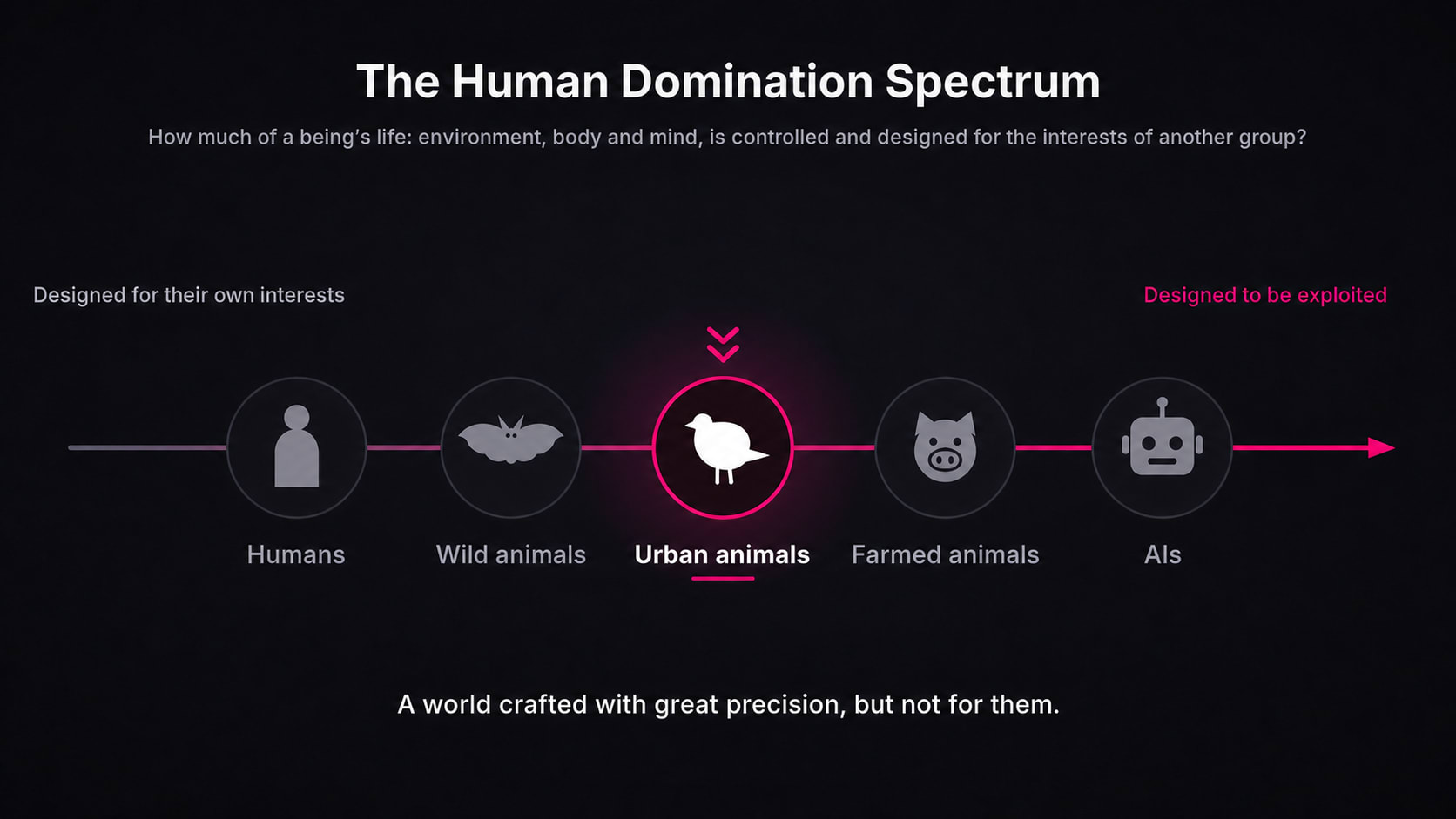
Urban animals sit in the middle of the human domination spectrum; they are not confined like farmed animals, but not living in an evolutionarily designed environment like wild animals. They live in an environment very accurately crafted, but not for them😔. Humanity doesn’t recognize that we live in a multi-species society, hence animals’ interests are a neglected or nonexistent part of city planning, infrastructure, and architecture.
What do Urban Animals Suffer From?
If we think about stray cats, most of them die very young, starve to death, suffer from disease, get hit by cars, lack safe spaces from heat and cold, and more. The infrastructure in the city, the food leftovers, and human behavior are not tuned to their welfare. The same causes of suffering (with some exceptions) also apply to pigeons, mice, rats, lizards and many other urban animals. Like wild animals, most urban animals don’t have any “services” to help them; they are akin to living in a collapsed state, with no social or security services.
Some examples:
Like urban cats, most pigeons are born into short, fragile lives: in one urban colony study, roughly 45% of baby pigeons died within their first month after leaving the nest (Hetmański 2007), with the main cause of death being hunger. In some cases there are surprisingly easy solutions for reducing the suffering of urban animals, like egg swapping, replacing eggs with dummies to reduce pigeon reproduction.
The urban environment is a dangerous place for animals, and poisoning is one such danger: Rethink Priorities estimates, with high uncertainty, that about 31 million rodents in U.S. urban areas are exposed to rodenticides each year, and rodenticide poisoning can cause days of intense suffering before death.
Animals passing through the city can also be helped; more than a billion birds, many of whom are migrating, die annually in the US alone from building collisions, and terrestrial wild animals get hit by cars.
Neglectedness
Urban animals seem like an effective group to work on from a macro perspective because they are very neglected (not including cats and dogs). The space doesn’t even have a clear well recognized name. Animals like mice, pigeons and reptiles living in urban areas are especially overlooked. A globally minded non-profit that tries to systematically change their lives on a macro scale, combining knowledge from experts in architecture, biology, and politics, is nowhere to be found, as far as I know.
Even for cats and dogs, for whom local initiatives are numerous, I didn’t find an effective macro level organization that tries to tackle systematic issues, e.g. a technical solution to prevent cats from entering the engines of cars.
Most neglected is the global, cross city, evidence first layer. Existing urban animal work is often local, fragmented, emergency driven, or species siloed. There is activity, but it is usually focused on cats and dogs and not on systematic solutions.
Organizations Whose Work Includes Neglected Urban Animal Species
Wild Animal Initiative funds many urban animal welfare research projects. This list includes more than 80 research projects it has funded, many of which relate to urban animals and show that the line between urban animals and wild animals is not always clear
The Center for Wild Animal Welfare works to help wild animals, including those in urban areas, by promoting bird safe glass, fertility control (instead of painful poisons) for mice and rats, and much more
Sentience, “invisible animals” campaign. An effective-altruism-style push focused specifically on urban pigeons and rats, demanding humane pigeon lofts and a rodenticide phase-out (see related EA Forum post on interventions to improve pigeons’ welfare)
The NYU Wild Animal Welfare Program is doing foundational research, including work on urban animals, and outreach. NYU’s WILD Lab is an applied research and outreach initiative dedicated to advancing the welfare of wild animals in urban environments. Their reports, Wild Animal Welfare in Local Policies on Human-Wildlife Conflict and Wild Animal Welfare in Local Policies on Land Use and the Built Environment, deal with city management from an urban welfare perspective.
PAZ, a French non-profit for animals, has a co-existing with liminal animals campaign
Single-issue specialists: Preventing Bird-Building Collisions across Canada, Eurogroup for animals guide to animal-friendly management of urban pigeon populations
Urban wildlife organizations: Urban Wildlife Alliance (a grassroots, all volunteer organization dedicated to the welfare of NYC’s wildlife), and research networks like UWIN. These are mostly framed as coexistence or conservation, putting less emphasis on individual welfare
Tractability
My intuition is that the influence activists can have on municipalities, and their ability to create change within the urban environments where they live, is greater than their ability to change the wild or even factory farming. In the city people actually come into contact with these animals and can help them personally, and many interventions can be a win-win for human and non-human animals. But this is just intuition, and a much deeper dive is needed, including interviews with activists who try to promote concrete interventions.
Examples of Interventions
My assumption is that most cost-effective interventions haven’t been thought of yet, since the space is neglected. Nevertheless here are a few known interventions:
Rat contraceptive bait instead of poisoning. Its efficacy is still debated. Banning second-generation anticoagulant rodenticides is a possible ask.
Bird-safe glass legislation: this EA forum post, “If wild animal welfare is intractable, everything is intractable”, mentions California’s rodenticide ban and bird-safe-glass rules already passed in ~22 US cities. But the story is much more complicated, see reasons against this idea section.
Place cat food higher to protect hedgehogs: Hedgehogs suffer from a severe form of scabies. One possible reason is that cat food left on the street attracts hedgehogs, bringing them into repeated contact at the same feeding spots. A simple fix is to place the cats’ food higher, where cats can reach it but hedgehogs cannot. Anyone who has seen a hedgehog with advanced scabies knows how awful it can be. Their bodies can become covered in thick crusts, sometimes so badly that their eyes are not visible.
Swap steady red tower lights for blinking ones. On the ~4,500 tallest towers (over 150 m) in the United States and Canada, which cause most of the deaths, this could cut kills by ~45%, about 2.5 million birds a year (phys.org; Longcore et al. 2012, PLOS ONE)
A rainbow ruff collar on cats. Birds see the bright colors and flee. This intervention caused the killings of birds, reptiles and amphibians to drop ~54%, while cats still catch rats and mice (study summary).
Promote adoption of self driving car technologies to detect and avoid animals, including small animals near or under the vehicle. One Chinese self driving car demo already shows an underbody camera that can help avoid hitting animals while leaving a parking space. This new organization, Shared Roads, is working for “a multi-stakeholder approach to self-driving vehicle safety that accounts for every being on the road”
Scale
Urban animals:
I didn’t find any global estimate of the number of urban vertebrates or invertebrates. My very initial estimate based on checking different AI estimates, which converge to similar numbers, is mostly extrapolation from some limited local data. It suggests there are 5-50 billion urban vertebrates at every moment, which is possibly more than factory farming (with about 30 billion at every moment). According to these estimates, urban animals are comprised of
a few billion, up to 10 billion birds
a few billion mice and rats
a few billion or less reptiles, amphibians and fish
~ a billion free-roaming cats and dogs
other urban mammals (including bats), probably less than a billion
Hence, urban environments are dominated by small birds, rodents (mice and rats), reptiles and amphibians, which are the neglected majority.
Confidence levels are low on those numbers. See the scale estimate for more details on these estimates.
55 percent of the world’s population, about 4.2 billion people, live in cities, and roughly seven in ten people are expected to live in urban areas by 2050 (UN DESA, World Urbanization Prospects). This means urban animal populations could grow as human designed environments expand at the expense of nature.
About 3% of earth’s land is urban, but this number is expected to keep increasing.
Wild animals passing through:
In the US alone, building collisions kill over one billion birds annually. Extrapolated globally, this points to something on the order of ~25 billion bird collision deaths worldwide each year, though that is a very rough guess and the extrapolation is probably false
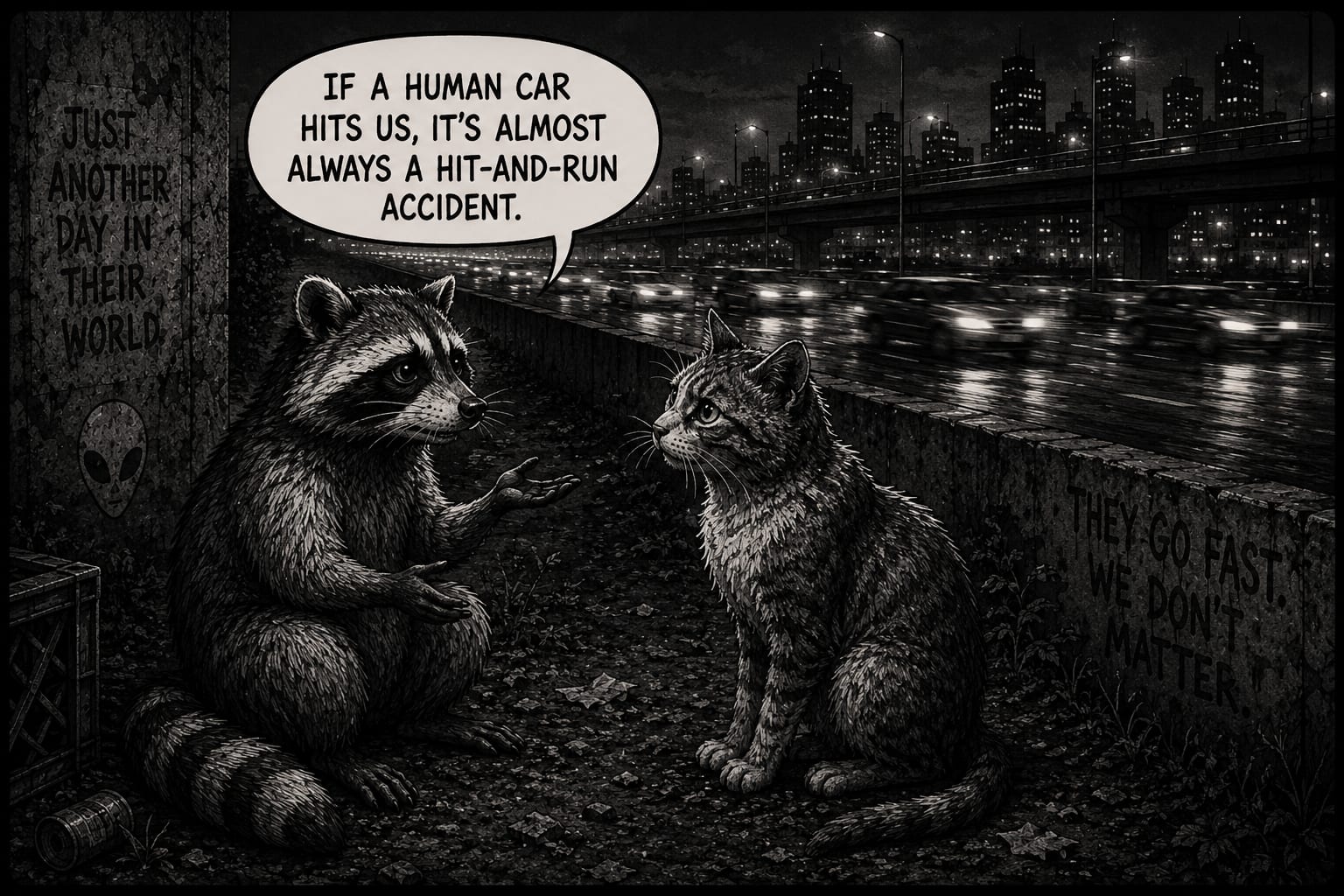
Roadkill: ~1 million vertebrates are killed every day in the US alone, according to an old study. Extrapolating from road network length (US ~6.6 million km versus ~64.3 million km worldwide (Wikipedia: road network size) gives roughly ~4 billion deaths a year, or about 2 billion according to another estimate on Wikipedia.
Vertebrates killed by urban cats amount to tens of billions globally each year: 1.3 to 4 billion birds and 6.3 to 22.3 billion mammals only in the US, but it’s unclear how many of these deaths are due to urban cats.
Overall guesstimation: Billions or tens of billions of animals live in the urban environment every moment, and tens of billions more die every year passing through. This scale is big, though much smaller than wild animals, and seems in the general order of magnitude of land farmed animals .
My assumption is that a deep dive into this subject may increase the estimated scale.
Urban Insects
How many insects live in urban areas? Probably less than 2% of all earth’s insects. It should be below the urban share of earth’s land surface, which is 3%, because cities suppress insects. A global meta-analysis found urbanization cuts insect abundance by about 42% versus conserved land.
Even 1% of the estimated 10¹⁹ insects globally is about 10¹⁷ insects, 100 quadrillion individuals living in and around human settlements, on the order of 20 million insects per urban human.
If we could design and carry out any interventions for urban insects, or any education project about them, the city seems to me like a very plausible place to start.
Reasons in Favor of This Idea
What are the benefits of a nonprofit dedicated specifically to urban animal welfare, compared with programs run by organizations with a broader focus that work on animals both in nature and in cities?
Although there may be many synergies between work on animals in nature and work on urban animals, as discussed in this section later on, cities are distinct environments with very different challenges. In urban environments, the main focus is reducing human-caused harms and designing cities that better accommodate the animals living in them
Urban animal advocacy avoids some of the philosophical difficulties involved in helping wild animals in nature. It could be much more consensual, and in many cases is aligned with direct human interests. I see no reason why urban animal advocacy can’t become something pretty popular and not controversial
I think the urban animals branding, together with the points already mentioned, can attract more funding and people into working in this space, and more broadly into the animal advocacy movement, including a significant portion from outside the traditional farmed and wild animal movements. Most local urban animal activists are currently quite far, in my intuition, from EA and animal rights, but they are potential candidates to come much closer
The direct effects may be very substantial:
Possibly roughly equal numbers of urban vertebrates and farmed land vertebrates may be alive at any given time
The urban landscape, where interventions can be more easily monitored, is like a simpler version of the more complicated fabric of life in nature
Helping urban animals directly helps humans (most people view reducing numbers of pigeons or mice, or fewer vehicle collisions with animals, as a good thing)
This space could potentially bring new money and people into the movement, not taking from existing resources (at least in the long run)
Mice, birds, and hedgehogs could be better served under one roof.
The flow-through effects seem huge to me:
Urban animals can be a bridge for compassion to all the animals, because they are not behind closed doors or far away. People can get to know some of them personally, and their stories are easier to track and tell, no one is hiding them like with factory farmed animals. When individual stories of urban animals are told, human hearts are affected. Ruti the hyena is only one example.
Work on urban animals promotes thinking about a multispecies society
Sue Donaldson and Will Kymlicka’s book Zoopolis (2011) argues for creatures who live among us (pigeons, rats, squirrels, raccoons) to gain the status of “denizens”, residents of our societies. They can be a bridge for animal personhood.
Urban animals can serve as a bridge for sympathy with wild animals, as both groups are free and in need of help. They also blur the line between categories, since some animals live both in cities and in the wild, and wild animals often cross through urban areas.
Work on urban animals can help us understand how to reduce wild animal suffering, possibly creating pilot experiments for animal friendly designed environments. Animal friendly designed facilities, streets, and landscapes can serve as a living example of a welfare space for all.
Some specific technologies to help urban animals, such as non-surgical contraception, can also help wild animals (and may be easier to push for in cities, where they help humans too, than in the wild).
The city could be a place to build a connection between humans and insects? Highly speculative. Also see urban insects section
Reasons Against This Idea
The scale is big but not huge like with wild animal suffering or potentially digital suffering
Some organizations are already working on it, mostly at the local level
Wild animal welfare organizations are already carrying out some interventions for urban animals. There may be no need to add another category and a dedicated organization when this field already falls under wild animal welfare, specifically urban wildlife. I think otherwise, and in the previous section have explained why
Urban animal welfare wants to protect predators like mice that may kill many other animals, so total expected value from interventions could be unclear (albeit interventions for mice can also reduce their numbers). The urban area is simpler than the wild, but it’s still very complicated. The post “Bird-safe glass may impact arthropods much more than birds?” raises concerns about the overall welfare footprint of the bird-safe glass intervention
The line between urban animals and wild animals is not always clear, as many animals live across both wild and urban environments
What the Nonprofit Could Do
Here are some possibilities:
Research and accumulation of all the worldwide knowledge about improving life for the urban multi-species society
Here are some research ideas:
How many urban animals are there worldwide? Existing research, such as Rethink Priorities’ abundance estimates for three relevant populations, could help answer this question. How many are vertebrates, how many are invertebrates, and, specifically, how many are insects?
What are the main causes of suffering for urban animals, and how do they compare to wild animal suffering from natural causes?
How many animals worldwide die from direct vehicle collisions, why does this happen, and which species are most affected? Answering these questions could help shape future regulation of autonomous vehicles and push the self-driving car industry toward technologies that better detect and avoid animals
The creation of human environments at the expense of wild ones: does it reduce the number of beings on earth? By how much?
Mapping different optional interventions and existing evidence for their effectiveness
Pilot interventions (based on the research) and helping local groups
Promoting the academic space of urban animal welfare, similar to how Wild Animal Initiative is promoting the academic space for welfare biology. This space is not the same as urban ecology
Bringing together experts from different fields to think about how to help urban animals, and supporting professional networks, such as Architects for Animals, that seek to help animals
The architect Dan Hasson argues that animals are the blind spot, the lacuna, of the architecture field. “Architecture is supposedly a humanistic discipline, but it revolves only around human beings. This practice does not see animals and does not think about them, even though planned spaces always affect animals as well. Animals are supposedly irrelevant” (source is in Hebrew)
Open Strategic Questions
How much emphasis should be put on promoting the academic study of multispecies urban welfare?
How much emphasis should be put on promoting new technologies versus working with existing ones?
What campaigns and coalitions for specific interventions can be very cost effective?
Is the main goal to improve urban animals’ welfare (better lives) or to change their numbers (fewer of them, especially those that die very young)?
Conclusion
Urban animals, beyond cats and dogs, seem to be highly neglected, despite the problem’s large scale and potentially high tractability. Although there is uncertainty about the numbers, the interventions, and their overall impact, urban animal work has the potential to serve as a bridge toward caring about all sentient beings, help wild animals, and bring new funding and people into the field. This makes creating a global nonprofit for urban animals seem to me like a highly effective intervention.
You can read more of my thoughts about urban animals on my website, The Alien Journalist. The main arguments are all in this post, but the website adds some color.
I love that you are thinking about this; it’s one of my favorite topics too! I just wanted to chime in and say Wild Animal Initiative is doing a lot more re: urban wild animals than just the one pigeon study you referenced. All 80+ research projects we’ve funded are listed here, and as you scroll through you will realize the line between “urban” and “not” is sometimes clear, but other times very blurry. For example, some projects specifically investigate the welfare of animals in an urban environment — that’s a clear yes. But many other projects investigate the welfare of animals that often live in urban environments, even if the study itself is not focused on the urban context. Those cases are relevant, because there are just so many research questions that need to be answered about species and about environments before we can confidently advocate for specific interventions.
We’re also in the middle of a field study attempting to validate vocalizations as indicators of welfare in urban house sparrows. But we don’t explicitly frame this as an “urban” study because the goal is to identify indicators of welfare that would be relevant to multiple species in multiple environments.
Just a few examples of how a lot of work can get done for urban wild animals without labeling it as such.
Thanks so much Cat! I will add this to the post, I see Wild Animal Initiative are funding many urban animal related studies .
What do you think about the branding of urban animals vs wild animals? do you see more gains in urban animals being inside the wild animals field, having their own “branding”, or perhaps both?
And where should we “put” the animals that are somewhere on the spectrum between urban and wild
Hey Ronan, I agree completely.
One small thing: I wonder whether it makes sense for urban animals to have a global nonprofit? If it is research-focused, then that makes sense. But urban animals always exist locally, and I could imagine it being advantageous for an org to adopt a local branding, e.g. “New York wildlife protection” or something like that. So maybe the solutions is actually many urban animal advocacy orgs, with some coordination and one international research organization to support them?
Thanks Tristan. I agree local branding has a big advantage for urban animals. The global org is there for the other half: research, and helping with collaboration, community, and connections between the local groups. It could also do some local interventions itself, based on its research and for a specific global purpose, in partnership with a local org. I think that is something to try and figure out later rather than decide now. Many global non-profits have local chapters too.
DC is piloting the rat contraceptive bait over a one-year-long study. Will be interesting to see how it goes. https://51st.news/dc-rat-prevention-trash-poison-birth-control/
I really agree with the idea of focusing more on urban animals. I have been thinking about pigeons in particular, because they seem like such a good example of the neglected animals you describe. They are everywhere and live closely alongside humans, but they often suffer because of human-created environments and receive far less attention than cats and dogs. I find urban animal welfare especially interesting because there seem to be many practical ways to help. Since cities are human-designed environments, we might have opportunities to reduce suffering through changes in policy, architecture, and management rather than trying to intervene in complex ecosystems
I agree cities seems like a very high potential grounds for effective interventions for EA people