I’m one of the Community Liaisons for the EA community (alongside Julia Wise, Charlotte Darnell, and Jonathan Mannhart).
I’m a contact for community health support for EA groups, and I also works on assessing and mitigating risks to the EA community.
I initially studied a lot of physics, then was a high school teacher for 11 years before moving full time into EA community building. I ran local and national EA groups and worked on EA outreach projects, before joining CEA’s Groups Team in early 2020 to support EA groups worldwide. I started working for the Community Health team mid 2021.
Catherine Low🔸
Karma: 4,562
If you’re an EA community organiser, you are also most welcome to contact me (Catherine from CEA’s Community Health team) if you’ve got any questions or concerns about the potential impact of this series on your local community. Our team might be able to brainstorm ideas with you and provide some advice.
Good push back Hazem!
Definitely some in the https://forum.effectivealtruism.org/groups are inactive, but there are also groups that haven’t put their details on this page, so it is hard to know. But on reflection my
> maybe a couple hundred EA University groups
is probably on the high side!
Some other numbers we know
- CEA currently has 72 university groups in the Organiser Support Program (the team are interviewing new organisers right now, so this number will probably increase soon)
- I was mostly anchored on the last time CEA did a detailed group census—and 200 uni groups was the ball park then. But now I look at it this was back in Dec 2022 so my anchor is really out of date.
https://forum.effectivealtruism.org/posts/aetatCMGqcAPsNbLs/growth-and-engagement-in-ea-groups-2022-groups-census299 EA groups [...] indicated that they are active.
Out of the active surveyed groups 150 were university groups and 25 were university/city hybrid groups.
Based on our records, we estimate that ~63 active EA groups (17% of all active EA groups) did not complete the census.
Hi Hazem, I’m Catherine from CEA (and a former group organiser).
I think is it really great idea to give LLMs context about running EA groups generally, and about your own EA group.
And thanks for linking to CEA’s Organiser Support Programme!
I just wanted to correct one thing:apparently, there are currently only seven “established” EA uni groups (established means very active if I understand correctly)
I believe there are maybe a couple hundred EA University groups around the world and CEA has has supported dozens of these groups in the last year (sorry I don’t have accurate numbers at my fingertips!). The website you linked is just the group supported by the NEST programme. There is no good up to date list of active groups, but this https://forum.effectivealtruism.org/groups has a lot of groups—some active some dormant.
But I agree with the point you made that
Too often, uni groups die
and that succession planning is important. And LLMs could help with that a lot!
Resources for group organizers on supporting a good culture
I’d really like it if AI resulted in amazing plant based or cultured meat, and that the general abundance coming from AI means that people can focus their thinking on morality, not just making their lives go okay.
BUT, so far, new tech and improved economical situations have caused farmed animal suffering to get worse.
So I have a big uncertainty, but lean disagree.
Thanks for sharing these Annika and Sam!
I’d recommend you (and anyone using these resources) check out the EA Groups Resources page on the approach to politics and polarised issues, so you can check out some considerations of when/how to raise such issues in your grouphttps://resources.eagroups.org/approach-to-politics-and-political-issues
It is important to know that, in the US (and lots of other countries)
charities or organizations funded by charities are NOT allowed to engage in political campaigning.
Includingfinancial support for a campaign, including reimbursing costs for people to engage in volunteer activities
endorsing or disapproving of a candidate, referring to a candidate’s characteristics or qualifications for office — in writing, speaking, mentions on the website, podcasts, etc.
Language that could appear partisan like stating “holding elected officials accountable” could also imply disapproval.
taking action to help or hurt the chances of a candidate. This can be problematic even if you or your charity didn’t intend to help or hurt the candidate.
Given most groups are funded by CEA (part of Effective Ventures which is a US charity), this applies to most EA groups in the US. It is probably also relevant for groups that might want to be funded by a US charity in the future.
Hi Yarrow, thanks for looping back on this.
Yes, we did do this project, which involved looking at existing data and doing some new interviews with community members, and looked at existing literature on women and non-binary people’s experiences in different communities, and what seems to improve things. Based on all this, we wrote an extended internal document, and shared some recommendations with a variety of EA organisations and EA groups. We think this information could be of use to more community members, but for some bureaucratic reasons a writeup hasn’t made it on to the Forum—sorry about that.
What a great spreadsheet. It gives me wonderful old-school EA vibes.
Do you have a fav seitan recipe?
I’ve made seitan 3 times. 1x failure, 1x fairly good, 1x amazing but really time consuming.
Correct! It is a great book!
When the world feels unstable...
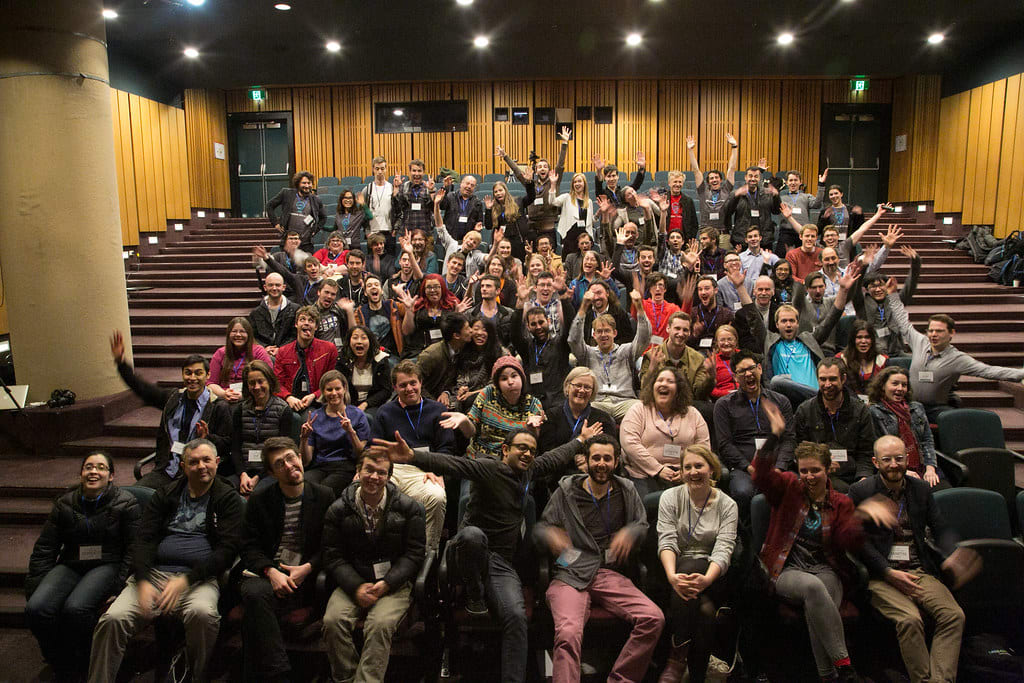
I look back fondly to 10 years ago at EA Global: Melbourne. It was small, simple, the catering was (literally) carrot sticks, corn chips and hummus, and it hugely influential to me. I knew no one before I arrived, but the conference photo shows many people I’ve gone on to work with and become close friends with.This talk was a highlight—I remember it bending my mind in ways it hadn’t been bent before, and it hammered home just how hard our mission to improve the world actually is:
The counterfactual attendances at EA conferences is a pretty interesting metric (at least for us at CEA) - I’m glad you’re tracking that.
Great to hear of all your progress over 2024 Gergő and Milán!
(And thanks for the thanks! In retrospect I think those initial meetings with EA Hungary might have been among my most useful meetings with group organisers!)
I’m thrilled to have an EA conference in my home town (thanks @Gavin Bishop 🔹 and @Ruben Castaing for leading this event)!
For those of you who are considering coming—a little (biased) plug from me:
The EA Christchurch and the EA Aotearoa New Zealand communities have been active for 10 years now, with a handful of very engaged EAs who have dedicated their careers to EA-aligned work of various types (community building, donation funnelling, civilisational resilience, AI safety, animal advocacy, probably other things too that I’ve forgotten), and many other engaged EAs have been involved in the past and have flown the coop for their high-impact careers. While our community is small in global standards I think we are pretty impressive by per-capita and by per-unit of resources invested. And we’re very friendly and supportive too! So it would be lovely to see people join us!
While the conference is just a single day, a few of us are planning to also have some more relaxed social activities on Friday night and Sunday, so try to come for the whole weekend if you can.
Nau mai, haere mai!
This is a great story of someone taking a selfless and high expected value bet, that sadly didn’t work out.
I’m grateful and impressed that you tried so hard to make the donation happen Santeri!
I hope Mikko gets a new kidney ASAP, and that you both experience excellent health in the future.
Depopulation is Bad
I think humans are good. And larger groups of people can do a lot more (more innovation, more cultural activities, more variety of human experiences).
Right now, in 2025, I would not advocate for more people due to animal welfare and environmental costs of having more people.
But looking at the many countries that have gone through a very demographic transition to less-than-replacement fertility (and all the other countries that seem to be following a very similar trajectory), I’m worried that the population will plummet shortly after it hits peak.
I’m not sure what to do about it. And I’m worried about governments/other people in influence increasingly trying to increase fertility in ways that reduce individual freedom.
Thanks for those analyses Lorenzo! I was aware of the claims that people don’t tend to be good at knowing what makes them happy or unhappy (thanks to an old 80K article!), but it didn’t occur to me that this could have influenced this data.
With this in mind it seems fairly possible that the real distribution should be more negative. Despite that, I still feel that the data feels like a positive update for me.
a) There are just quite a few people reporting that being in EA is good for their mental health—and I don’t want to doubt that too much (but maybe that is hopeful thinking on my part)
b) Also, before the survey results came out I expected that a larger number would report negative impacts as I had heard many people in the community reporting to me that EA had negatively affected their mental health (which is expected given my role), and I’d also heard some community builders tell me that they felt that EA was often bad for members mental health (which worried me a lot more).It would be interesting to ask people in comparable groups, the same question of how involvement changed their mental health—if the distributions were a lot more positive or negative than EAs then that would be interesting. Maybe environmentalism or animal advocacy would be a reasonable comparison group as involvement might also give a similarly increased sense of awareness and obligation.
Turns out Rethink Priorities have been funded by EA Funds to work on something that could shed some light on this question. I’m looking forward to hearing how they get on at gathering survey respondents and seeing the results they get.
I’m really not sure.
I do think it is likely that many people get exposed to EA and realise it isn’t a great space for them personally, and choose not to engage as a result. These people won’t have filled in the EA Sometimes those people might not be a good fit for EA anyway—they have different priorities or values in their lives. But I expect some would have been very value aligned and gotten a lot out of being involved, so that is the group I’m worried about.
The Rethink Priorities data makes me (tentatively) a little less worried that a large number of people spend a couple of years engaging EA (and so fill in the survey) and find it too rough for them and then leave (and don’t fill in subsequent surveys). I DO think this happens to some people. But if this was a very large pattern I would expect community member who had been around longer to say it is more positive for their mental health, whereas the data points gently in the opposite direction.
I don’t know whether active community members are more or less likely to fill in the survey if they’re having a rough time in EA. I think it could go either way.
This sounds plausible. Unfortunately I don’t think we or Rethink Priorities have this data to do this breakdown at the moment.
Hi Laura,
We know that this has been a difficult experience for you.
I’ll give some information publicly here and also send a message privately to you. As you may be aware there are some constraints about what we can share publicly.
I can assure you that our team has reviewed all the information you’ve sent us very carefully, and taken that information into account. As I’ve previously said to you, we’re open to revisiting our decisions if you have new information to send us.
On the Community Health team’s role
We listen to and sometimes act upon complaints from the community. Here is the Community Health team’s website if you want to learn more about what we do.
CEA has the right to admit people (or not) to our private events for a variety of reasons. Nearly all of the time that people are rejected from EAG, it’s because their application doesn’t meet the EAG bar in some way. But sometimes we do reject people due to concerns raised by other community members. The EA Global FAQ has got some more information.
Sometimes we reject people without asking them for their point of view on the concern raised. This can happen for a variety of reasons, such as:
We don’t have permission from people who raised concerns to tell the specifics.
The concern is sufficiently clear or serious that information from the person is unlikely to change our decision.
Sometimes there are conflicts between two individuals in the EA space, and we review those situations on a case-by-case basis.
Most of the time we just advise the people and don’t reject anyone from events.
Sometimes we reject one person, sometimes both, and occasionally we make arrangements so that the two people involved attend different events.
We are always open to getting more information. We regularly admit people to conferences who we’d previously rejected, either because of new information or because we feel the downsides of admitting that person have gotten smaller over time.
We’re no longer sharing private information outside of CEA
In the past some EA organisations (including EA groups) could come to us about people they were thinking of giving opportunities to. If we had any information relevant to the opportunity that we had permission from the source to share, we might pass that information on. We no longer do this and we haven’t done so for over a year. This sharing was so that community leaders could make more informed decisions about who to give what opportunities to, with the aim of improving the wellbeing and impact of the whole EA community—not just CEA spaces.
We knew it was possible that people may feel pressured to take certain actions because of the information we shared, but we tried to reduce that risk through steps like making it clear that the final decision was theirs. Often we’d offer advice on multiple ways they might handle the situation, like how they might reduce downsides if they did offer the opportunity.
As Laszlo commented, the 2024 EA Germany summer camp organisers chose to give us a list of applicants and we did pass on some information about Laura. We explicitly told the organisers that it was their decision, and that if they chose to go ahead with offering the opportunity, there might be ways to reduce risk and we’re available to help brainstorm ideas. But it is very possible that we still made the organisers feel pressured to make a particular decision.