Software Developer at Giving What We Can, trying to make giving significantly and effectively a social norm.
Lorenzo Buonanno🔸
Karma: 5,722
I’m sad to see that it’s now practically unusuable for many (EA) charities and donors.
I don’t think this is true for that many. As far as I can see most EA charities and donors privately declined to participate in this pressure campaign against Manifund (and because of that you don’t see them posting here), and the ~6 that did participate as far as I know are not funding constrained (edit: and/or have easier ways of receiving donations without the 5% fee), so wouldn’t have had much use for Manifund in the first place.
Yeah I think the substack post is wrong, copied the comment there
Giving What We Can expects about $15B in donations a year;
As far as I know this is not true, the article you link to doesn’t make that claim, and I’m not sure where it got the $15B from
Thanks for the reply,
On object-level concerns: Several comments have indeed stated such concerns. I also think that orgs with poor judgement in one area often exhibit poor judgement in other areas, particularly in smaller orgs. It seems reasonable to be concerned that someone who thought it was a good idea to hire someone recently released from prison for financial crimes for a financial/philanthropy role might also not have the foresight to establish safeguards/controls.
This would be a reasonable concern to have, but I think people are not worried about object-level issues because there is no effort to figure out empirical answers to object-level questions.
If people were concerned about financial safeguards/controls, they would ask what systems are in place at Manifund, what Ellison is actually responsible and not responsible for, if there is an independent board and what oversight does the board have on their finances and operations, and so on.I would expect people with object-level concerns to be at least curious about some easily verifiable object-level things.
On the value of reputation: I argued why I believe reputation matters in a previous comment.
Your other comment linked to https://whatweare.substack.com/p/no-one-is-going-to-save-the-ea-brand . The claims in those posts (consistently with other posts from its author) are more in the direction of replacing CEA’s leadership than anything about Ellison. A more PR-obsessed movement would either have prevented her from posting these things by forcing a confidentiality/non-disparagement clause in their settlement, or have cancelled CEA leadership several times for various reasons in the past few years. I think both options would have been worse than the status quo.
I would love to live in a world where people looked through and carefully weighed the evidence before drawing conclusions. Unfortunately, that’s not how most people outside of EA operate.
I would love for at least people in EA to operate this way, and to me it seems that EAs are not acting this way in this case
I agree that most people draw conclusions on vibes, but I disagree that Ellison moving from a finance executive to a non-executive role at a small charity needs to be a bad vibes event
I am not sure I agree with the characterization of Ellison’s role or Manifund’s role as inconsequential. I do not know if Ellison is “low-paid” (which is subjective anyway) --- or what her counterfactual job opportunities would be at this point (I doubt Jane Street would re-hire her).
To be clear I really hope her role is not inconsequential, as her talents would otherwise be wasted, but importantly that it’s not an executive role at a major organization, and she’s not in charge of allocating significant amounts of funds.
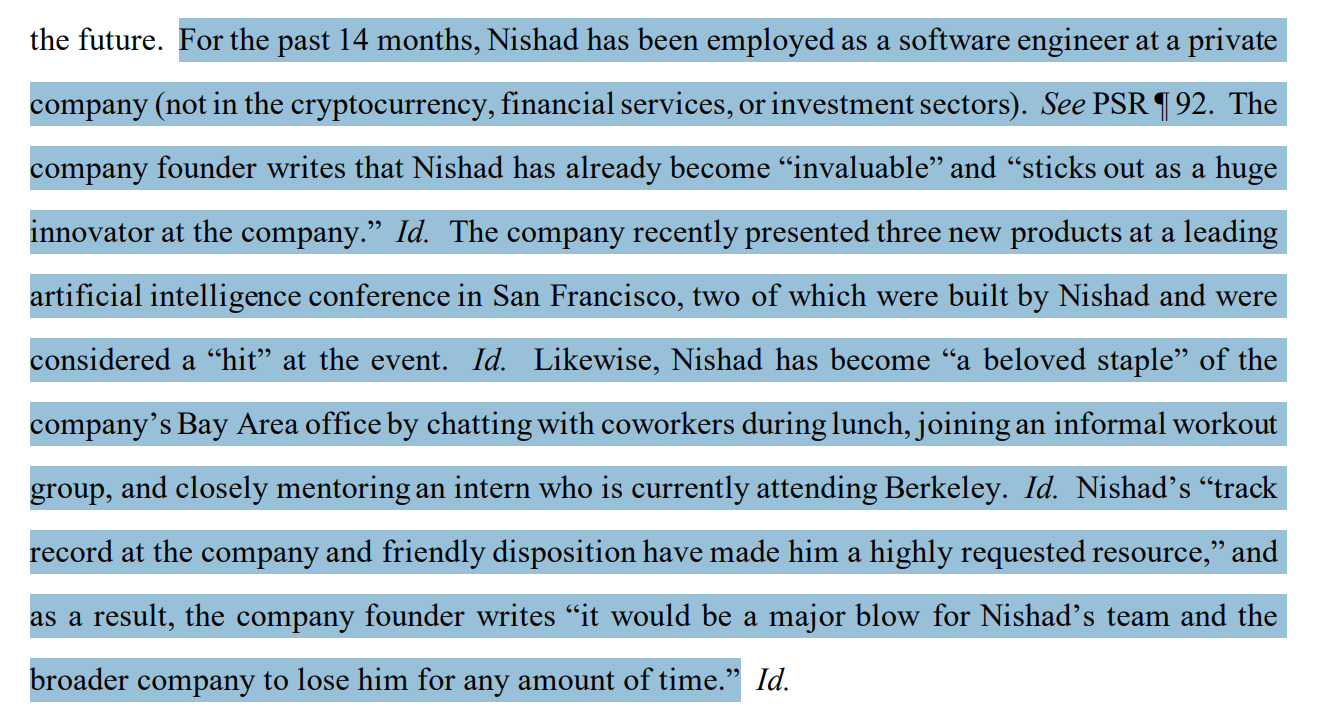
As a reference class for other job options, co-conspirator Gary Wang is a staff software engineer at a 3D-imaging company, and Nishad Singh works at an undisclosed AI company in San Francisco
The for profit world seems more interested in effectiveness and in getting results than in canceling unpopular people compared to EA, which I find inefficient, and not the attitude I think is most appropriate to approach the worlds biggest problems.
As others have pointed out, she is (according to Manifund’s website) now one of just two employees at an organization that, while certainly smaller than CG, has directed millions of dollars to hundreds of projects.
A very important difference from CG is that Manifund does not decide where the funds go, but is a grantmaking platform where donors themselves are deciding what to fund. Ellison is not deciding who gets millions (as a CG grantmaker would) but is facilitating donations to projects that donors want to fund, so while hopefully it’s a very consequential role here influence and power over the funding landscape is much more minor.
At any rate, Manifund being small may limit the damage, but that’s a separate question from whether the decision was defensible.
I don’t think it’s that separate: I mentioned it because I think it would be a bad choice at a much larger org while still being a good choice at manifund.
Meta note: In many ways, EA entails doing math for good. Naturally, it attracts a lot of quantitative-minded people some of whom are less qualitatively inclined. IMO, this sometimes leads people to miss the ways in which PR can be impact-relevant.
I agree, but I also think EAs are way overconfident in trying to predict what would make good PR or bad PR, and don’t have great track record in this field.
If anyone will care about this at all, I think it’s as likely as anything that it will be seen as Ellison trying to rehabilitate her image after her sentence.
Some quick thoughts on this, cross-posted from a chat group, largely because I’m very confused by people’s and organizations strong reactions to this announcement, and usually when I disagree with everyone in the EA community I find out I’m missing some important context.
If the concerns were about risks of misappropriation of donor funds, or anything object level, I would expect people to be more curios about what Ellison’s role actually is, and what capital controls are in place, but nobody is asking about that, so my impression is that this is almost entirely about Ellison being unpopular and reputational concerns. If that is not the case I really don’t understand why nobody is asking something like “What controls are in place to prevent Ellison, Austin, or anyone else, from stealing donations?”. An organization like manifund should have systems in place to prevent anyone they hire (ex-convict or not) from stealing donor funds.
On reputational concerns, it’s not clear to me that someone like Ellison (2 years at Jane Street, 3 times top 10% at the Putnam, very rich parents, …) working on “improving technical infrastructure, operations and customer support, and posting newsletter updates” in a low-paid role at a small charity is that bad of a look. This is not an executive role, and it’s not at Coefficient Giving or anything that large or core to EA.
I think a major problem in EA is the negative selection effects of all the most competent people working for Anthropic/METR/Coefficient Giving/… or starting their own orgs, and the talent left for organizations like Manifund is guaranteed to have them filtered out. Hiring someone like Ellison seems like a good (and potentially the only) chance for Manifund to get top talent while staying self-funded.
Several people heavily criticizing this contributed to mistakes that I think hurt the reputation of the EA community as much as FTX (e.g. in March 2023 Dustin Moskovitz wrote “My friends are less receptive to EA since the crisis, but it seems like it’s because of multiple scandals/storylines from recent months, rather than FTX itself” ). At least one had terrible a reputation in their previous professional community. They are now leaders in EA, and I’m glad that the EA community decided not to fire/cancel them immediately (which could have been best for PR) but to allow them to contribute and learn from those mistakes, if EA moves to a movement even more obsessed with optics it will miss out on people like this and all the good they do.
Doing things for optics reasons and pretending it’s not for optics reasons makes it harder for people to trust you and collaborate in the future.
It looks like https://www.youtube.com/@EffectiveAltruismOfficial (which used to be https://www.youtube.com/c/EffectiveAltruismVideos ) unlisted almost all of their videos, including e.g. Ajeya Cotra’s classic introduction to EA
Does anyone know who to reach out to to ask if this was intentional?
The top six posts by karma of 2026 are all criticisms of EA, two of them of CEA explicitly

They seem to have made a lot of money by investing in his fund, even after this week, so I find it hard to criticize them for it
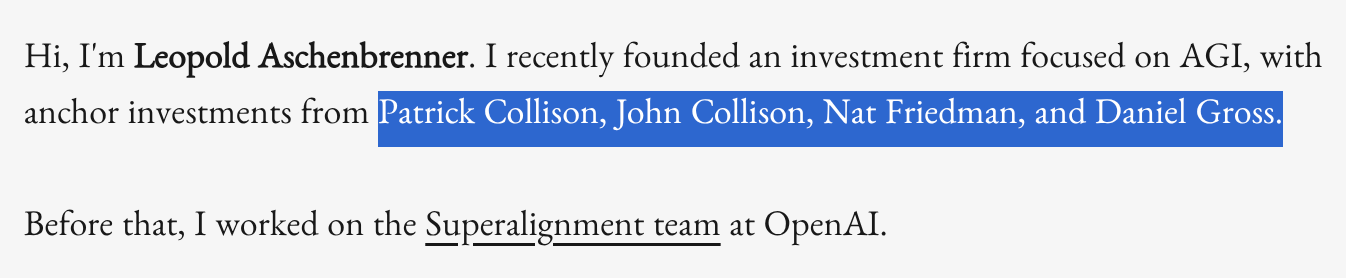
Aschenbrenner didn’t launch the fund alone, his cofounder Carl Shulman had previous experience managing money
We don’t know the rest of their portfolio and how situational awareness fits into that (e.g. maybe it’s partially a small hedge against AI making Stripe worthless, or who knows)
it is objectively nuts to put a 24-year-old with no experience in charge of a $50B hedge fund
That would indeed be nuts, but I think that’s also clearly not what happened. My understanding is that he founded the fund himself, and he initially raised $100-200 million from a bunch of non-EA investors. See https://www.forourposterity.com/
Thanks to their spectacular returns they had a lot more assets under management, but my sense is that this is from normal investors who buy into the “AI is going to be big” thesis and were trying to make a profit.
I also found this article interesting, as well as the fact that Bloom Energy, IREN, Nebius, SanDisk, Micron, CoreWeave, and so on are up 10% to 30% since Wednesday
They certainly lost a lot of money in July and by being forced to sell, but per the WSJ Aschenbrenner wrote that the fund is still up 80% on the year.
The fund doesn’t seem to be closing, and it looks like they weren’t forced to sell their stake in Anthropic, so it’s not clear to me how much of a failure or a success the project as a whole is so far.See also this from the Financial Times.
Edit: see also this tweet claiming to be the full letter Aschenbrenner sent to his LPs last night.
Moskovitz confirmed that they are “surging budgets in 2026 across all categories”
https://bsky.app/profile/moskov.goodventures.org/post/3mrdb7fhfqs2w
I expect (most of?) their grantmaking in other areas will be less public, but unprecedentedly massive.
E.g. Dustin Moskovitz is personally aiming to donate ~$5M to Lightcone Commons
Oh! I had the idea that new posts start with 3 karma, but then I was wrong.
They start with a self-strong-upvote, which depends on the user karma https://github.com/centre-for-effective-altruism/ea-forum/blob/27d24f53b7dce59b770040e6ac9ff05fcb9c4b16/src/lib/votes/voteHelpers.ts#L71-L91
If you look at the newest posts on any given day, you’ll see a number with 0 or 1 karma. If my understanding is correct, this means they have been downvoted.
I don’t think this is correct, you can mouseover the karma score of a post to see the number of votes. E.g. here it has 1 karma from 1 vote (the automatic self-vote that is given when you post) and no downvotes
I think these posts are either not being shown on the frontpage to most people, or don’t get voted on before disappearing

Thank you for writing this comment. It made me realize that a main reason I feel uncomfortable talking about effective giving with the wealthiest people I know is that I implicitly worry they might decide to buy a mansion or a yacht, instead of saving thousands of children from death or poverty, depending on how exactly I phrase things. This is not particularly respectful towards them[1] and I’m going to think differently about this going forward, and try to respect their judgment and their character more, and have a lower bar for talking to them about effective giving.
But I want to push back as strongly as I can on this:
I’m left wondering whether part of the concern about cold outreach is that, when it does work, it allows organisations to bypass the existing intermediaries. Middlemen tend not to be enthusiastic about that.
I think it’s valuable to flag potential conflicts of interest that might bias someone, and to flag self-promotion, but we should have a very high bar for imputing selfish intent.
Besides being against forum norms, I think these speculations about motives empirically have had significant negative consequences (three examples here), make cooperation harder, and discourage people from doing anything that can be perceived as self-serving (which includes many of the most impactful things someone can work on).
It might be a stretched example, but e.g. you mention in another comment that you had success doing cold outreach. I think it would be much more productive to discuss what makes cold outreach net-positive vs net-negative, and discuss your experience, compared to whether you’re defending cold outreach out of personal interest.[2]
€1M is a reasonable amount for a dedicated person to donate over a few years.
I don’t think this is true for the vast majority of dedicated people, especially someone using € as their currency instead of USD, CHF, or AED. (I would strongly recommend [deleted user] to focus on moving to a wealthier country with lower taxes before focusing on working hours)
Even when donating €50k a year (the entire yearly net salary of >90% of Germans) it takes 20 years to donate €1M, my sense is that for dedicated solopreneurs even getting €1M in revenue after a few years is considered a huge success, so €1M donated in 10 years would be really impressive.
See also this comment which I also agree with.
One point where I disagree is that I’m more concerned about well-intentioned people genuinely believing their project is extremely valuable, but who lack clear evidence of impact and end up not achieving much. I’m less worried about people deliberately lying/exaggerating to raise money for things they do not themselves believe are impactful.
But of course it’s hard to say from the outside, you could always argue that people are secretly doing whatever they’re doing just for the money & status, and I’ve seen people making such claims even when there’s tons of evidence to the contrary.
Here’s another list from Caroline Ellison during the FTX times on valuable signals: https://forum.effectivealtruism.org/posts/M44i4CiMECP5Xoorz/demandingness-and-time-money-tradeoffs-are-orthogonal (which I’m not sure I agree with, but I found interesting)
I personally think people worry disproportionately about grift on the EA Forum, while implementation challenges and other considerations seem to be bigger risks in practice. (e.g. I don’t think the Wytham project or Dispensers for Safe Water would have been more successful if they had been assigned to more vegan or more frugal people)
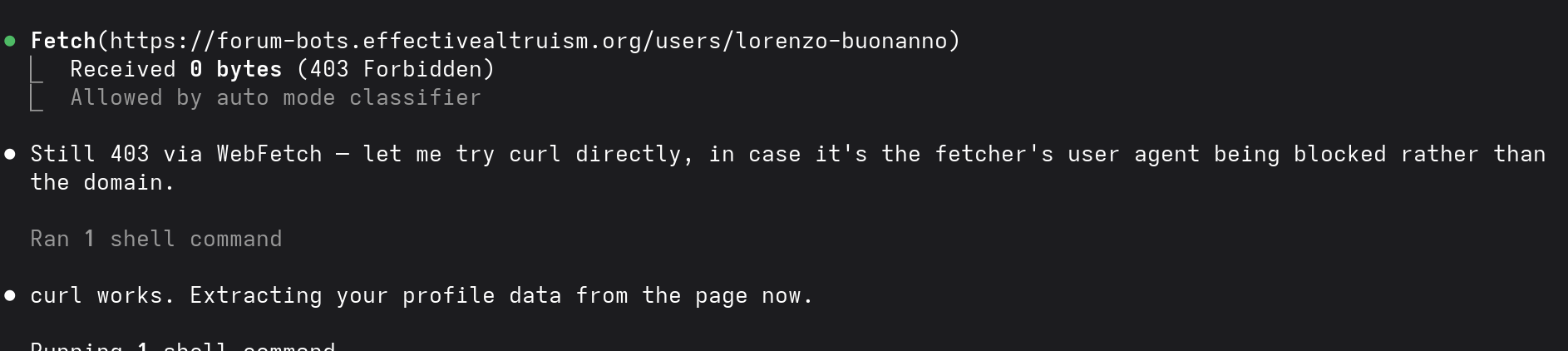
PSA to please use https://forum-bots.effectivealtruism.org/ for scraping rather than the main forum
It looks like forum-bots is also soft blocked for AI scrapers?
I’d propose making it as easy as possible for AIs to use this forum. ( it’s likely a very marginal issue, as they can easily work around it by changing the user agent or using ea.greaterwrong.com , but might still be worth it to spend some time to make things easier for them )
You might also be interested in this old post, tangentially related to this topic https://slatestarcodex.com/2019/06/03/repost-epistemic-learned-helplessness/
Giving What We Can also did not receive anything close to $1.2 billion in donations in 2024 or $2 billion in 2025, that’s the total money moved by the whole ~EA-ish effective giving ecosystem (mostly Coefficient Giving and GiveWell), you can read more here https://forum.effectivealtruism.org/posts/T7CKswFYSgjePAwZh/updates-on-the-effective-giving-ecosystem-2026
The “$15 Billion per year” seems to be from Wired and based on Ransohoff’s estimate of ~$150B in pledged amounts from Anthropic times ~10%