I created this account because I wanted to have a much lower bar for participating in the Forum, and if I don’t do so pseudonymously, I am afraid of looking dumb.
I also feel like my job places some constraints on the things I can say in public.
I created this account because I wanted to have a much lower bar for participating in the Forum, and if I don’t do so pseudonymously, I am afraid of looking dumb.
I also feel like my job places some constraints on the things I can say in public.
This is fun and long enough to really enjoy it!
Why do you spend your time writing negative comments about fun articles instead of community building and being welcoming to people?
Exciting! This sounds like a great initiative, and I very much look forward to seeing what kind of research will be produced here!
As someone from an AI governance org, I think collaboration on certain topics definitely makes sense, and I also hope that this new organisation can play the same role of thought leadership that I think many governance orgs have benefited from with Forethought.
This sparks many questions. For one thing, I’m curious to hear why this work doesn’t fit into Forethought anymore. Are they changing direction?
I’m also very curious to hear who exactly will be the target audience of the research that you’re hoping to do?
Has anyone at CEA ever looked systematically at the near-misses: the people who came to one or two meetings and never came back? The success stories are striking, but without some comparison group it’s hard to tell how much is the group’s doing and how much is that ambitious people at those universities end up in those roles regardless. Even an informal follow-up on the handful of drop-out names you can still remember would say something.
Not that I need this to be convinced, the anecdote here is striking enough, I’m mostly just curious.
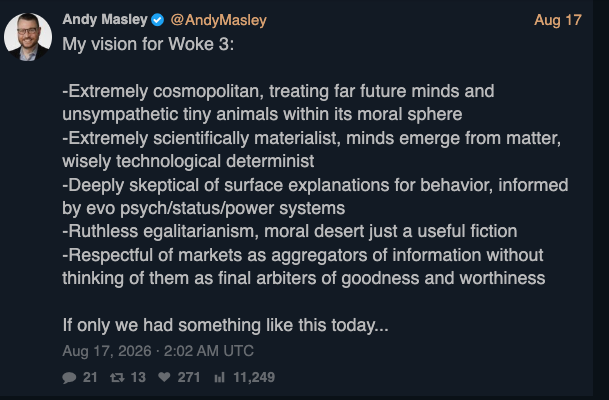
⬆️ The future we are all dreaming of!
(I hope sharing of what is essentially a meme is allowed here)
Out of curiosity, where are you hosting this for free?
This is only part of the point you are making, but worth pulling apart: the Omnibus processes, which have slightly deregulated AI, are a different thing from the fast-tracking and permitting of data centres, which as far as I understand has received no interest from the US government.
I’d also add that the authors want Europe to stay economically competitive through using AI, whereas the US government is looking out for its own companies. And yes, some of the AI Europe adopts will be American-owned. But if that adoption keeps the EU economy strong, the two aren’t necessarily in conflict.
Hi Sarah! I have more to say on this, and this comment may sound more dismissive than I intend it to, because I don’t have the time right now to respond in full (and I’ll be honest: I can’t promise I’ll make the time later either).
But a few things I’d say for now:
1. The scenario is a story, and all narrative scenarios are. It is not presented as inevitable, otherwise there would be no point in writing it. It’s a possible world we could end up in if nothing changes in Europe. The point is not to paint a full analytical picture; the point is to change minds and inspire action. So I don’t think it’s quite right to hold it to the standard of a rigorous analytical exercise: it’s a different tool for a different job. The fire alarm is not the same as the fire-safety report. Of course the questions you raise are absolutely legitimate and important to discuss, but I would put back to you: have you actually seen less of this kind of discussion since Europe 2031 came out? Or has it sparked more debate about how to generate European agency, and what we should use that agency for?
2. The scenario clearly describes itself as having a narrow focus on purpose. The scenario is exclusively about maintaining European agency, and says nothing about how to use that agency once it has been achieved or strengthened. But that is a scope choice, not a statement of what the authors care about. The FAQ addresses your concern almost directly:
We realise our scenario focuses almost exclusively on European sovereignty, and only briefly touches on many other aspects of the AI transition, some of which are arguably more pressing. This was deliberate. We believe Europe must preserve its agency and leverage if it is to do anything at all, which includes mitigating AI risks.
We embarked on this project partly because we think a more empowered Europe will, on the current margin, lead to a safer and better AI transition. Europe has a strong track record as a defender of fundamental rights and values, including in AI. We strongly support the AI Act’s General-Purpose AI Code of Practice, and the EU’s expert-led process that led to it. We believe a strong Europe can act as a more responsible and positive-sum counterbalance to major powers, while a weak Europe can’t.
We have spoken candidly about AI security and safety before. To avoid any misinterpretation, let us be very clear: we believe there is a serious chance that advanced AI goes badly wrong, whether through cyber- or biological misuse, extreme concentration of power, or a failure to align AI systems with human values. In the worst cases, this could lead to human extinction or its permanent disempowerment.
These risks are widely discussed, including in authoritative works like the International AI Safety Report. Our story is by no means an attempt to dismiss them. Rather, we hope to empower Europe so that it can, among other things, mitigate these risks from a position of strength.
3. On power concentration and international coordination: These are super important, but you can’t do much about them without agency. Europe being “AI colonized” and losing its agency to a handful of foreign companies and states, is itself one of the forms of power concentration the scenario is trying to get Europe to defend against. Building European leverage is, in part, a hedge against exactly that concentration, as well as a way to gain the agency to combat other problems.
For a nice description of how unreasonably effective this kind of fictional account can be, I’d recommend this post too.
I think this is a great initiative, and I’m happy that you’re pursuing it. But I think it is particularly impressive how much amazing design work went into this website!
Just wanted to say: I read this when it was first posted and I still come back to it regularly. Really grateful you shared this.
One of my very minor complaints about EAG is that they give out T-shirts that I would not normally want to wear in daily life. I now have three (admittedly very nice) pyjama T-shirts from conferences. This is nice! But I would love to have a simple shirt with a small logo that I can wear in everyday life, not just at home. It would actually get more exposure than the current T-shirts do!
For inspiration, a subtle range of T-shirts from Cortex. Just imagine the small heart-lightbulb there!

I agree that Amsterdam is a good option, but if you are interested in AI policy, Brussels now has a very active ecosystem, most of which is quite EA-oriented. Oddly enough, this is completely separate from the Belgian EA ecosystem.
Can you share how you have set this up?
Thank you!
Hi @Peter Wildeford , It has been a few years, but I hold your opinion in pretty high regard and I was just wondering: To what degree do you stand by the lessons of this book (with or without skimming your own post again)?
Thank you for your post! I think it is essential to consider how charity interacts with power dynamics and the risks of neocolonial approaches, but this did make me think of a point in this kind of critique that consistently puzzles me.
You write:
The final, and perhaps most foundational critique, is that EA interventions are too often designed from the outside —based on what donors or researchers believe is effective— without meaningful consultation with the people these interventions are supposed to help. The result, critics say, is not just technocratic or impersonal, but paternalistic: a form of help that is imposed, rather than co-created. If poor people are experts in their own needs, who is in a better position to know what would help them? And if effective altruists genuinely want to improve lives, why not begin by amplifying the voices of those they aim to support?
I live in a wealthy country, yet I often appreciate when problems are solved for me without needing my direct involvement. The underlying critique here is valid: local knowledge is invaluable, and listening to those affected will usually improve interventions. As a general heuristic, amplifying local voices makes sense.
However, when I consider how progress works in my own life and in developed countries more broadly, the picture looks different. Many improvements I rely on exist because experts, not locals, prioritized technical knowledge and scale. The water from my tap meets WHO standards rather than being based on local opinion. My appliances result from global competition that identifies expertise wherever it exists. Healthcare is guided not just by local doctors, but also by national and international bodies that assess quality and effectiveness. Medical breakthroughs often arise from global expertise rather than local insight. These examples illustrate that relying solely on local perspectives would leave wealthy countries significantly worse off.
This raises a question: why do we hold global development to a standard of strict localism, when wealthier societies themselves achieved prosperity by leveraging expertise wherever it was found? The principles that drive progress in developed nations, identifying and scaling the best solutions, are directly relevant to tackling global poverty.
Of course, this approach should not override fairness or safety. If interventions risk active harm or require sensitive political trade-offs, local input is crucial. But many EA-funded interventions—like reducing worm infestations, malaria, or lead exposure—are a lot like the water from my tap: technocratic precisely because they avoid contentious political questions. These are large-scale problems that individuals cannot realistically address alone, yet they have minimal local opposition when implemented effectively.
In this sense, I think EA is often more systemic than critics acknowledge. It focuses on solving deep-rooted problems through scalable solutions, much like the systems that underpin prosperity in wealthier countries.
Yes! 😄 Some of us are working on exactly this!
That said, there are also a few caveats:
- At the moment it is actually the Dutch government, not the EU, that is responsible for export controls and which places ASML is allowed to export to and what kinds of restrictions need to be put on that.
- Increasingly, things like export controls are also bypassing European jurisdictions because the U.S. is applying ever more control over the entire supply chain through new legislation that gives them the right to implement export controls on products that contain only a relatively small amount of U.S.-made goods. On the other hand, that is obviously not total control, and the fact that the Atlantic alliance is not in the strongest shape right now might actually indicate that the EU might be willing to move more independently on this in the future.
- Unfortunately, there is much less awareness of the long-term geopolitical importance of AI in EU capitals. So the theory of change most people working on this now follow is something like: first raise awareness of this being an important issue, simultaneously raise awareness of this being a leverage point in the chip supply chain, and then start advocating for these regulations.
- ASML is also a company that might threaten to relocate to a more permissive jurisdiction. Now, I don’t see that happening very quickly, but it is worth thinking about as a consideration.
I’m still figuring out how I feel about all of this, and I’m not yet sure how it should change my behaviour. But I wanted to say that this post has stayed with me since I read it, thank you for writing it.
I also find it quietly reassuring that Mjreard, of all people, is engaging with this topic; someone I think of as unsentimental, focused on what truly matters, and a sharp critic of ideas. I’m not sure I entirely endorse the comfort I take from that, but it does make it feel more socially acceptable to be concerned about these shifts too.
Interesting idea! This got me thinking about this, and I think I find it tricky because I want to stay close to the truth, and the truth is, I’m not really a “moderate EA”. I care about shrimp welfare, think existential risk is hugely underrated, and believe putting numbers on things is one of our most powerful tools.
It’s less catchy, but I’ve been leaning toward something like: “I’m in the EA movement. To me, that means I try to ask what would do the most good, and I appreciate the community of people doing the same. That doesn’t mean I endorse everything done under the EA banner, or how it’s sometimes portrayed.”
My only critique of this post is that if you are going to share this excellent post, then do let people know you have a blog and they can subscribe to your work there!