Gaslit by humanity
Hi all,
This is a one time cross-post from my substack. If you like it, you can subscribe to the substack at tobiasleenaert.substack.com. Thanks
Gaslit by humanity
After twenty-five years in the animal liberation movement, I’m still looking for ways to make people see. I’ve given countless talks, co-founded organizations, written numerous articles and cited hundreds of statistics to thousands of people. And yet, most days, I know none of this will do what I hope: open their eyes to the immensity of animal suffering.
Sometimes I feel obsessed with finding the ultimate way to make people understand and care. This obsession is about stopping the horror, but it’s also about something else, something harder to put into words: sometimes the suffering feels so enormous that I start doubting my own perception—especially because others don’t seem to see it. It’s as if I am being gaslit by humanity, with its quiet, constant suggestion that I must be overreacting, because no one else seems alarmed.
“I must be mad”
Some quotes from the book The Lives of Animals, by South African writer and Nobel laureate J.M. Coetzee, may help illustrate this feeling. In his novella, Coetzee speaks through a female vegetarian protagonist named Elisabeth Costello. We see her wrestle with questions of suffering, guilt and responsibility. At one point, Elisabeth makes the following internal observation about her family’s consumption of animal products:
“I seem to move around perfectly easily among people, to have perfectly normal relations with them. Is it possible, I ask myself, that all of them are participants in a crime of stupefying proportions? Am I fantasizing it all? I must be mad!”
Elisabeth wonders: can something be a crime if billions are participating in it? She goes back and forth on this. On the one hand she can’t not see what she is seeing:
“Yet every day I see the evidences. The very people I suspect produce the evidence, exhibit it, offer it to me. Corpses. Fragments of corpses that they have bought for money.”
But then again she thinks that she is the odd one out:
“Calm down, I tell myself, you are making a mountain out of a molehill. This is life. Everyone else comes to terms with it, why can’t you? Why can’t you?”
Why can’t others see becomes why can’t I accept it. The latter is, of course, the wrong question. Ultimately, Elisabeth knows that: she knows that she is seeing what others should see too, but can’t, or won’t. For any animal person, this position can be deeply disorienting—even tormenting. Coetzee’s formulation of this sentiment is powerful:
“We are haunted by what we do to animals, but we are equally haunted by how unhaunted others are”
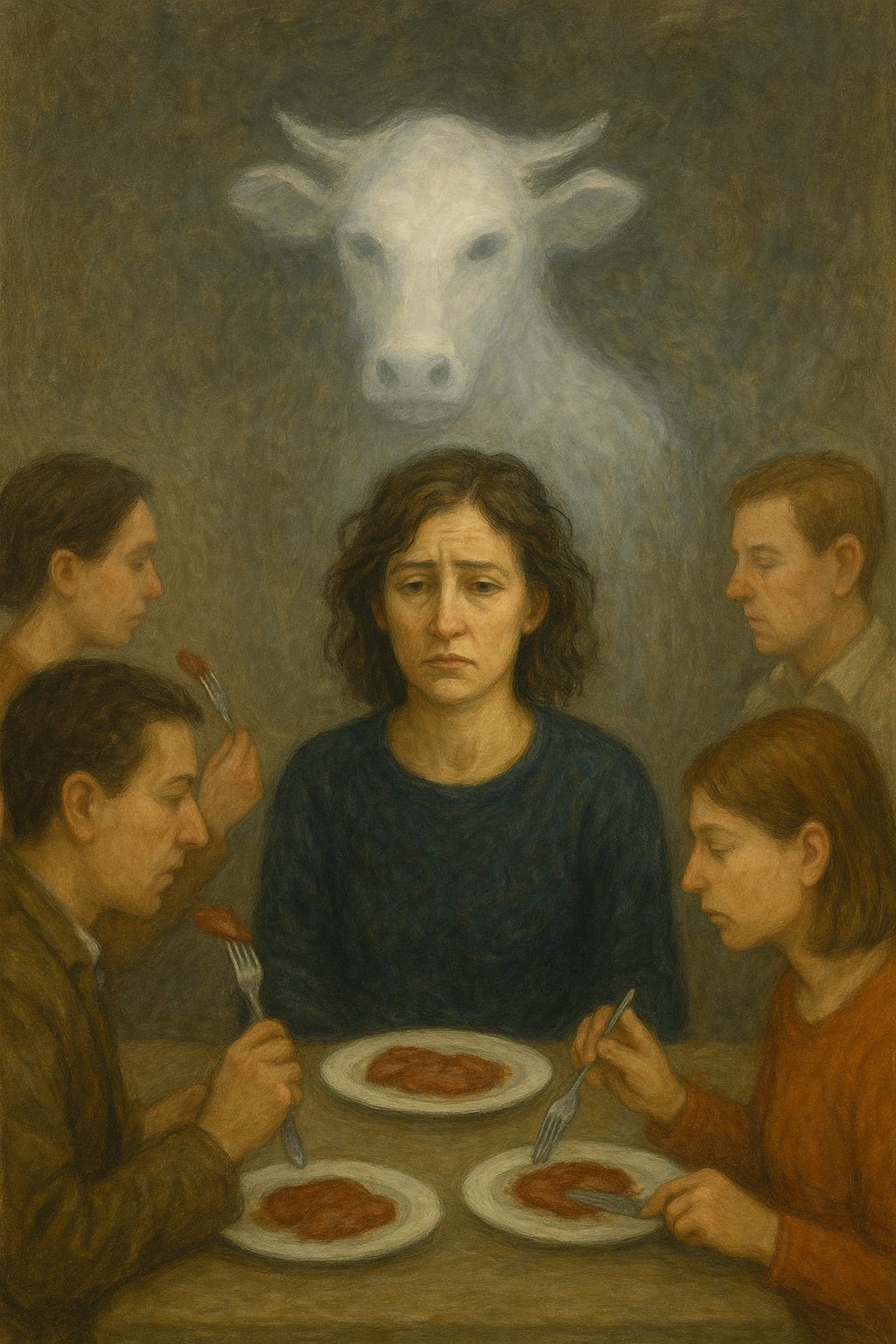
This absence of hauntedness is structurally reflected in the meager resources we have at our disposal to solve the issue of farmed animal suffering: the total global budget for all advocacy campaigns for chickens, pigs, cows and fishes is estimated at a mere 300 million dollars. That’s less—as Open Philanthropy’s Lewis Bollard commented—than what Harvard University spent on the renovation of one of its residential buildings.
Why are they so unhaunted?
While it’s haunting to see others so unhaunted, it is at the same time not so difficult to understand. For one thing, when people see others not responding to something and simply accepting it, they tend to assume that indifference is appropriate.
Apart from this vicious circle, there are other reasons for people remaining unhaunted. Powerful forces work to keep them from seeing the horror. The meat industry spends much more time and money on keeping the suffering out of sight than on trying to address and alleviate it. But the main reason, of course, is that people are not willing to see the suffering, not only because it is in itself quite uncomfortable, but also—and perhaps more so—because they know that honestly facing it could force them to change things they don’t want to change. Their convenience, their continuation of their culinary and other comforts, and also their peace of mind depend on them NOT looking.
Making compassion easier
It is tempting to scream in people’s faces and hold a laptop with cruel images in front of their eyes, but we know by now that that is not enough. If we want people to be haunted by what humanity is doing to animals, we must first make it safer for them to look. That means changing the environment so that seeing leads to hope, not helplessness.
As I’ve argued in my book How to Create a Vegan World, it is crucial that we lower people’s dependence on animal products by making great, affordable alternative products available in any restaurant, cafetaria or supermarket. The more positive plant-based taste experiences people have, the easier it will be for them to open their hearts and minds. Attitude change, in many cases, follows behavior change. That is the way we make compassion easier.
Thank you for letting yourself be haunted, and for helping haunt the world awake.
This is a one time cross-post from my substack. If you like it, you can subscribe to the substack at tobiasleenaert.substack.com. Thanks
A moving and disturbing book. The “fragments of corpses” excerpt continues with Elizabeth saying to her (non-vegetarian/vegan) son:
As someone who ignored the pleas of my vegan sister for many many years, I have been on the gaslighting side I guess (and now feel awful about it). Then I discovered EA and became vegan, so I think there is something here about how different arguments work for different people. But, I do still really find it confusing the most people don’t care about animal suffering—I am now so totally 110% convinced, and I don’t even like animals very much, so how do animals lovers still eat meat???
I’m the same way. I don’t like animals all that much, I find them kind of gross and annoying tbh (especially farmed animals), and my favorite food ever used to be bbq, by a wide margin. But even someone like me is still able to recognize they don’t deserve to suffer for me, and stop, so how is it so hard? I feel like I’m not even all that compassionate either
i find this very interesting. so would you say you come by the idea of avoiding animal products mainly by reason alone?
I left religion, and had to explore ethics/morality beyond “whatever the bible says is right”. I went in a pretty utilitarian direction, and then arguing with my dad about how you can have morality without god, he said “but wouldn’t that include animals too?” And I initially said yes, any reasonable moral framework should be able to tell you that e.g. kicking dogs is wrong, but thinking about it more got me to veganism.
it’s definitely not reason alone, I really don’t like suffering/pain, so I’m probably more emotionally against it in general (i.e. even when it’s not me experiencing it) than a lot of people?
I will say too that I don’t dislike all animals, I like hanging out with some cats and dogs
I think it was more having the arguments put forth to me by people I thought of as more rational (my sister tends towards the dramatic in general*, I think that made it easier to avoid her arguments). But yeah having numbers and data definitely helped, and adding in the climate change POV rather than solely focussing on the more confronting animal welfare aspects. Its like, that got me over the cognitive dissonce and then once on the other side all the animal welfare arguments could suddenly sink in.
*not to be too harsh to my sister, we were also just teenagers and sisters are annoying haha, but once we were older, for actually implementing the diet in my life, she was very very helpful :)
I have been feeling this strongly over the last year, the tension between the horrible large-scale suffering and everyone around me including my loved ones taking part in it and not seeing through it. Talking about it with other animal advocates has been bringing me some relief, thanks for writing this post!
it can be crazy-making :-)
I can totally understand your feelings. I am a musician and with my songs, I try to point on these problems and reach people from the emotional side as well.
Staying in the animal welfare world, I want to share some experiences with my song “Number in a Cage”. The song is about a female chick that experiences the first hours of life, witnessing her brother to get shreddered. When we play the song on stage, I am acting what this little chick experiences and my whole band acts mechanical as the factory surrounding.
Audience reactions are very diverse.
1) people who come to me after the show saying “Finally someone who understands that and points it out. I guess you are vegan as well?”—so those that feel seen.
2) people have trouble to digest the song. We often experienced people not clapping immediately after the song and trying to process what they just have seen. If things go well, they reflect and take sth out of it. If things go bad, they push it away and just continue their lives as if never been confronted with that.
3) people who avoid us due to our not so easy to stomach-songs. The worst was a concert where people became completely icy after that song towards us and when we continued with a song about tolerance and not letting refugees drown in the Mediteranean Sea you could feel the atmosphere was kind of hostile. We didn’t sell a single merch item that night.
4) people who don’t get it at all and just find the playful chick-motive funny, happily dancing around.
For us, this led to discussions on which concerts we could play which songs without being so confrontational that we loose the audience completely. It is a serious problem. Both lyric-and musicwise, I want to be progressive, not just walk the “easy to stomach, easy message, easy, catchy hooks”-way. But if you are so out of the box for most of the possible audience, the reach is super low. Only to reach group 1 (and musically group 4) audience is nice for giving them hope and feel seen, but not the goal of writing such lyrics. I want people to think about the issue who aren’t on that path yet. But to create the group 2-environment and not loosing too much to group 3 feels like a hard to hit balanace.
In addition, I often feel kind of desperate. I am doing the poisonous comparison to the reach of easy to stomach-songs vs my art. Even the comparison inbetween my songs—our love song always is spotify algorithms darling while those that feel really relevant to me have a way poorer reach. So it feels to me like: Do my thoughts and my art really have a resonance, a space here? Is it trying to move windmills with my breath? Is it kind of self-punishment to stay with my messages and believes, as I keep myself from more career success with restricting my audience? So I am in a constant back and forth between a fighting and a desperate spirit.
thanks Janika. I understand the dilemma. sometimes even just with social media posts, it’s the easy ones that go far and the ones that are deeper, more meaningful, more challenging… that don’t.
(is there a video online somewhere of you chicken song?)
True, that social media frustration is very real for us as well. “Happy Christmas” and a picture with a friendly smile has more interactions than the new release we worked on for months and years or a more philosophical post. Feels completely stupid. If we would just constantely post bikini pictures of our female band members, we would definitely rise more attention. But we would also have a way lower/different connection to our followers. I think one shouldn’t just look at the numbers, but also how much is just social media noise and how much is a meaningful connection. How many people did you really touch and influence. In the end, those have a way higher value for the overall mission. Nevertheless, reach is a problem—when the meaningful content drowns in the noise, it is harder to reach the people. When paid ads are the only medicine to cut through, it binds ressources—and, in addition, companies also optimise your ad possibilities to their advantage. E.G. META used to have the possibility to cap how often one person gets the same ad and silently removed the function at some point because it resulted in ads that couldn’t be delivered when your targeting was narrow. As a result, you now pay for one person getting your ad 20 times in that scenario. Also filters don’t always work as you expect it—otherwise I can’t explain that band members get the ads delivered despite the configuration not to deliver to page followers or, my absolute favourite, me getting delivered my own ad and getting charged for it.
Edit says: You asked for a video of the song, the music you find on any streaming platform, I link you the website as the lyrics are there as well: https://molllust.com/music/2015-in-deep-waters/ (Number in a Cage)
Video: I realized that videos are only online from the acoustic version where acting is way less (especially due to me playing the piano all the time instead of running around on stage), but I found a small excerpt live in a best off-video of a show, I linked the time stamp:
Thanks for the post, Tobias. I feel slightly similarly with respect to many people caring about farmed animals largely seemingly neglecting effects on wild animals. I would be curious to know your thoughts on the possibility that increasing animal farming is beneficial due to increasing the welfare of soil nematodes, mites, and springtails more than it decreases the welfare of farmed animals.
hi vasco, i can see the parallel too yes, often thinking about vegans: you complain that meat eaters don’t see the suffering, but you yourself can’t see the suffering in nature...
As to animal farming being beneficial re increasing the welfare of the creatures you mention: I’m not sure about the experiences of those small animals. If it’s a matter of increasing their numbers, I hold more of a person-affecting view re population ethics so more doesn’t mean better for me. Thirdly, i feel the suffering of farmed animals is so clearly terrible that i’d need a lot of certainty on this before I’d think it’s a good thing for other organisms. But i saw you posted something on this—which i still have to read.
Thanks for the reply, Tobias.
I am not sure I understand. I can see the suffering in nature in the sense I acknowledge the suffering of wild animals. I think increasing animal farming is beneficial because it decreases the suffering of (wild) soil nematodes, mites, and springtails much more than it increases the suffering of farmed animals.
It is the opposite of increasing their numbers. I think people who care more about decreasing the number of future negative lives, relative to what is implied by classical utilitarianism, should be even more in favour of increasing animal farming. I estimate eating 0.1 kg less of chicken meat decreases the living time of chickens by 2.87 animal-days, but increases the living time of soil nematodes, mites, and springtails by 6.16 M animal-years for feed crops replaced with temperate grasslands, savannas, and shrublands[1], which is 783 M times as many animal-years. The increase in the time of suffering is so large that I estimate it is enough to outweigh the smaller suffering per animal-year of soil animals. For that same replacement, I estimate the increase in the net suffering of soil nematodes is 4.81 k times as large as the increase in the net suffering of the directly affected animals (broilers).
Because temperate grasslands, savannas, and shrublands have more soil animals per unit area than feed crops.
sorry, with the “you complain that...” i was addressing imaginary vegans-who-don’t-get-the-WAS-thing, not you :)
I’ll read your article first before going into this further. Definitely an interesting question.
Thanks! I look forward to your thoughts. As a side note, I read your book How to Create a Vegan World: A Pragmatic Approach around 5 years ago, and I really liked it.
glad to hear that :)
This post is about emotions and the strange disconnect between something which seems obviously bad yet people can’t see it. Don’t think this response is relevant to this post.
Thanks for the feedback, Nick.