Might Intense Agony Be Widespread?
Humans are capable of experiencing very intense agony. But how widespread is this capacity in the animal kingdom? How many animals can experience intense pain? In this essay, I will argue, from both theoretical and experimental considerations, that capacity for feeling intense agony might be quite widespread. It may be that even the simplest creatures capable of suffering can suffer intensely. This essay was largely based around a piece I entered in an essay contest, hence the higher-effort citations.
1 Introduction
Humans can experience quite intense agony. If a human is stabbed, set on fire, or drowned, they suffer a great deal. But are other creatures capable of similarly intense agony, and if so, which ones? This is a question that has been surprisingly neglected, despite considerable research into which animals feel pain.
Here, I will argue for what can be called the widespread agony thesis. This thesis simply holds that the capacity to feel intense pain is quite widespread, being present in crustaceans like shrimp and lobsters; insects like ants, flies, and bees; and fish. If this thesis is correct, humans constitute only a tiny fraction of the conscious organisms capable of intense pleasure and pain. Intense pain could be present in every species whose consciousness is seriously debated.
This thesis is quite important if true. Humans kill around 25 trillion wild shrimp every year for food and farm about 440 billion (Waldhorn & Autric, 2023). About a trillion insects are farmed and killed annually (Rowe, 2020). Tomasik (2016a) estimates that the average human prevents about 14 million years of insect life through their annual environmental impact. If the creatures we affect in staggering numbers are capable of very intense pain, that has quite significant implications. Indeed, it may mean that the impact that we have on the suffering of non-humans far exceeds the impact that we have on the suffering of humans.
I do not claim that this thesis is overwhelmingly likely. It could, for all I know, be false. But I claim that given the huge implications that this thesis has if it is true, it deserves quite a bit more investigation. So long as the thesis is merely plausible—which I shall argue it is—this has quite significant ethical implications.
This article will have several sections. Section 2 will present general considerations favoring the presence of ubiquitous intense pain in animals and address general arguments against the notion that intense pain is widespread. Section 3 will provide a case study, analyzing evidence of intense pain in fish. Section 4 will analyze evidence of intense pain in crustaceans. Section 5 will analyze evidence of intense pain in insects. Then, section 6 will conclude.
2 General considerations
Typical practice towards shrimp, fish, and insects seems to take for granted that they do not suffer very much. Few think that when they swat a fly, there is a remote possibility that the fly experiences anywhere near the amount of pain that a human would from being crushed to death. Yet what justifies this confidence? In my view, there are several independent considerations which make this confidence unwarranted.
The first concerns our general uncertainty about consciousness. We do not have an agreed upon theory of consciousness. There isn’t even agreement about whether consciousness is physical or non-physical (Schneider & Velmans, 2017). Consciousness is arguably the thing that science has given us the least insight into, and some have even daringly proposed that we will never solve the mystery of consciousness (e.g. McGinn, 1989).
This uncertainty gives us some reason to be suspicious of very low estimates of animal consciousness. As an analogy, if we do not know much about some particular class of aliens, we should not confidently declare them to be very small. Similarly, if we are highly uncertain about consciousness—as, indeed, we are—that is good reason to not be very confident that various creatures only suffer mildly. This analysis is somewhat complicated by two-envelope questions. I plan to write a post at some point explaining why I don’t think that those considerations, but for now, see St. Jules, 2024.
Our uncertainty should also make us suspicious of arguments that proceed from a specific theory—say, the integrated information theory of consciousness—to specific judgments about the pain-capacity of animals. The standard theories of consciousness are largely silent about how intensely animals suffer and even whether creatures with very different brains from ours are conscious (see Birch, 2022). In light of this and our high degree of uncertainty about which theory of consciousness is correct, it would seem premature to let this majorly influence our judgments about the intensity of valenced experience in animals. More general views of consciousness like dualism and panpsychism don’t have any direct implications on the intensity of suffering in non-humans.
The second argument is behavioral: even simple animals, when injured, behave as if they’re in a lot of pain. Suffocating fish thrash around with great force. Lobsters being boiled alive struggle, rather as one might expect you or I to do if we were boiled alive, as David Foster Wallace (2005) famously noted in Consider The Lobster. Lobsters show heightened neural activity for quite some time after being boiled (Birch et al., 2021)—once again, as one might expect if they were in pain. Though we typically don’t notice because they are small, insects often behave similarly (Qu et al., 2022).
If a creature behaves dramatically, as would be expected if it were in intense pain, we should think it’s reasonably likely that the creature does, in fact, feel intense pain. If we came across aliens struggling and thrashing when boiled, it would be reasonable to think with decent odds that they feel quite intense pain. If this is so, we should accept a similar inference with regards to simple animals.
A third consideration is evolutionary: there is every evolutionary reason for simple creatures to feel intense pain. Pain in humans causes them to avoid various behaviors that are likely to be harmful. Pain in fish, insects, and decapods serves similar functions. We should expect intense pain in these creatures to be adaptive for the same reason that pain in humans is adaptive. If a creature just felt mild discomfort, that would be unlikely to sustain the kind of behavior needed to safeguard survival. Intense pain could be adaptive for eliciting rapid and dramatic behavior.
For this reason, we should expect evolution to take various shortcuts to allow even simple creatures to feel rather intense pain. Thus, if it’s in principle possible for simple creatures with few neurons to feel intense pain, then it’s decently likely that actually-existing simple creatures feel intense pain. Given that humans can feel very intense pain despite only a small share of our neurons being responsible for its production, we should expect a brain efficiently geared towards producing pain in response to noxious stimuli to efficiently perform such a feat.
A fourth reason simple creatures might suffer intensely has been proposed by Dawkins (2011): the purpose of pain is to teach a creature a lesson, to get it to avoid certain activities. If a creature is simpler and has less great cognitive capacities, it might need more pain to teach it a lesson. It may be that intense pain is needed for a creature to remember its agony in the long-term. Only intense pain would leave a lasting impression on such a simple creature. This would also accord with findings that simple creatures like crabs (Fernandez-Duque et al., 1992), fish (Sneddon, 2015), and insects (Giurfa, 2015) can remember unpleasant experiences and avoid them.
A fifth argument for pain being intense in simple creatures: perhaps pain intensity is more a function of the share of an organism’s cognitive architecture spent on pain, rather than the absolute processing power spent on pain (Tomasik, 2016b). For instance, imagine a creature with only 10,000 neurons, but all of those neurons were spent processing pain signals.
Plausibly, such a creature would feel pain more intensely than a creature with 10 million neurons, where only 10,000 neurons were spent on feeling intense pain. For the first creature, pain would occupy its entire consciousness, while for the second it wouldn’t. The most intense pain occurs when pain occupies the entire conscious field of the sufferer, like during brutal torture, so that they can focus on nothing else. If simple creatures routinely have almost their entire cognition taken up by pain, then perhaps their pain is of similar unbearable intensity.
To give an analogy from Merker (2016), the mechanism of replication works as well in DNA with short sequences of base pairs as with long and complex sequences. Perhaps the neural structure underlying consciousness is similar, and can be produced with significant intensity despite fairly simple neural architecture. Or to give another analogy, while simple creatures likely tend to have less developed higher-order processing related to vision, they still have the ability to see objects with decent proficiency. Perhaps conscious abilities are similar—simple conscious creatures can feel reasonably intense pain states, just as they can have reasonably developed visual faculties.
A sixth consideration: historically, humans have underestimated sentience in animals. Prior to 2002, when nociceptors were discovered, it was widely believed fish had no nociceptors (Sneddon, 2015, p.968). Throughout the 1980s, it was widely thought that animals weren’t conscious, and veterinarians routinely ignored their distress. Similarly, it was widely thought that newborns were not conscious (see Anand & Hickey, 1987 as well as Birch, 2024, p.194).
If we notice a widespread pattern of error, we should worry that we are making the same error. This gives us a reason to suspect that we underestimate the consciousness of simple creatures. If consistently humans have underestimated the consciousness of things different from us, that should lead us to suspect that we might be underestimating the consciousness of animals (particularly when the main reason people think simple creatures aren’t intensely conscious is from direct intuition).
A seventh argument (see Tomasik, 2016b) is a variant of the argument from marginal cases. The argument from marginal cases was popularized by Singer (1975) as an argument for taking animals seriously. The core idea is as follows: suppose there’s some trait used to argue that animals should not be afforded significant moral status. If we imagine a human with that trait, then presumably we wouldn’t deny them moral status. For instance, if it is suggested that animals are on the menu because of their diminished mental capacities, this would seem to imply that humans with similarly diminished mental capacities (babies, for instance) were similarly morally unimportant. But clearly, this is an unacceptable result!
A similar argument can be employed against many of the objections to significant pain in animals. Animals have relatively simple brains. But if we came across a human with a comparatively simple brain, who seemed to respond aversively to external damage the way animals do, we would be hesitant to be confident that its conscious experience is only mild. We should have similar skepticism directed towards arguments for such conclusions about animals.
The eighth and final argument for taking seriously the suffering of simple creatures: the most detailed report to date which attempted to estimate intensity of valenced experience in animals guessed that even simple creatures were, in expectation, intensely conscious. This report came from the team of Fischer et al. (2024). Using a mixed function taking into account various different behavioral proxies, the final estimate (p.233) was that shrimp suffer 8% as intensely as humans and carp 24% as intensely. The median estimate was that shrimp suffered 5% as intensely as humans.
Using a more integrated model that took into account even more inputs (see Duffy, 2024, table 2) their mean estimate was that shrimp suffered a whopping 19% as intensely as humans, bees 14.8%, and carp 17.5%. The median estimate from that other model was 7.1% for bees, 8.1% for carp, and 2.9% for shrimp. And while the authors emphasize that you shouldn’t take the numbers super literally or treat them as highly precise, they do provide rough order-of-magnitude estimates.
The methodology for the report was as follows: they first tried to ascertain the evolutionary function of pain. There are three main theories of the function of pain (Schukraft et al. 2024, p.164):
Pain functions to enable organisms to learn. If some experience is pleasurable, an organism repeats it. If the experience is painful, the organism learns to avoid it.
Pain serves as a common currency. When comparing different actions, pain can give a single axis along which to compare them.
Pain might disincentivize behaviors that are bad for fitness. If an organism dies, for instance, that will be bad for its fitness, so evolution makes death painful.
On each of these theories, there should be various proxies of pain. For instance, if an organism made motivational trade-offs between pain and reward, then that seemed to indicate that the organism had a cognitive representation of painful stimuli. If an organism demonstrated greater associative learning in response to painful stimuli or greater anxiety after a painful stimulus, that seemed to be behavioral evidence that it was in more intense pain. If, for instance, pain serves as a common currency, then we should expect organisms with greater associative learning to feel more pain, because their brain more vividly represents external damage.
Taking into account a range of these behavioral proxies, as well as various proxies for the brain’s information-processing capacity, they compiled a series of estimates of the intensity of valenced experience in animals. Now, of course, these proxies were far from perfect. But this is by far the most detailed estimate of animal consciousness to date. In light of this, we shouldn’t find results broadly consistent with its findings to be wildly implausible.
There are various considerations that might lead one to be skeptical of this thesis. A first argument purports to show that these animals aren’t conscious at all. Brian Key (2015) and James Rose (2002) have suggested that fish (and this argument would generalize to crustaceans) are not conscious because they don’t have a cortex. Key and Rose argue that a cortex is needed for human pain and that because other animals lack a cortex, we should assume they do not feel pain.
The literature has not been kind to the Key and Rose thesis (for criticisms see, among others Braithwaite & Droege, 2016; Broom, 2016; and Dinets, 2016). First, many have argued that a cortex isn’t needed for pain in humans or other mammals (see, e.g., Merker, 2007). Panksepp et al. (1994) show that rats without a cortex go on to play mostly normally and display seemingly conscious behavior. Such a theory would also imply that octopi aren’t conscious, despite their complex behavior, which includes a tendency to play (Kuba et al., 2003) and likely dream (Godfriey-Smith, 2017). Octopi also behave, in various ways, as if they’re in pain (see Birch et al., 2021).
Second, even if a cortex is responsible for human pain, there could very well be other structures that give rise to pain in other creatures. Arms and legs are needed for humans to swim, but this doesn’t mean fish can’t swim because they don’t have arms and legs. In fish, for instance, the hippocampal homologue might sustain consciousness (see Zacks & Jablonka, 2023). Similar things may be true of the mushroom body in insects (see Heisenberg, 1998) and the hemiellipsoid body in decapod crustaceans (see Crump et al., 2022).
For these reasons, it seems clear that one should have significant doubt that the cortex is needed for consciousness. But if one is uncertain in this thesis, then it does not significantly undermine the probability that simple animals suffer intensely.
A second reason people often doubt that simple animals feel intense pain is that they have very few neurons (see, e.g. Budolfson & Spears, 2020 for discussion of this method). The argument goes that because animals have vastly simpler brains than humans, with many fewer neurons, they are probably not very conscious. Now, it’s unclear exactly why one would be confident that few neurons leads to mild pain. As discussed before, intense pain might be the sort of thing that doesn’t take many neurons to maintain, just as a basic visual system doesn’t take many neurons to maintain.
Such an argument would seem to have odd consequences. Elephants have more neurons than humans, though not more impressive cognitive capacities (see Hart et al., 2008). Despite this, presumably they do not have more intensely valenced conscious experience. And when humans lose many neurons, so long as their brains perform similar functions, we don’t normally think they are vastly less conscious.
Shriver (2024) provides a number of reasons to be skeptical of neuron count proxies. The biggest challenge is that it doesn’t fit with evidence from neuroscience (p.114). Neuroscientists haven’t identified anything like a robust correlation between neuronal activation and intensity of valenced experience. In various cases (p.116) there was an inverse correlation between intensity of valenced experience and thickness or activation level of brain regions. The more significant effect comes not from the number of neurons but instead which patterns of neurons are active—thus, in simple creatures, so long as their brains execute the right sorts of functions, experience could be intense. Indeed, neuronal activation is not empirically adequate to settle the question of which of two people has more intense pain (p.125).
Shriver additionally notes (p.119) that it would be quite strange if merely adding extra neurons without changing the broad functions they performed increased valenced experience. If redundant neurons were added that didn’t change which functions were performed, it would be surprising if this increased the intensity of valenced experience. Any amount of neuronal activation can, in principle, produce precisely identical behavior and computations (p.127). For this reason, it would be odd if neuron count on its own, without producing new functions or different behavior, significantly affected the intensity of valenced experiences.
Neuron counts might particularly underestimate small minds, which have advantages over large minds in terms of computation per neuron (Chittka & Niven, 2009). For this reason, perhaps a more appropriate measure of intensity of experience is the natural log of the number of neurons. But such a method typically turns up much more modest results. Log₁₀(86 billion)/log₁₀(100,000) ≈ 2.19.
Another reason one might doubt that simple animals can suffer intensely is that they are incapable of higher-order reflection on their pain. They cannot appreciate the injustice of their suffering, nor can speak about it. But babies cannot do these things either, and few think that babies are incapable of intense pain. While higher-order reflection often makes pain worse, the mere fact that a creature is incapable of it should not lead us to doubt they feel intense physical pain.
There is one last reason to suspect simple animals suffer less intensely than more complicated animals. What we know of evolutionary processes is that they tend to begin at low levels, and then expand in more complicated creatures. For instance, various creatures have extremely rudimentary eyes that are little more than light censors. It would be surprising, therefore, if even the simplest creatures who felt pain experienced it just as intensely as the most complex creatures.
This consideration has some force. On average, we should expect simpler creatures to suffer less intensely. Likely the simplest logically possible suffering creature does not feel very intense pain. But given that even simpler creatures on Earth are likely far more complicated than the simplest of creatures that are possible, this consideration should not be overwhelmingly decisive. Eyesight is a good example; while more complex creatures tend to have more developed eyesight, even simple creatures can often see decently well. Perhaps simple creatures can feel pain intensely too. Various crustaceans like shrimp and crabs often have impressive visual capacities—perhaps, they similarly have rather intense ability to feel pain. Such a possibility shouldn’t be ruled out at the start.
So far I’ve presented fairly broad and general considerations supporting the presence of intense pain in various simple creatures. In the next section, I will discuss specific behavioral evidence indicating that they feel pain—starting with fish, moving on to crustaceans, and lastly discussing fish.
3 Fish
Over the last several decades, there has been an increasing consensus in favor of fish pain. Fish sentience has been recognized by the American Veterinary Medical Association, Royal Society for the Prevention of Cruelty to Animals, and various others. Sneddon (2015) nicely summarizes the behavioral evidence for pain in fish via the chart shown below.
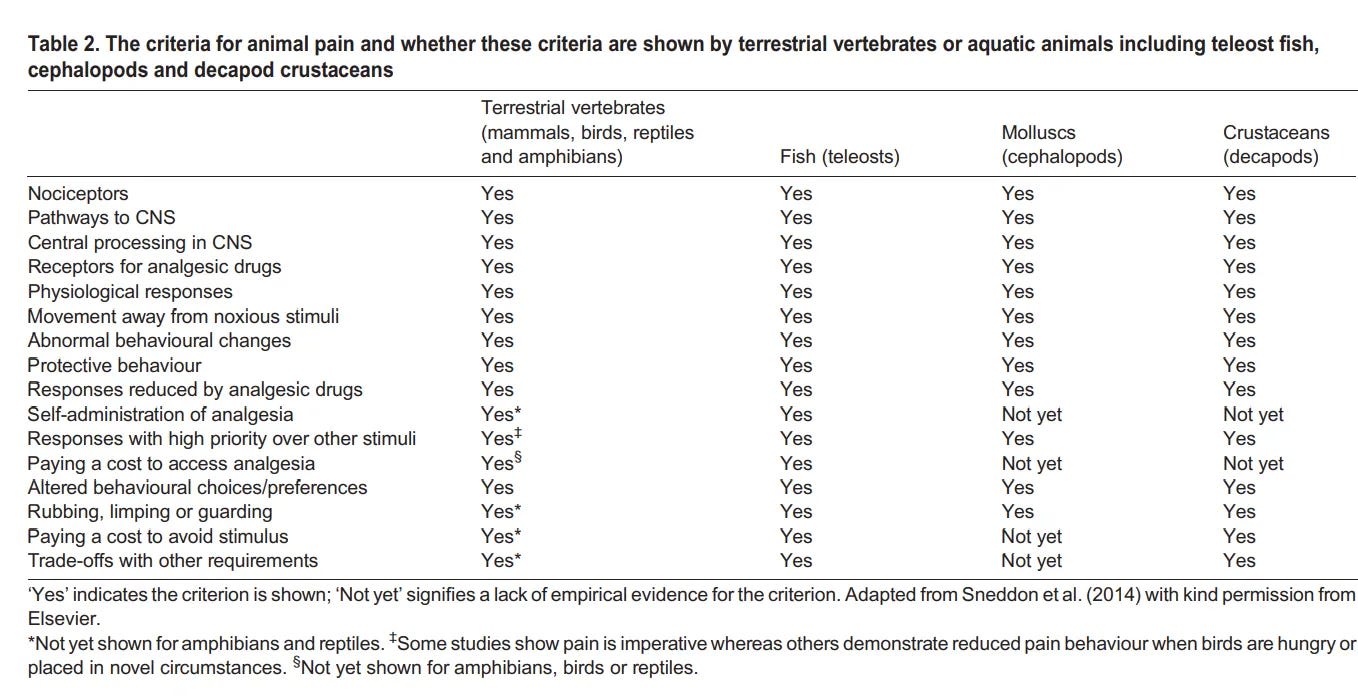
The presence of nociceptors (censors detecting external damage), central processing in the central nervous system, and so on demonstrate that fish have brain structures that might be able to sustain pain. If fish lacked nociceptors—censors that detect external damage—pain would be impossible. As previously discussed, though fish lack a cortex, this should not lead to any confidence that they lack the ability to feel intense pain.
Much of this behavioral evidence seems indicative of intense pain. If a creature limps and pays a cost to avoid pain, it should be assumed that it is in relatively intense pain. Sneddon (2003) shows that fish in pain display physiological changes, just as humans in pain do (see also Roques et al., 2010). For example, their opercular beat rate went up, similar to a human’s heart rate going up (which occurs when humans are in pain). Fish injected with acid were shown to rock back and forth after being injected with acid. However, this was blunted by morphine. Mettam et al. (2011) showed similarly dramatic fish responses to pain killers. Chervova & Lapshin (2011) demonstrate that though fish display less pain behavior in response to electric shocks after being given pain killers, non-pain related behavior doesn’t decrease. Painkillers don’t decrease general motion—they only stop pain-related behavior in fish (see also Jones et al., 2012).
Not only should this evidence cause us to think that fish feel some pain, it gives us evidence that their pain is intense. If a fish could only feel mild pain, so that when injected with acid fish only felt like a person might after stubbing their toe, this dramatic rocking behavior would be unlikely. Similarly, blunting by morphine shows that the fish brain processes pain signals in a significant way—if fish behavior was primarily operated by reflex, morphine would be less likely to play a role. Fish given morphine also returned to eating more quickly, which is parsimoniously explained by the assumption that the morphine shut off their pain.
Dunlop et al. (2006) showed that fish displayed reinforcement learning. When provided electric shocks after entering some specific location, fish (both trout and goldfish) learn to avoid that location. However, trout are willing to remain in that location if there is another trout in that area (trout display a preference for being with other trout). This seems to illustrate that fish response to harmful stimuli is deliberate and subject to both benefits and rewards, rather than an automatic reflex. If, as discussed before, part of the reason pain evolved is to encode fitness-relevant information, the high granularity of this information increases the odds that fish feel intense pain.
Particularly demonstrative of intense pain in fish is a paper by Millsopp & Laming (2008) which shows fish learn to avoid locations if provided electric shocks when in those locations. However, if starved for three days, they will then risk entering those locations in order to acquire food. Fish pain is sufficiently intense that they are willing to trade it off against a few days of starvation. Once again, if fish just felt mild pain, given their strong innate desire to eat, presumably the shocks would not have deterred them for several days.
Similarly Sneddon et al. (2003) provide particularly impressive evidence that fish feel intense pain. Intense pain is distracting. If someone is afraid of spiders but is in really intense agony, they might be too distracted by the agony to notice the spider or react to it aversively. Rainbow trout are afraid of novel objects. Trout injected with acid were much likely to react fearfully to a novel object. However, when given a painkiller, trout went back to reacting fearfully to the novel object. This seems to indicate that trout are capable of pain that is sufficiently unpleasant to be almost entirely distracting and debilitating—and this amount of pain does not require particularly over-the-top external damage.
Reilly et al. (2008) also show that fish display often pronounced, but variable responses to pain. This is what we should expect if they feel pain. Not all mammals have the same response to pain—if fish feel pain, rather than mere nociception, we should expect similar variation in their behavioral response to pain. And if their pain is intense, we should expect various behavioral indicators. Sneddon (2015) also demonstrates that fish engage in new and anomalous behaviors in response to pain which include tail beating, rocking, and rubbing the injured area. These kinds of dramatic behavioral responses are likely to accompany intense pain rather than mild pain—we should thus think that fish aren’t merely in mild discomfort. Lastly Sneddon (2019) notes that the threshold for aversive fish behavior is lower than for aversive mammal behavior when exposed to harmful stimuli, which may be indicative of greater fish sensitivity—and in turn, pain.
Some fish display particularly impressive cognitive feats that demonstrate surprisingly deep mental representation. Various kinds of fish play and can pass the mirror test, demonstrating self-awareness (see Dinets, 2016). Even fish without uniquely impressive cognition appear to have the ability to recognize numbers (Xiong et al., 2018). They can also learn from visual cues (Doutrelant & McGregor, 2000). Fish also appear to feel fear and stress (Chandroo et al., 2004), which seems indicative of a rich kind of phenomenology able to sustain more intense pains.
Overall, then, the evidence for fish pain is quite strong. As already discussed, the primary argument against fish pain—that fish lack a cortex—is unconvincing. Based on their behavior, fish appear to feel quite intense pain rather than merely mild pain. Whatever fish experience is intense enough to cause them to forgo eating for several days, nurse their injured areas, distract them from fear, cause them fear, and produce dramatic physical reactions. That the circle of animals capable of very intense agony includes fish seems fairly likely.
4 Crustaceans
Crustaceans are a kind of mostly aquatic arthropod—examples include shrimp, crab, lobsters, and krill, though I’ll mostly talk about decapods, which include crabs, shrimp, and lobsters. Others tend to be less studied and less likely to be sentient. One literature review by Elwood et al. (2009) found that crustaceans possessed every reliable behavioral indicator of pain. The behavioral indicators cited were:
(1) a suitable central nervous system and receptors, (2) avoidance learning, (3) protective motor reactions that might include reduced use of the affected area, limping, rubbing, holding or autotomy, (4) physiological changes, (5) trade-offs between stimulus avoidance and other motivational requirements, (6) opioid receptors and evidence of reduced pain experience if treated with local anaesthetics or analgesics, and (7) high cognitive ability and sentience.
Sneddon (2015) and Birch et al. (2021), after reviewing the literature, similarly found that decapod crustaceans possessed a great number of behavioral indicators of pain. But what are those indicators?
One such indicator, whose relevance has already been discussed, is avoidance learning. Denti et al. (1998) showed aversion learning in a crab species. Crabs were shocked when placed into a light compartment but not when placed into a dark one. They learned to avoid the light compartment, and maintained this preference for up to three hours (though had apparently forgotten a day later). This is expected if they feel intense pain; intense pain tends to leave a lasting mental imprint, leading to avoidance in the future. While this result on its own is not dispositive, it is certainly evidence for the intense agony hypothesis. Similar results were obtained by Fernandez-Duque et al. (1992) and Dimant & Maldonado (1992). Other crustaceans likely also display reinforcement learning, but the studies on them are typically less convincing (see Birch et al., 2021, p.58).
Appel & Elwood (2009) show that crabs leave a shell when given electric shocks. However, their hesitance to leave the shell is a function of how nice the shell is. This result, if correct, seems to illustrate that they make complex trade-offs between pain and reward, instead of having an automatic response. As discussed before, the greater extent to which one represents harmful stimuli, the more intense their pain likely is.
Eyestalk ablation is the practice of crushing the eyes of shrimp as a method of increasing fertility. After eyestalk ablation, shrimp swam erratically, and this erratic behavior lasted in some cases for over an hour (Taylor et al., 2004). However, this erratic swimming was blunted by anesthetic. In addition, shrimp were slower to eat when in pain, but this effect was once again blunted by anesthetic. Were the shrimp to be in no or mild discomfort, it would be surprising that they displaced such dramatic behavioral responses, which were then shut off by anesthetic.
Diarte-Plata et al. (2012) additionally showed that after eyestalk ablation, shrimp rubbed the affected areas, flicked their tails with greater frequency, and acted disoriented. These effects were blunted by anesthetic. Just as in humans or dogs, one should think it’s more likely they’re in intense pain if they display dramatic behavioral changes after being harmed, one should think the same thing about shrimp.
McCambridge et al. (2016) show that when crabs’ claws have been manually removed, they often touch the wounded area, foam at the mouth, shield the wound, and shudder when the wound is touched. They also displayed less aggression. The dramatic shudder response is particularly indicative of at least a serious possibility of intense pain.
Aside from direct pain-related behaviors, decapods have other indicators of distress. For instance, both shrimp and crayfish seem to experience anxiety (see Fosat et al. 2014 and Takahashi, 2022). After being exposed to danger, they proceed more cautiously. In crayfish, this greater caution is mitigated when they’re given anti-anxiety medications. Patterson et al. (2007) show that crabs continue to display different behavior for up to a full day after being presented with danger.
Various crustaceans also display remarkably complex cognitive traits. Crabs can learn how to navigate a maze, and even remember how they navigated it when sent back to the maze two weeks later (see Davies et al., 2019). Hermit crabs display complex behavior regarding preferred shells, including remembering shells, integrating together many different bits of information to form an overall picture about the desirability of shells, and planning (Elwood 2022). The fighting decisions crabs make over new shells are influenced by the niceness of their present shell. Data et al. (2018) showed that crayfish learn to self-administer amphetamine, providing evidence that they have desires of various kinds. Additionally, though this is somewhat speculative, if crayfish actively seek out amphetamine, it’s reasonably likely that they’d also actively seek out painkillers, providing yet more evidence for decapod pain.
Now these factors on their own aren’t pain related. Being able to navigate a maze doesn’t mean a creature can feel pain. But as we’ve discussed, on each of the leading theories, pain serves to represent a kind of mental information—either a common currency, an encoding of fitness-relevant information, or information that allows organisms to learn. Thus, the deeper one’s mental representations are, the more pain we should expect them to feel according to the leading theories. Elwood et al. (2009) goes as far as suggesting that some crustaceans must have degrees of cognitive ability comparable to that of some vertebrates.
There are some arguments given against pain in decapods. However, aside from the general considerations—based on neuron count, for instance—discussed above, there aren’t specific arguments against intense pain in decapods. None have argued explicitly that if decapods feel pain, their pain is very mild.
Some reasons people doubt decapods feel pain are generic: critics suggest, for instance, that creatures without cortexes can’t feel pain. This argument has already been discussed and criticized. Others are more specific. Puri & Faulkes (2010) demonstrate that two species of shrimp and one species of crayfish don’t respond to extreme acid concentrations and suggests “the evidence for nociception in crustaceans is still relatively weak,” noting that nociceptors in decapods haven’t yet been discovered.
Such considerations are inconclusive. Humans do not experience pain when poisoned with carbon monoxide, but that doesn’t mean we never experience pain. For a creature to feel pain, it need not respond to every kind of harmful stimuli. Sneddon (2019, p.3) notes that the African mole rat doesn’t respond to extreme acid concentrations, despite being a mammal that clearly feels pain. Just as we should expect simpler creatures to be less adept at discerning visual cues, we shouldn’t be surprised for their pain censors to detect fewer kinds of damaging stimuli. Thus, while failing to respond to extreme acid concentrations is some evidence against a creature feeling pain, it is far from conclusive.
We should not doubt decapod sentience on grounds they lack nociceptors because we don’t really know that they lack nociceptors, and there are many reasons to suspect they have nociceptors. First of all, decapod nociceptors may have been discovered recently in a species of crab (see Kasiouras et al., 2024). Second, nociceptors are hard to find, having not been discovered in fish until 2003. The mere fact we haven’t yet found them, particularly in species that haven’t been investigated very thoroughly, is weak evidence that they don’t exist. Third, the behavioral evidence discussed before—including, for instance, analgesic response—provides considerable evidence for their existence.
Fourth, nociceptors are very useful and widespread evolutionarily. They “have been found in annelid worms, nematode worms, gastropod molluscs and insects,” (Birch et al. 2021, p.44). Given their usefulness and ubiquity, it would be surprising if they were absent in decapods. Lastly, Birch (ibid) notes that there are various molecular indicators of nociceptors in decapods.
Overall, the evidential situation regarding decapods seems to support that they probably feel pain. It is not as conclusive as the evidence for pain in fish, but is rather significant nonetheless. If they feel pain, based on their behavior, it is reasonably likely that their pain is intense. Certainly there have been no aspects of their behavior that indicate they’re in only mild discomfort, and there have been quite a number of aspects that seem to indicate dramatic pain. Just as we infer that a dog is in great pain if it whimpers and cowers, the behavioral evidence adduced so far makes it reasonably likely that decapod crustaceans can experience intense agony.
5 Insects
Few people seriously consider the interests of insects. Despite their ubiquity—outnumbering humans by a factor on the order of 100 million to one (Tomasik, 2019)—few take them seriously as creatures capable of experiencing non-trivial degrees of pleasure and pain. Yet perhaps this is just a bias. Because they are small and we do not easily empathise with them, it can be easy for our judgments about their sentience to be distorted. For this reason, we shouldn’t take our intuitive disinclination to believe insects feel intense agony as particularly evidentially significant.
There are, of course, many insects. Just because some of them feel pain doesn’t mean that all of them do. Thus, my aim here will not be to argue that it’s plausible that all insects feel intense agony, but instead that it’s reasonably plausible that at least many of them do.
Insects have a great many features standardly used to indicate that a creature feels pain (Gibbons et al., 2022a). They have nociceptors and integrated brain regions that take in pain signals (ibid). On some theories of consciousness, insect brains sustain consciousness in the same way as the human midbrain (see Baron & Klein, 2016). When exposed to excessive heat, insects often recoil dramatically and try to escape (Im & Galko, 2022).
One particularly impressive study came from Jang et al. (2023) who performed a study on a species of fly. Normally, that species of fly doesn’t have capsaicin receptors, which detect the presence of spicy food (animals other than humans typically find capsaicin receptors very aversive). This study, however, genetically modified the species of fly to have capsaicin receptors. Then, researchers put capsaicin in their food.
The flies reacted very aversively to the food. After consuming it for one second, the flies ran away, moved around erratically, and pulled on their mouth. Their aversive reaction was proportional to the capsaicin concentration. The flies had such strong negative reactions to capsaicin that they eventually starved themselves to death! But when the flies were given pain-killers, this dramatic and aversive behavior was reduced or eliminated. The common combination of dramatic behavior that overcomes even very powerful biological drives with that behavior being shut off by anesthesia is significant evidence that a creature feels substantial suffering. And studies finding that analgesics work in insects are widespread (for a summary, see Gibbons et al., 2022a).
Gibbons et al. (2022b) showed that bumblebees made tradeoffs between heat of feeders and reward. They were less likely to eat from a feeder that was hotter, though they traded this off against the quality of the food. They even learned to remember which color heater was associated with greater heat, and avoided those heaters. This degree of complex motivational tradeoff illustrates that their brains clearly represent external stimuli proportional to their intensity—thus, it wouldn’t be surprising if very high temperatures were extremely painful.
Another study by Tully & Quinn (1985) provided flies with electric shocks when exposed to a particular odor. Flies then learned to avoid that odor. Similar conditioning has been found in ants (Desmedt et al., 2017), bees (Nouvian & Galizia, 2019), and various other insects (Gibbons et al., 2022a, p.196). While not definitive, this result is certainly more expected if insects feel intense pain than not. Intense pain would be expected to leave a lasting impression, while such conditioning would be more surprising in creatures only capable of mild suffering or not capable of suffering at all.
Marques et al. (2025) show that the extent of insect neural activation scales with the degree of external harm. Thus, it’s plausible that insects do not merely possess reflexes which are binary, but instead have experiences that scale in intensity proportional to the harm they experience.
Insects also display a great variety of remarkably complex cognitive traits. Fruitflies show depressive symptoms—when subject to stressors, they were far less prone to swim for their life, and this effect was blunted by anti-depressants (Neckameyer & R. Nieto-Romero, 2015; Araujo et al., 2021). Bees were capable of tool use (Loukola et al., 2017), avoiding difficult choices (Perry & Barron, 2013), and bumblebees could learn to backtrack to get a reward (Mirwan et al., 2015).
For a while, the consensus was that insects did not feel pain, and much of this owed to an influential paper by Eisemann et al. (1984). Eisemann claimed that insects lacked nociceptors, had simple and mechanical brains and behavior, and behaved normally after severe injury. However, Barrett & Fischer (2024) show that more recent research has overturned the early conclusions of Eisemann. Nociceptors in insects have been discovered. Some insects have brain sizes and neuron counts similar to very small geckos. Some extinct insects probably had larger brains than many vertebrates. And many small brains can support very complex functions—insects may be able to more rapidly change behavior when the rules of tasks change (a process called reversal learning) than some vertebrates.
Contra Eisemann, Barrett & Fischer note that insects do modify their behavior after great injury. Crickets, for instance, often stop attempting to mate. Insects often groom their wounded areas and reduce movement of body parts after injury. While Eisemann cites reports of insects walking on injured body parts, this is based on anecdotal observations; its ubiquity is unknown. And small animals with exoskeletons have very different behavior and movement from larger animals—for this reason, we shouldn’t be surprised that they respond differently to pain. It’s much more adaptive for insects to respond aversively to heat and shock and less aversive to mechanical damage, which is often less harmful to creatures with exoskeletons.
There are two different kinds of nociceptors (censors for external damage): the first produces sharp, immediate, shooting pain, and the second produces dull, aching pain. Sneddon (2004) has shown fish nociceptors are mostly of the first kind, meaning their long-term response to pain is limited. Insects could be broadly analogous, and this would explain why insects respond aversively to immediate damage, but sometimes fail to display long-lasting behavioral change.
Overall, while the jury is still out to some degree regarding insect pain, there are no decisive reasons to doubt they feel pain and several reasons to suspect that they do feel pain. Many of the indicators of pain in vertebrate species are also present in insects. If insects are conscious, it wouldn’t be very surprising if they could suffer quite intensely. Certainly their dramatic behavioral responses seem much better explained on the assumption that they feel dramatic agony than on the assumption that they have such mild capacities for welfare that the peaks and valleys of their conscious experience aren’t too far apart.
6 Conclusion
Consciousness is perhaps the most mysterious thing in the universe, and nothing about it is more mysterious than its presence in other animals. There is a great deal of uncertainty about which other creatures are conscious. Fish, insects, and crustaceans are all creatures that have been suggested not to be conscious, and though there is some evidence for their consciousness, it falls well short of proof.
But here I’ve argued it’s not merely plausible that these animals are conscious but that they are intensely conscious. It is plausible, in other words, that an ant’s ability to feel raw physical pain and pleasure aren’t too dissimilar from yours. We shouldn’t be overwhelmingly certain that insects, fish, and crustaceans are capable of only mild pain. The odds are non-trivial that such creatures’ capacities for pleasure and pain are quite significant. If this is correct, it may be that nearly all the world’s intense pleasures and pains are experienced by invertebrates—that the oceans contain thousands of times more intense agony and pleasure than all that which is experienced by humans.
There is no decisive proof of this hypothesis, but quite a number of lines of considerations are suggestive of it. Some of these are highly-general, having to do, for instance, with the sorts of evolutionary pressures that are to be expected. Others are highly specific, having to do with how very simple creatures behave. The topic merits a good deal of further research. Until then, however, we can no longer be confident in the assumption that creatures with small bodies, small brains, and few neurons are vastly less able to suffer than us.
Sources
Anand, K. J., & Hickey, P. R. (1987). Pain and its effects in the human neonate and fetus. New England Journal of Medicine, 317(21), 1321-1329.
Appel, M., & Elwood, R. W. (2009). Gender differences, responsiveness and memory of a potentially painful event in hermit crabs. Animal Behaviour, 78(6), 1373-1379.
Araujo, S. M., Bortolotto, V. C., Poetini, M. R., Dahleh, M. M. M., Couto, S. D. F., Pinheiro, F. C., … & Prigol, M. (2021). γ-Oryzanol produces an antidepressant-like effect in a chronic unpredictable mild stress model of depression in Drosophila melanogaster. Stress, 24(3), 282-293.
Barrett, M., & Fischer, B. (2024). I. The era beyond Eisemann et al..(1984): Insect pain in the 21st century.
Barron, A. B., & Klein, C. (2016). What insects can tell us about the origins of consciousness. Proceedings of the National Academy of Sciences, 113(18), 4900-4908.
Birch, J., Burn, C., Schnell, A., Browning, H., & Crump, A. (2021). Review of the evidence of sentience in cephalopod molluscs and decapod crustaceans.
Birch, J. (2022). The search for invertebrate consciousness. Noûs, 56(1), 133-153.
Birch, J. (2024). The edge of sentience: risk and precaution in humans, other animals, and AI (p. 398). Oxford University Press.
Braithwaite, V. A., & Droege, P. (2016). Why human pain can’t tell us whether fish feel pain. Animal Sentience, 1(3), 3.
Broom, D. M. (2016). Fish brains and behaviour indicate capacity for feeling pain. Animal Sentience, 1(3), 4.
Budolfson, M., & Spears, D. (2020). Public policy, consequentialism, the environment, and nonhuman animals. In The Oxford Handbook of Consequentialism (pp. 592-615). Oxford University Press.
Chandroo, K. P., Duncan, I. J., & Moccia, R. D. (2004). Can fish suffer?: perspectives on sentience, pain, fear and stress. Applied Animal Behaviour Science, 86(3-4), 225-250.
Chervova, L. S., & Lapshin, D. N. (2011). Behavioral control of the efficiency of pharmacological anesthesia in fish. Journal of Ichthyology, 51(11), 1126-1132.
Chittka, L., & Niven, J. (2009). Are bigger brains better?. Current biology, 19(21), R995-R1008.
Crump, A., Browning, H., Schnell, A., Burn, C., & Birch, J. (2022). Sentience in decapod crustaceans: A general framework and review of the evidence. Animal Sentience, 7(32), 1.
Dawkins, R. (2011). Richard Dawkins on vivisection:“But can they suffer?”. Retrieved from website: https://boingboing.net/2011/06/30/richard-dawkins-on-v.html
Datta, U., Van Staaden, M., & Huber, R. (2018). Crayfish self-administer amphetamine in a spatially contingent task. Frontiers in Physiology, 9, 433.
Wallace, D. F. (2005). Consider the lobster: And other essays. Little, Brown.
Davies, R., Gagen, M. H., Bull, J. C., & Pope, E. C. (2019). Maze learning and memory in a decapod crustacean. Biology letters, 15(10), 20190407.
Denti, A., Dimant, B., & Maldonado, H. (1988). Passive avoidance learning in the crab Chasmagnathus granulatus. Physiology & behavior, 43(3), 317-320.
Desmedt, L., Baracchi, D., Devaud, J. M., Giurfa, M., & d’Ettorre, P. (2017). Aversive learning of odor–heat associations in ants. Journal of Experimental Biology, 220(24), 4661-4668.
Diarte-Plata, G., Sainz-Hernández, J. C., Aguiñaga-Cruz, J. A., Fierro-Coronado, J. A., Polanco-Torres, A., & Puente-Palazuelos, C. (2012). Eyestalk ablation procedures to minimize pain in the freshwater prawn Macrobrachium americanum. Applied Animal Behaviour Science, 140(3-4), 172-178.
Dimant, B., & Maldonado, H. (1992). Habituation and associative learning during exploratory behavior of the crab Chasmagnathus. Journal of Comparative Physiology A, 170(6), 749-759.
Dinets, V. (2016). No cortex, no cry. Animal Sentience, 1(3), 7.
Doutrelant, C., & McGregor, P. (2000). Eavesdropping and mate choice in female fighting fish. Behaviour, 137(12), 1655-1668.
Duffy, L. (2024) Welfare Range and Probability of Sentience Distributions. Accessed at https://docs.google.com/document/d/1xUvMKRkEOJQcc6V7VJqcLLGAJ2SsdZno0jTIUb61D8k/edit?tab=t.0
Dunlop, R., Millsopp, S., & Laming, P. (2006). Avoidance learning in goldfish (Carassius auratus) and trout (Oncorhynchus mykiss) and implications for pain perception. Applied Animal Behaviour Science, 97(2-4), 255-271.
Eisemann, C. H., Jorgensen, W. K., Merritt, D. J., Rice, M. J., Cribb, B. W., Webb, P. D., & Zalucki, M. P. (1984). Do insects feel pain? A biological view. Experientia, 40(2), 164-167.
Elwood, R. W., Barr, S., & Patterson, L. (2009). Pain and stress in crustaceans?. Applied Animal Behaviour Science, 118(3-4), 128-136.
Elwood, R. W. (2022). Hermit crabs, shells, and sentience. Animal cognition, 25(5), 1241-1257.
Fernandez-Duque, E., Valeggia, C., & Maldonado, H. (1992). Multitrial inhibitory avoidance learning in the crab Chasmagnathus. Behavioral and neural biology, 57(3), 189-197.
Fischer, B., Schukraft, J., Shriver, A., Barrett, M., Schnell, A., Trevarthen, A., … & Miller, R. (2024). Some Tentative Welfare Range Estimates. In Fischer, Weighing Animal Welfare, pp.206-252. Oxford University Press.
Fossat, P., Bacqué-Cazenave, J., De Deurwaerdère, P., Delbecque, J. P., & Cattaert, D. (2014). Anxiety-like behavior in crayfish is controlled by serotonin. Science, 344(6189), 1293-1297.
Gibbons, M., Crump, A., Barrett, M., Sarlak, S., Birch, J., & Chittka, L. (2022a). Can insects feel pain? A review of the neural and behavioural evidence. Advances in insect physiology, 63, 155-229.
Gibbons, M., Versace, E., Crump, A., Baran, B., & Chittka, L. (2022b). Motivational trade-offs and modulation of nociception in bumblebees. Proceedings of the National Academy of Sciences, 119(31), e2205821119.
Giurfa, M. (2015). Learning and cognition in insects. Wiley Interdisciplinary Reviews: Cognitive Science, 6(4), 383-395.
Godfrey-Smith, P. (2017). The mind of an octopus. Scientific American Mind, 28(1), 62-69.
Hart, B. L., Hart, L. A., & Pinter-Wollman, N. (2008). Large brains and cognition: where do elephants fit in?. Neuroscience & Biobehavioral Reviews, 32(1), 86-98.
Heisenberg, M. (1998). What do the mushroom bodies do for the insect brain? An introduction. Learning & memory, 5(1), 1-10.
Im, S. H., & Galko, M. J. (2012). Pokes, sunburn, and hot sauce: Drosophila as an emerging model for the biology of nociception. Developmental Dynamics, 241(1), 16-26.
Jang, W., Oh, M., Cho, E. H., Baek, M., & Kim, C. (2023). Drosophila pain sensitization and modulation unveiled by a novel pain model and analgesic drugs. Plos one, 18(2), e0281874.
Jones, S. G., Kamunde, C., Lemke, K., & Stevens, E. D. (2012). The dose–response relation for the antinociceptive effect of morphine in a fish, rainbow trout. Journal of Veterinary Pharmacology and Therapeutics, 35(6), 563-570.
Kasiouras, E., Hubbard, P. C., Gräns, A., & Sneddon, L. U. (2024). Putative Nociceptive Responses in a Decapod Crustacean: The Shore Crab (Carcinus maenas). Biology, 13(11), 851.
Key, B. (2015). Fish do not feel pain and its implications for understanding phenomenal consciousness. Biology & philosophy, 30(2), 149-165.
Kuba, M., Meisel, D. V., Byrne, R. A., Griebel, U., & Mather, J. A. (2003). Looking at play in Octopus vulgaris. Berliner Paläontologische Abhandlungen, 3, 163-169.
Loukola, O. J., Solvi, C., Coscos, L., & Chittka, L. (2017). Bumblebees show cognitive flexibility by improving on an observed complex behavior. Science, 355(6327), 833-836.
Magee, B., & Elwood, R. W. (2016). No discrimination shock avoidance with sequential presentation of stimuli but shore crabs still reduce shock exposure. Biology Open, 5(7), 883-888.
Marques, M. J. M., Minghao, P., Okada, R., Sakura, M., Hirose, K., & Umezu, S. (2025). Electrophysiological Investigation of Insect Pain Threshold. arXiv preprint arXiv:2502.16088.
McCambridge, C., Dick, J. T., & Elwood, R. W. (2016). Effects of autotomy compared to manual declawing on contests between males for females in the edible crab cancer pagurus: Implications for fishery practice and animal welfare. Journal of Shellfish Research, 35(4), 1037-1044.
McGinn, C. (1989). Can we solve the Mind-Body problem?. Mind, 98(391), 349-366.
Merker, B. (2007). Consciousness without a cerebral cortex: A challenge for neuroscience and medicine. Behavioral and brain sciences, 30(1), 63-81.
Merker, B. H. (2016). Insects join the consciousness fray. Animal Sentience, 1(9), 4.
Mettam, J. J., Oulton, L. J., McCrohan, C. R., & Sneddon, L. U. (2011). The efficacy of three types of analgesic drugs in reducing pain in the rainbow trout, Oncorhynchus mykiss. Applied Animal Behaviour Science, 133(3-4), 265-274.
Millsopp, S., & Laming, P. (2008). Trade-offs between feeding and shock avoidance in goldfish (Carassius auratus). Applied Animal Behaviour Science, 113(1-3), 247-254.
Mirwan, H. B., Mason, G. J., & Kevan, P. G. (2015). Complex operant learning by worker bumblebees (Bombus impatiens): detour behaviour and use of colours as discriminative stimuli. Insectes Sociaux, 62(3), 365-377.
Neckameyer, W. S., & R. Nieto-Romero, A. (2015). Response to stress in Drosophila is mediated by gender, age and stress paradigm. Stress, 18(2), 254-266.
Newby, N. C., & Stevens, E. D. (2008). The effects of the acetic acid “pain” test on feeding, swimming, and respiratory responses of rainbow trout (Oncorhynchus mykiss). Applied Animal Behaviour Science, 114(1-2), 260-269.
Nouvian, M., & Galizia, C. G. (2019). Aversive training of honey bees in an automated Y-maze. Frontiers in Physiology, 10, 678.
Panksepp, J., Normansell, L., Cox, J. F., & Siviy, S. M. (1994). Effects of neonatal decortication on the social play of juvenile rats. Physiology & Behavior, 56(3), 429-443.
Patterson, L., Dick, J. T., & Elwood, R. W. (2007). Physiological stress responses in the edible crab, Cancer pagurus, to the fishery practice of de-clawing. Marine Biology, 152(2), 265-272.
Perry, C. J., & Barron, A. B. (2013). Honey bees selectively avoid difficult choices. Proceedings of the National Academy of Sciences, 110(47), 19155-19159.
Puri, S., & Faulkes, Z. (2010). Do decapod crustaceans have nociceptors for extreme pH?. PLoS One, 5(4), e10244.
Reilly, S. C., Quinn, J. P., Cossins, A. R., & Sneddon, L. U. (2008). Behavioural analysis of a nociceptive event in fish: Comparisons between three species demonstrate specific responses. Applied Animal Behaviour Science, 114(1-2), 248-259.
Roques, J. A., Abbink, W., Geurds, F., van de Vis, H., & Flik, G. (2010). Tailfin clipping, a painful procedure: studies on Nile tilapia and common carp. Physiology & Behavior, 101(4), 533-540.
Rollin, B. E. (1989). The unheeded cry: Animal consciousness, animal pain and science. Oxford University Press.
Rose, J. D. (2002). The neurobehavioral nature of fishes and the question of awareness and pain. Reviews in fisheries science, 10(1), 1-38.
Rowe, A. (2020). Insects farmed for food and feed—global scale, practices, and policy.
Qu, Y., Meng, L., & Li, B. (2022). Defensive thrashing behavior of caterpillars incurs a fatal retaliation from predatory stinkbugs. Biological Control, 176, 105097.
Schneider, S., & Velmans, M. (Eds.). (2017). The Blackwell companion to consciousness. John Wiley & Sons.
Schukraft, J., Barrett, M., Schnell, A., Trevarthen, A., & Fischer, B. (2024). Differences in the intensity of valenced experience across species. In Fischer, Weighing Animal Welfare, pp.103-134. Oxford University Press.
Shriver, A. (2024). Using Neuron Counts to Estimate Welfare Ranges. In Fischer, Weighing Animal Welfare, pp.135-180. Oxford University Press.
Singer, P. (1975). Animal Liberation: A New Ethics for Our Treatment of Animals. New York: The New York Review.
Sneddon, L. U., Braithwaite, V. A., & Gentle, M. J. (2003). Novel object test: examining nociception and fear in the rainbow trout. The Journal of Pain, 4(8), 431-440.
Sneddon, L. U. (2003). The evidence for pain in fish: the use of morphine as an analgesic. Applied Animal Behaviour Science, 83(2), 153-162.
Sneddon, L. U. (2009). The effects of the acetic acid “pain” test on feeding, swimming, and respiratory responses of rainbow trout (Oncorhynchus mykiss): a critique on Newby and Stevens (2008). Applied Animal Behaviour Science, 116(1), 96-97
Sneddon, L. U. (2004). Evolution of nociception in vertebrates: comparative analysis of lower vertebrates. Brain Research Reviews, 46(2), 123-130.
Sneddon, L. U. (2019). Evolution of nociception and pain: evidence from fish models. Philosophical Transactions of the Royal Society B, 374(1785), 20190290.
Sneddon, L. U. (2015). Pain in aquatic animals. The Journal of experimental biology, 218(7), 967-976.
St Jules, M. (2024, February 19). Solution to the two envelopes problem for moral weights. Effective Altruism Forum. https://forum.effectivealtruism.org/posts/L4Cv8hvuun6vNL8rm/solution-to-the-two-envelopes-problem-for-moral-weights
Takahashi, K. (2022). Changes in the anxiety-like and fearful behavior of shrimp following daily threatening experiences. Animal cognition, 25(2), 319-327.
Taylor, J., Vinatea, L., Ozorio, R., Schuweitzer, R., & Andreatta, E. R. (2004). diar. Aquaculture, 233(1-4), 173-179.
Tomasik, B. (2016a) Humanity’s Net Impact on Wild-Animal Suffering
Tomasik, B. (2016b) Is Brain Size Morally Relevant?
Tomasik, B. (2019) How Many Wild Animals Are There?
Tully, T., & Quinn, W. G. (1985). Classical conditioning and retention in normal and mutant Drosophila melanogaster. Journal of Comparative Physiology A, 157(2), 263-277.
Waldhorn, D. R., & Autric, E. (2023). Shrimp: The animals most commonly used and killed for food production.
Xiong, W., Yi, L. C., Tang, Z., Zhao, X., & Fu, S. J. (2018). Quantity discrimination in fish species: fish use non-numerical continuous quantity traits to select shoals. Animal cognition, 21(6), 813-820.
Zacks, O., & Jablonka, E. (2023). The evolutionary origins of the Global Neuronal Workspace in vertebrates. Neuroscience of Consciousness, 2023(1), niad020.
Great post. As you point out, this is one of the important unresolved questions in science, and much more research aimed at generating relevant evidence is needed.
Meanwhile, I find the evolutionary perspective especially useful at this stage, so I wanted to raise one disagreement with the claim that there is “every evolutionary reason” for relatively simple organisms to feel intense pain. The adaptive value of a rapid and dramatic response does not, by itself, tell us how intense the underlying felt state must be. Reflexive behavior, for example, can be rapid and dramatic without involving affective experience at all. Even in a sentient organism, a strong behavioral response could be triggered by a low response threshold rather than by an extremely intense felt state.
Framed as a cost–benefit question, I therefore do not think evolutionary reasoning alone makes high-intensity pain in simpler sentient organisms the parsimonious default. We explored that broader perspective here.
Briefly, affective scales help organisms prioritize among competing needs and actions. Organisms with simpler nervous systems are expected to have more limited behavioral repertoires and fewer competing motivations, in which case a lower-resolution affective scale may be sufficient. Organisms with richer behavioral and cognitive repertoires, by contrast, needs to integrate a much larger set of memories, sensory inputs, and competing priorities.
Lower resolution does not by itself imply a narrow affective range. But expanding the range to include extreme states is only one possible way of producing urgent behavioral prioritization. All else being equal, selection should favor a less costly mechanism when it provides the same functional benefit. Very high affective intensity probably involves additional energetic, physiological, or architectural demands
Taken together, these considerations do not rule out intense pain in insects or decapods. But evolution makes high-intensity pain an important hypothesis to investigate, not a default conclusion (We explored the distinction between affective range and resolution more directly here).
Good to debate this topic!
Just one pointer, I understand that as humans we try to look through our own bodies, but anthropomorphizing other living beings only does them harm. I noticed this particularly in the example of the fly being crushed.
I would argue that swatting a human vs a fly it could be better for the human, as we do have a central brain that once you pop up, you go bye bye.
Flies and insects in general have several ganglia, and depending on their evolutionary development they might have a brain like structure, but they might also have nerve segments that all could perceive pain, so swatting a fly and crushing it’s head, could still leave some part of the fly here and conscious and in incredible pain.
Boiled alive, our skin would be in immense pain, but unless we are drowning, it wouldn’t affect our breathing. Lobsters for an example, breathe through gills. A comparative experience for boiling alive would be to be in a steam boiler and breathing air that is really heated up and humid.
TLDR: Anthropomorphizing of animals could make us underestimate their suffering.
Hi Matthew. Great post.
I think consciousness is usually defined in a way that is either unfalsifiable or too vague for estimating a probability to be useful (like what-is-it-likeness). I believe it would be better to focus just on what animals can do (for instance, probability of a given animal having a score of at least x % on a given test), which can be be empirically assessed.
I agree that is a possibility, but I struggle to quantify how likely it is. Their pain during dramatic behaviours could be much more intense than their typical experiences, but still much less intense than human pain.
Evolutionarily speaking, nothing would change if the rewards and punishment had a value of “alternative value” = k*”value”, where k is positive? The expected value of each action would have been k times as large, but the ratio between the expected value of any 2 actions would have been exactly the same. k can in principle be arbitrarily close to 0. So experiences could have an intensity arbitrarily close to 0 while leading to exactly the same behaviour?
This argument only applies to mammals at most?
The estimates for sentience-adjusted welfare ranges in Bob Fischer’s book are calculated for 3 models. The value for shrimps as a fraction of that of humans is 40 % for the equality model, 0.035 % for the neurophysiological model, and 6.6 % for the simple additive model. However, it is very unclear to me how to combine these in a principled way. I would say that the key takeaway is that a best guess equal to any of those 3 values is reasonable. Moreover, the 3 models only cover a very tiny fraction of possibilities. Models leading to estimates of the type “estimate for the neurophysiological model”^”exponent” with high exponent could easily lead to very small sentience adjusted welfare ranges as a fraction of that of humans. For example, 1.23*10^-7 (= (3.5*10^-4)^2) for shrimps for an exponent of 2. How do you rule out such models? I read the whole book, and I did not find any justification.
Bob’s book superseded that work. “For updates, please see this [Bob’s] book”.
This could be true, and animals still have experiences of astronomically low intensity? Say the intensity of experiences (or the sentience-adjusted welfare range) is proportional to “individual number of neurons”^2. Decreasing the number of neurons by 1 % would decrease intensity by 2 %. Nothing dramatic? Estimates for the number of neurons in humans range from 61 billion to 99 billion. So the intensity of experiences would vary by a factor of 2.63 (= (99/61)^2) specifically because of differences in the number of neurons, which seems like a reasonable upper bound to me. If so, the experiences of shrimps could have an intensity as low as 10^-12 (= (10^-6)^2) times that of the experiences of humans, as shrimps have 10^-6 times as many neurons as humans.
On the other hand, I am also open to the experiences of shrimps being roughly as intense as those of humans. For intensity proportional to “individual number of neurons”^”exponent”, values from 0 to 2 cover the best guesses that I consider reasonable.
“Number of neurons”^0.188 explains very well the estimates for sentience-adjusted welfare ranges in Bob’s book.
More importantly, the highest estimate for the number of neurons is humans is 1.62 (= 99⁄61) times the lowest estimate, whereas humans have 1 M times as many neurons as shrimps. So I think the number of neurons explaining very little of the variation in the intensity of human experiences is practically no evidence for human experiences being roughly as intense as those of shrimps.
You write:
This question gets to me a lot. It seems totally unclear how much the valence of an experience correlates to behavior. Like, it seems plausible that extraordinarily little pain could motivate behavior in simple organisms, but it’s also hard to imagine, since, as a complex organism, I need pretty intense pain to be motivated to significantly change my behavior. And, it doesn’t seem like there’s any way we could reduce uncertainty about this.
--
Also, in regards to Bob’s book, it seems like it would make sense, rather than adding the model’s estimates together to instead act on each model separately, i.e. assigning 5% of resources to help animals according to the equality model, 25% according to the neurophysiological model, and 70% according to the proxies model. Then, within the 70% for the proxies model, we could assign 33% of resources to applying a high exponent to the welfare ranges, 33% to applying no exponent to the welfare ranges, and 33% to applying a low exponent to the welfare ranges.
The problem of what percentages you should use and what models to use would, of course, still remain though.
Hi James.
Makes sense. Relatedly, you may be interested in the post “Do primitive sentient organisms feel extreme pain? disentangling intensity range and resolution” by Wladimir Alonso and Cynthia Schuck.
I think the above goes against maximising expected value in principle, even if it may be a good approach in practive, and I believe maximising expected value follows from very intuitive premises.
Right.
Thanks for sharing that post. I made this comment on it in case you’re curious.
I broadly agree with the points you made in that comment.
You may be interested in my estimates of the total welfare of various organism populations assuming welfare per fully-happy-animal-year is a power law of the individual number of neurons, or of the basal metabolic rate (BMR) at 25 ºC. Here is some context about why a power lay may be appropriate.
The metabolic energy argument makes sense. It’s unclear to me whether we should apply any kind of power law though since consciousness seems to be different in nature, as I view it as likely non-physical.
Only physical consciousness is falsifiable? I think so. So I believe it is better to focus on physicalist theories of consciousness. Relatedly, you may be interested in this discussion between me and Wladimir Alonso from the Welfare Footprint Institute (WFI) about whether sentience is binary.
Something like this is proposed in the article “Moral Uncertainty, Proportionality and Bargaining”.