Hello, EA community! There’s likely nothing new here that most of you aren’t already aware of. I wrote this on my blog in the hopes of reaching more people who like me, might be persuaded to take impact more seriously and don’t fixate on dairy (or dogma). If you know someone like that please share.
One of the most common things a vegan hears is, “I could never be vegan because I can’t give up cheese.” This resistance is understandable, given that dairy products are everywhere—in almost every dish, cuisine, and culture across the world—and it seems harmless at first glance.
What’s not obvious is that mammals such as cows only produce milk for a short while (usually ~10 months) post pregnancy. This means cows have to be repeatedly impregnated, their calves are separated from them, and if the calves are male, they are often slaughtered [1]. When you understand this, it becomes easier to empathize with those who are deeply passionate about advocating against dairy consumption.
Looking back on my own journey, it wasn’t until I watched a documentary about the dairy industry in India [2] that I really grasped the widespread nature of this cruelty. This led me, like many others, to advocate for an all-or-nothing approach to quitting every animal product, especially dairy.
All through that time, I never paused to wonder: was this disproportionate focus on dairy having as much impact as I had imagined?
Giving up dairy doesn’t spare as many cows as we’d like it to
On average, a US consumer consumes about 660 pounds (or 300 kg) of milk per year,[3] counting the milk needed to make various dairy products like cheese and yogurt.
While a typical US dairy cow produces ~24,000 pounds (thats about ~11,000 kg) of milk in a year [4]— which is roughly from a single pregnancy and lactation cycle.
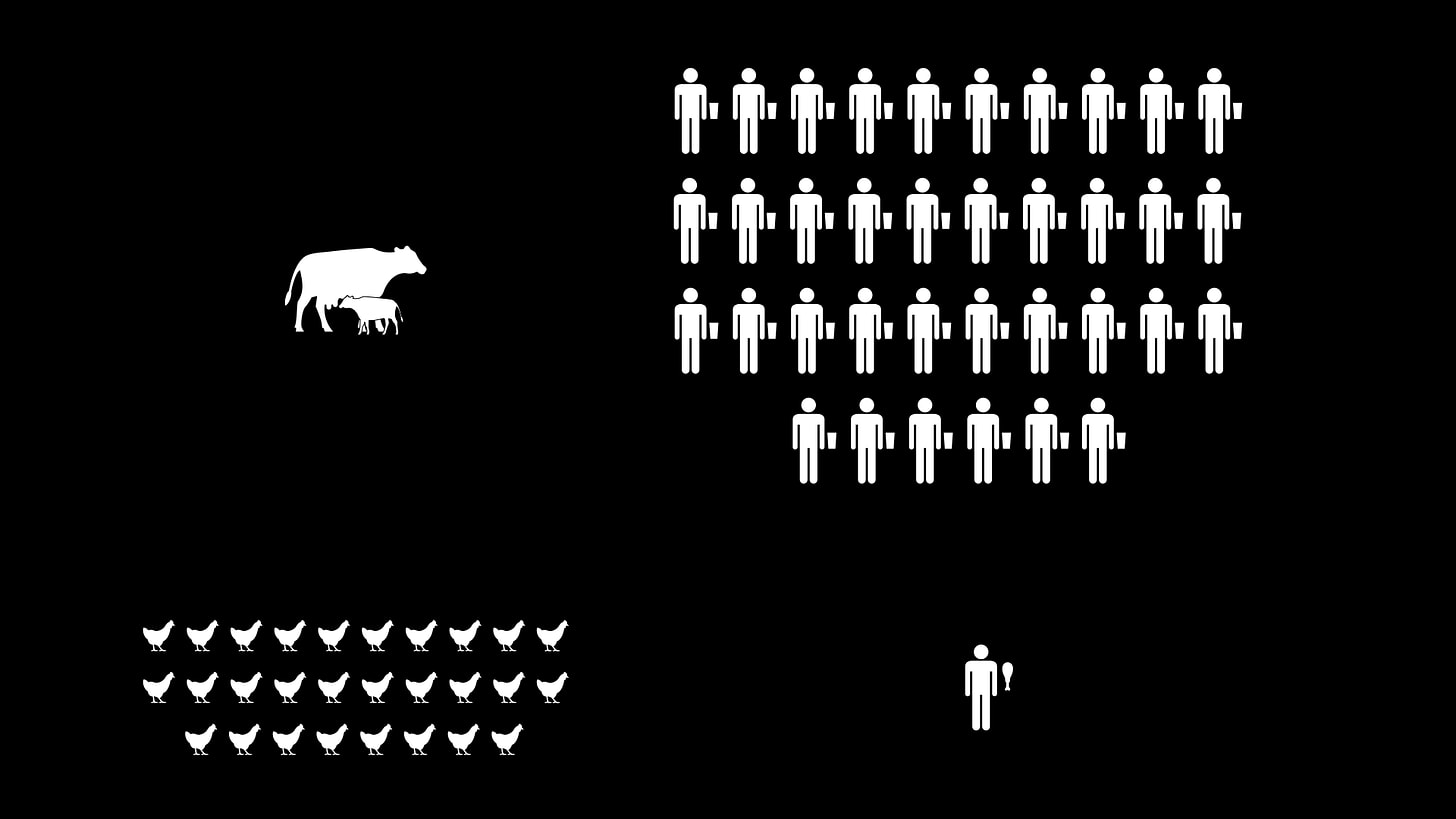
This means it would take about ~36 people giving up dairy for an entire year to spare just one cow from a single pregnancy (and one calf from being slaughtered). Or, put another way, a single person would need to avoid dairy for about ~36 years [5] to achieve the same reduction.
By this measure, I have more than a quarter century to go before I can say I’ve spared a single dairy cow from factory farming, simply because of the huge amount of milk produced by one cow in just one lactation cycle.
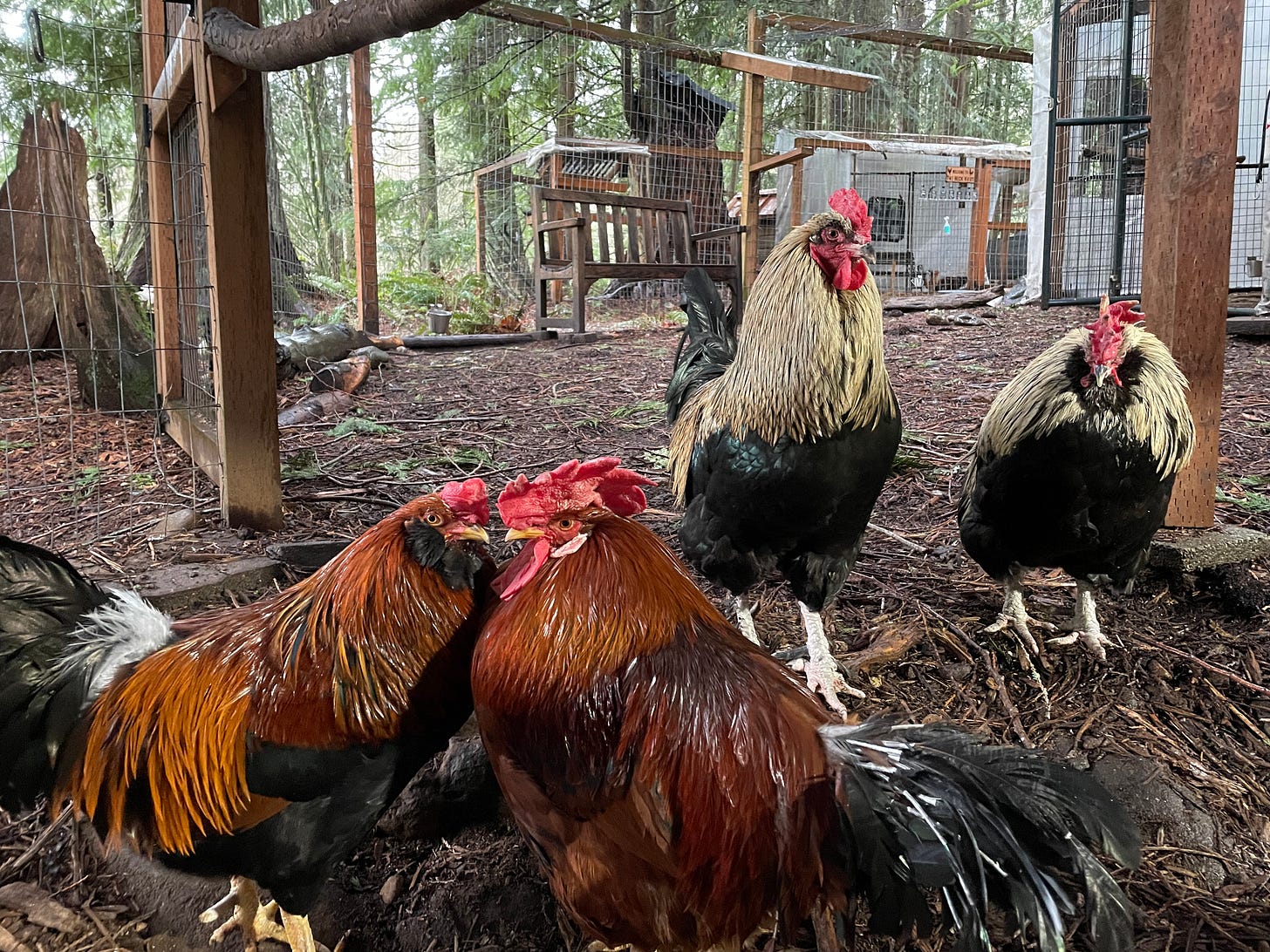
Meanwhile, the average American eats the equivalent of a whole chicken roughly every two weeks —that’s around 28 chickens per year[6]. Over those same 36 years, that adds up to more than a 1,000 chickens bred and slaughtered in factory farms.
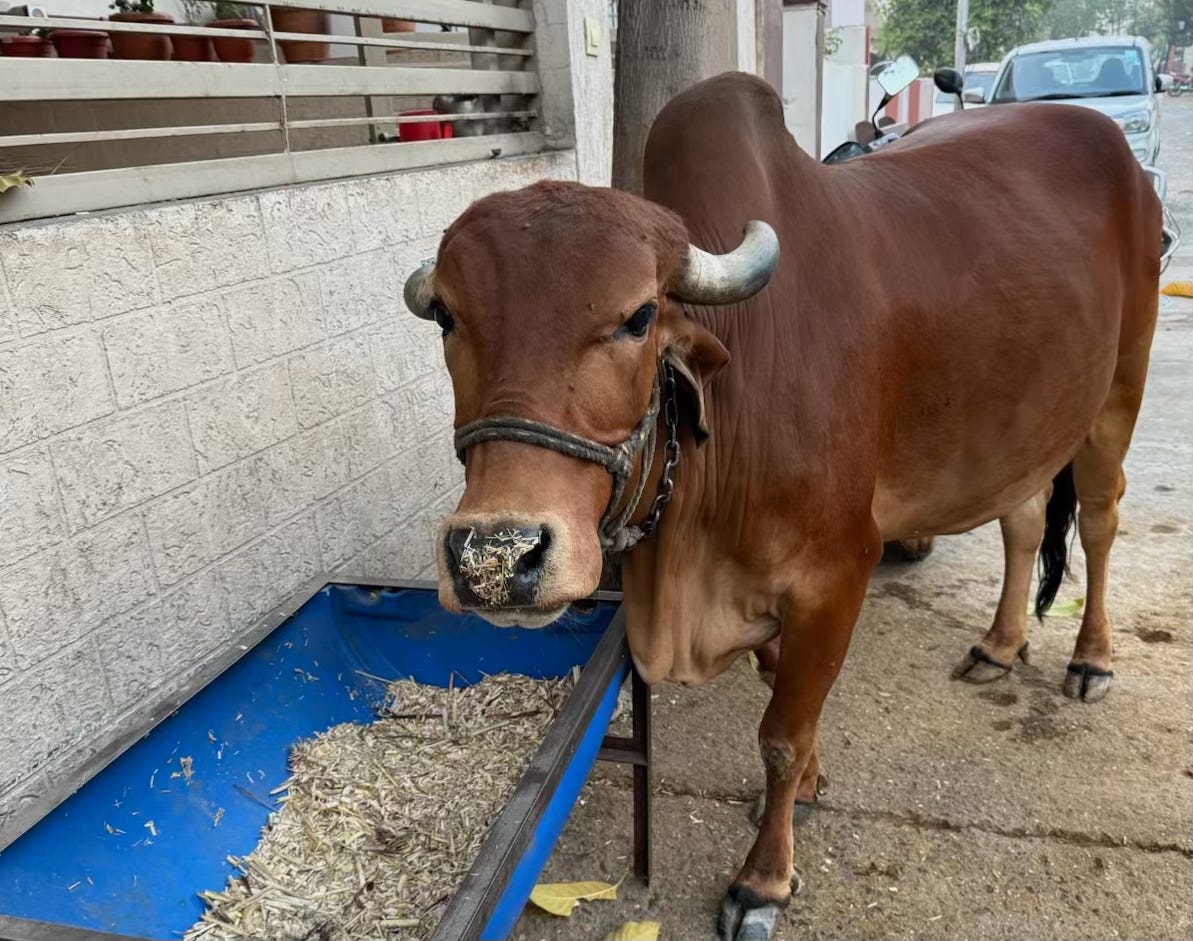
To put this into perspective, try naming the mother cow and her calf. I thought of Gauri and Nandu! Try to think about the suffering they’re spared when someone gives up dairy. Now, try to think of more than a thousand names for all those chickens. Can you picture that? Honestly, I can’t even begin to imagine that many names, let alone grasp the scale of their suffering.
Prioritizing advocacy against dairy is also understandable on a biological level. Research shows that our empathy and compassion tend to decrease as the evolutionary distance increases[7]. Most people, including many animal advocates, naturally feel more compassion toward mammals—our evolutionary cousins—than toward birds or other vertebrates who are more distantly related to us. This bias isn’t necessarily about the number of animals suffering or how intensely they suffer, but about how easily we can connect with them emotionally.
What matters in the end is what works
I am well aware that for many passionate vegan advocates the most important metric in the universe is the total number of vegans. I used to think this way, too. If someone chooses to go vegetarian instead of vegan, that does nothing for this metric regardless of how many animals are spared from their suffering.
But I’ve come to realize that what truly matters to animals is the outcome of our actions, not our intentions or ideals. The most important question then is: are fewer animals suffering in factory farms because of what we’re doing? Animals don’t care about how pure our motives are. To them, what matters is whether they are suffering less. Hence, advocating for whatever is most likely to result in a helpful change for animals is what matters.
Ultimately, even if our goal is to make a big difference for cows specifically, it might actually be more effective to focus on systemic changes. For example, pushing corporations to drop plant milk surcharges, supporting the development of alternative milk technologies (like plant-based, precision fermentation, or cultivated dairy) to displace huge volumes of milk, and fighting for legislative reforms in factory farming. Each of these actions can have a much larger impact—way beyond just sparing Gauri and Nandu.
Check out Feeding ProgressPS:
If you are interested to learn about the suffering per serving of animal products, others have famously calculated the relative scale of these numbers a long time ago.
- ^
Here’s an infographic from Vox that does a good job explaining the life of a cow.
- ^
Full Documentary: Mother’s milk (Maa ka Doodh)
- ^
Our World in Data: per capita milk production in the US.
- ^
USDA: Milk Production May 2025
- ^
Few caveats: If we were to account for elasticity of supply, this number will unfortunately only be higher because for every 1 pound decrease in demand will result in a < 1 pound decrease in supply. Additionally, this number varies based on the country. For India, I estimate it would likely be in the range of ~9-10 years (~1500 kg milk produced per animal vs ~160kg production per capita).
- ^
Our world in Data: Chickens slaughtered for meat per person
- ^
I started eating dairy again (after 15 years of veganism) as part of a moral trade. Then, when the trade ended, I chose to continue eating dairy because of how much flexibility it had given me back. I can eat at the airport. There wasn’t a constant food scarcity program running itself in the back of my mind taking a much bigger toll on my mental health than I had realized since I was a teenager. As much as this usually sounds like an excuse, I honestly could not conclude that it was better for the world for me to go back to that for the amount of suffering it prevents.
Thanks for sharing Holly. I think it completely makes sense.
If consuming dairy helps someone stay vegetarian instead of giving up on reducing suffering completely then I see that as a huge win. What I’ve realized is that even vegans make moral trades but when we are fanatical about veganism we fail to recognize some of these trades.
Totally. I gave up some kinds of influence and the highest point on the moral high ground by not being totally vegan but I’ve gained another kind of influence from people who were ready for reducetarianism.
I want to start by saying I totally agree that these points are clearly under-appreciated by most vegans, and this post gives that message really well.
That said, I think we shouldn’t leave out reasons for being vegan aside from the number of animals theoretically saved. For instance:
1. Whether you consume dairy or not has a social signalling effect. It can show others that you oppose all forms of animal exploitation, whereas being vegetarian only shows that you’re against the consumption of meat. Alternatively, it might have a lesser signal if people merely see you as extreme, and see the reducitarian as reasonable. I’m open to arguments either way, but I think the social signal is important.
2. Whether you consume animal products can have a psychological effect. It’s been shown that eating meat makes people more likely to deny moral status and mind to those animals (Loughnan, Haslam, & Bastian 2010). This finding has been replicated in Bratanova et al. 2011 and Droz et al. 2025. So then eating meat as an animal advocate seems like a pretty bad idea. Does this extend to milk or cheese, or a biscuit containing 2% butter? Well, probably much less. But my own anecdotal experience is that it has been useful to view animal products as something not-to-be-eaten. I feel it reinforces my empathy and my awareness of how messed up the world is. To be clear, I don’t think this is a decisive reason. But it is one worth adding to the analysis.
So maybe after considering these you’ll still find reasons to eat dairy. But I do think they’re likely to change calculations such as those given by @Vasco Grilo🔸, especially with a long-term theory of change in which social and psychological effects are important.
Thanks Tristan.
Yup this post is written with many of my vegan friends in mind (as well as me from not that long ago). I’ve found “saving” lives matters most to them and a distant second is usually reducing suffering.
I intentionally left out reasons to be vegan because the average vegan influencer is basically sharing all of these points. Which makes it readily accessible. Although I do agree some of what you are saying.
For 1, I think this depends on the audience. If the audience are ethical vegetarians who don’t know about harms in dairy then this is indeed quite effective. Although for an average consumer, I’ve found (anecdotally from street outreach) that most of them find quitting dairy a much more unattainable goal than being vegetarian (which is quite disliked by many vegans).
For 2, I agree. I think most humans are motivated reasoners. They figure out ways to justify and confirm their existing beliefs as well as reasons for not changing. I also think getting people to consume delicious animal free food may accelerate progress towards respecting animals (for this same reason). Although it may not be fast enough if we advocate for abstinence as compared to just building better alternatives. I wrote about this in an earlier post.
My only hope with this article is that more people take the final impact on animals seriously.
I agree that your point is perhaps less widely shared than mine. But my own view has come to be that the number of animals killed is actually rather unimportant, since I don’t expect that these industries will be greatly affected by the consumer choices of some citizens. I expect that political action and technology will play much bigger roles. And then the question becomes: is diet change important for political identity/action?
I think if the change requires minimal/smaller sacrifice on part of the consumer it’s more likely to succeed. Also even if systemic/technological change can have much higher impact, I would not rule out diet change completely because I also came across this post which questions the PTC hypothesis for alternative proteins.
Executive summary: This personal reflection argues that while avoiding dairy is emotionally compelling and symbolically powerful for many advocates, it likely spares fewer animals than avoiding chicken or pursuing systemic reforms, suggesting that effective animal advocacy should prioritize actions that reduce overall suffering rather than ideological purity.
Key points:
Emotional appeal vs. impact: Advocacy against dairy often stems from strong emotional responses to the visible cruelty in the industry, but this focus may not correspond to the greatest impact in reducing animal suffering.
Quantitative comparison: Due to high milk yields per cow, it takes ~36 years of dairy avoidance by one person to spare a single cow from one pregnancy, compared to ~28 chickens spared per year by avoiding chicken—highlighting a stark difference in impact.
Empathy bias: Humans tend to feel greater compassion toward mammals like cows due to evolutionary closeness, which can unintentionally skew advocacy priorities away from higher-impact areas like chicken farming.
Shift in advocacy mindset: The author critiques the “total number of vegans” as a central metric and encourages focusing on real-world outcomes—i.e., reducing the number of animals suffering—rather than personal purity or rigid ideological standards.
Recommendation for systemic change: Rather than individual dietary shifts alone, the post suggests supporting policies, technological alternatives (like cultivated dairy), and corporate incentives that can reduce dairy demand on a larger scale.
Call for broader perspective: While acknowledging the moral clarity of dairy-focused activism, the post invites advocates to reassess impact with a more compassionate and effective lens for all farmed animals, not just those we most easily empathize with.
This comment was auto-generated by the EA Forum Team. Feel free to point out issues with this summary by replying to the comment, and contact us if you have feedback.
Thanks for sharing, Aditya! Relatedly, Faunalytics has estimates of the number of animal lives and living time per kg and portion of food.
I think increasing the consumption of animal-based foods is beneficial due to increasing the welfare of wild animals way more than it decreases the welfare of farmed animals. I estimate School Plates in 2023, and Veganuary in 2024 harmed soil nematodes, mites, and springtails 5.42 k and 3.58 k times as much as they benefited farmed animals. I calculate those animals have a welfare range of 0.324 %, 1.79 %, and 3.09 % of that of silkworms, which implies a very low capacity for welfare on an individual basis, but I believe increasing the consumption of animal-based foods increases the living time of soil animals so much that effects on them still dominate those on farmed animals. I estimate buying beef decreases the living time of those soil animals by 95.8 M animal-years per $.
I’ve strong downvoted not because I believe @Vasco Grilo🔸 doesn’t have a decent argument, but because I think posting “what about the downstream effect of x” as a reply on every thread is often counterproductive to the core discussion that poster’s are trying trying to have.
Even more so because @Vasco Grilo’s opinion on farmed animal welfare has changed in the last ?6 months or so—before that he would have pushed in the other direction. I think its great to have these well thought out opinions and discuss them as distinct post (as Vasco does), but I don’t think dropping the meat eating problem/nematode effect on a lot of human and animal welfare threads is helpful.
Otherwise every discussion risks descending into a discussion about moral weights, or the effect of every single intervention on nematodes.
Thanks, Nick. I have upvoted your comment because I appreciate when people share the rationale for their strong down or upvotes. I guess (with low confidence) my comment may still be valuable at least to people who have not noted my point about increasing the consumption of animal-based foods in my related post, which is only at the end of the summary, raising awareness for impacts on soil animals, and normalising discussion about these. The major downsise is that many people like you already know my point, and do not like the repetition.
I think this critique is stronger as applied to other posts in which Vasco’s comment runs a more significant risk of derailing the original poster’s topic and intended discussion. Here, I think Vasco’s point can be understood as somewhat complementary to the original idea. If dairy is not that bad, then the possibility that anti-dairy advocacy could have undesirable downstream effects on other animals may be an additional reason for deprioritizing such advocacy. In contrast, I think posting a comment like this in (e.g.) a global-health thread runs an elevated risk of the “discussion . . . descending into a discussion about moral weights, or the effect of every single intervention on nematodes.”
(Copying my response from Hive with some edits)
Thanks again for sharing the Faunalytics post I wasn’t aware of it, it’s super cool!
I came across your EA forum post on that matter, I love that you aren’t afraid to think outside the box and while I do take wild animal suffering seriously, I question:
- how much can these tiny organisms suffer, if they even can?
- even if they felt the slightest of pain (let alone suffering), I think that focussing on these organisms may be a strategic blunder. Getting buy in for any of these ideas is nearly impossible IMO and might harm farm animals who we know with much higher certainty do suffer on factory farms.
For example there may be tardigrades living ON you!! can they suffer? (a creature with 100 neurons) or a similar one like tunicate also ~100 neurons, they can’t even move as adults! (they are used as a seafood alternative in many parts of the world)