The EA case for an EA Group House + how to start one (its easy!)
I started 2 EA(ish) group houses now, so I figured there’s an opportunity to share my experience and how you too can start one!
There’s a whole substack dedicated to community living, so I’ll stick to the EA lens of it.
Note: My experiences are based in NYC and SF, which have a nice flow of travelers & concentration of like-minded folks. I also lived in ~4 group houses/communities prior to starting my own.
What is a Group House? (aka Intentional/Community Living)
Well, there’s a few levels.
Baseline: Cohabiting
Multiple people (3+) cohabit in a single abode. There’s common spaces like the kitchen or living room.
Level 1: Friendly
You like to talk to each other in common spaces.
Level 2: Spending Time
You join in on serendipitous activities happening inside the house—joining someone playing video games or watching a movie. Cooking and sharing food.
Level 3: Intentionality
You initiate house activities, have active rituals ((like weekly house meetings or monthly brunch), communication channels beyond necessary logistics (sending memes or interesting articles). You enjoy spending time together inside or outside the house.
Level 4: Schelling Point Hub
Your house is a schelling point or landmark for people in your community (a unique house name is helpful for this).
Things That Happened to Me Because I Lived in an EA Group House
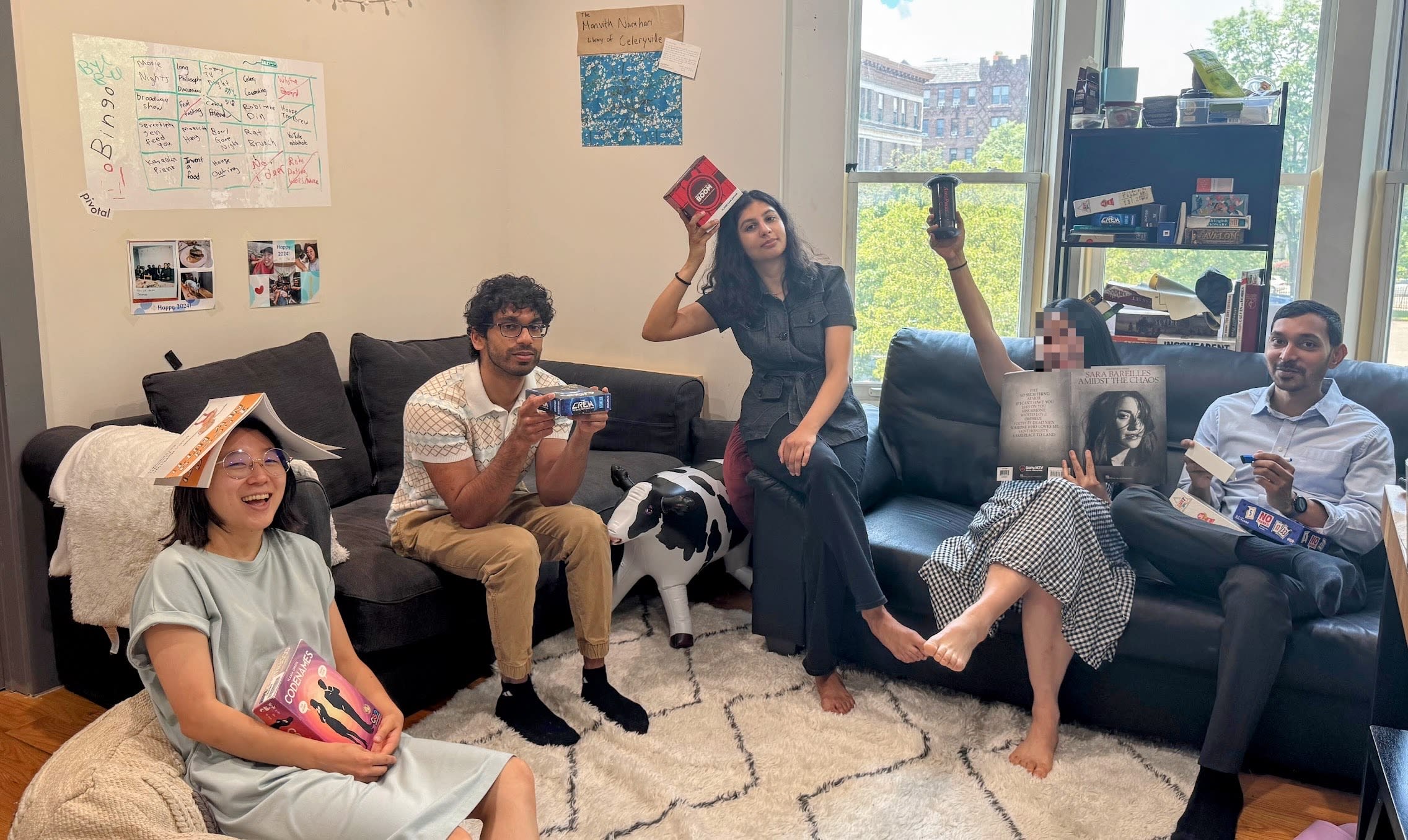
I became AI Safety-pilled!
At The Celery, I lived with @Robi Rahman🔸 while he was working at Epoch. Over the course of the year, he would occasionally talk about his work in kitchen conversations (such as this paper). When AI 2027 came out, he urged me regularly to read it. I became AI Safety-pilled and proceeded to badger him with my novice questions. (Thanks, Robi!)
We hosted a slew of out-of-towners visiting
We hosted >10 travelers, including @Tilman, @Simon27, and @Austin.
Someone staying in your home helps build a steady line of connection vs. one-off at events. I got to learn more about their work in the broader EA ecosystem, but also to hang out and have fun :) Higher level of friendship compatibility vs. random couch-surfers from the ether.
I got connected to opportunities.
One of my housemates was participating in an accelerator and offered me a warm introduction to the organization, where I provided pro-bono generalist support to them & their batch of startups. In my sabbatical era, this was a blast!
We became a somewhat informal Schelling point.
My vision was a 1-mile-radius group chat “Celery & Friends” that would be active: does anyone has nutritional yeast, help I baked too many cookies, I’m watching Shrinking—does anyone want to join?
Didn’t end up quite like this, but still exists and good :)
Misconceptions
“I’m an introvert.”
You don’t have to be “on” all the time. My personal philosophy is that the group house should not feel like another obligation where you feel pressured to engage and contribute, but rather an accessible breeding ground for antics.
I’ve had phases where I was too tired to engage and would camp in my room for days at a time. You can do whatever you want.
“Do you just talk about EA all the time? Is it just a prolonged EA meetup in your home?”
Nope. Seldom. Having a mix of non-EA people helps (2/4 and 2⁄5 in my previous houses). Having EA-ness is correlated with a couple of other mutual interests: board games, YouTube rabbit holes, personal development, movies.
“I don’t know anyone to start this with. None of my friends want to do a group house.”
Same! I started with the lightbulb moment and proceeded to spam channels. After you get a few committed bites (my golden ratio: half of the ideal full size), form a somewhat binding coalition to search for a unit based on your collective specificities. Proceed to spam your social channels that you’re looking for a housemate to fill the rest of the spaces. (Network effects!)
Great For...
Lazy people
Want to watch a movie with friends but not leave your house? Play a movie, let the house know and hope they join in.
Remote workers
Coworking days, shared lunch breaks!
New to a city
Congrats, you have 3 friends already who can now introduce you to their friends!
You like hosting, organizing events, and cooking for people
Shared home = bigger common spaces = more flexibility to host.
You have a pet
Shared responsibility! Hey, can someone walk the dog while I’m out today?
Not Great For...
You have a busy work life as a lawyer or founder & the home is a place to unwind and unplug.
Your S/O is not community-pilled.
I’ve been lucky that most housemates’ S/Os actually love to engage with the rest of us, but it’s definitely possible that an S/O is very introverted and not keen on a shared home.
Strict and unpopular location preferences.
If you want to live in Long Island, I think it’ll just be hard to source people!
Here’s How
1. Plant a Flag (Find a Place to Rent)
For the Celery, I searched for 4+ bedroom units in accessible areas with high likelihood of being approved by a future housemate (near transit, safe).
For Bread House, I put out feelers first, got two bites, and then we proceeded to search for a place with our specifications.
2. Find People (What most people are afraid of. Indeed, the most legwork.)
I posted across EA, Rat, Veg Facebook groups & channels.
Friends of friends.
Randos.
My houses have been a mix of EA-pilled and not, and I like how this works!
Host interviews, pick people you like.
3. Have a Vision
This is also to share with prospective housemates.
What future are people committing to?
Rules/limitations: what don’t people want the house to be?
4. Select and Sign the House
You + Claude know what to do here.
5. House Governance & Logistics
Decide on house communications medium: WhatsApp, Signal,
Discord is best for multiple channels. Some of ours are: priority important stuff, random chat, events, photos, kitchen.
Create a house Google calendar, for people out of town & house events, or events to share with housemates that you’re going to and would welcome company!
Up to the housemate’s specific preference, but when there’s an empty bed, hosting someone from the community is a fantastic house-vibes experience! At the Celery, we also offered our couch regularly.
Decide on meeting/chore schedule.
At Bread House, we decided no meetings. At The Celery, we had meetings as needed (once every few months to discuss an agenda).
Guest preferences: do we want guests (incl. S/Os) to be announced/communicated?
6. Things That Might Happen Over Time
Rituals will serendipitously float up: someone likes to watch movies on Thursdays, the house decides to host brunch on Sundays, someone’s always down for Super Smash Bros, someone’s also cooking and offering taste tests.
Ask: In the comments, share your experience of the EA Group House life!
What are some unique rituals that your house enjoys?
What is difficult about running the group house?
What are the different roles needed to make a house flourish?
I will add: Have a very clear contract between the founding members of the house about who pays rent to the landlord (every tenant directly, or one tenant who is paid by other tenants), subletting rules, who is responsible for finding the sublets or successors for their own bedrooms when they leave, and especially:
whether founders remain responsible for finding successors for their own bedrooms after the mandatory lease period with the landlord is over (adding emphasis here!), or whether the founder (or founders) who stays longest is responsible for maintaining the finances and existence of the group house on their own
edit: or option (C), whether each successor to a room is expected to find their subsequent successors in turn, rather than the founding occupant of their room continuing to find successive occupants indefinitely—and how it will be communicated and contractualized with those successors
Ideally, have this contract notarized. But definitely don’t have a verbal agreement on it, and definitely don’t make assumptions about what it means to have a joint intention to keep the house going into the future.
For London, people might find this map of where EAs live useful.
Hello! good guide, and i’ll +1 on supernuclear
I just started an EA group house in philadelphia and I agree it’s easier than people think
Honestly I don’t know why most people doesn’t make more effort to live with their friends and other people they deeply respect. We naturally spend much of our time with our housemates, yet so many people live alone or with randoms. When I ask people why, often its just because they didn’t plan or put in the effort, rather than an intentional decision not to. My 3 years living in an intentional community were life-changing and I regretted not living like that earlier. We were pretty hardcore at your level 4.
People sometimes fear losing friendships or messing up relationships by living with their friends, but I think this is misplaced. Two people I lived with found me really hard to live with (I loved living with them :D) but despite that I would say living with them only strengthened our friendship after we stopped living together. Also what kind of friendship can’t sustain living together for a year? It’s not like you’re committing to marriage
Thanks so much for this post, I think you’ve captured the important points super well and this is an underappreciated awesome thing to do!
+1 that a great co-living space can be a huge quality of life improvement! My day-to-day sense of happiness and belonging in SF increased enormously once I moved into a place with friends.
One other meaningful benefit of coordinating a housing group (at least in California) is that you can freeze your starting rent rate. E.g., a four-bedroom unit in the building I lived in was listing at $6,500/month in 2022 when friends and I moved in. A group moved in, then vacated last year. The landlord then successfully re-listed the same unit at $9k/month (a 38% increase). Meanwhile the rent in our unit has only increased by ~2% over the last four years because CA rent protections only allow a landlord to increase rent by a modest, state-set annual cost-of-living/inflation rate.
Had that 4-bedroom been able to Theseus’ ship the move-out transition—changing the names on the lease to other friends/EAs gradually without fully vacating—they would be able to save $28,440 ($7,110 per resident) per year in perpetuity.
I think having some non-EA housemates would lead to talking about EA *more* because you’d have to give more context and field more questions on what you’ve been up to. I find EA-like topics come up relatively rarely in my all-rat house.
Hoping you accidently mixed up the frequency of these two events