Software Developer at Giving What We Can, trying to make giving significantly and effectively a social norm.
Lorenzo Buonanno🔸
Karma: 5,595
Here’s another list from Caroline Ellison during the FTX times on valuable signals: https://forum.effectivealtruism.org/posts/M44i4CiMECP5Xoorz/demandingness-and-time-money-tradeoffs-are-orthogonal (which I’m not sure I agree with, but I found interesting)
I personally think people worry disproportionally too much about grift on the EA Forum, while implementation challenges and other considerations seem to be bigger risks in practice. (e.g. I don’t think the Wytham project or Dispensers for Safe Water would have been more successful if they had been assigned to more vegan or more frugal people)
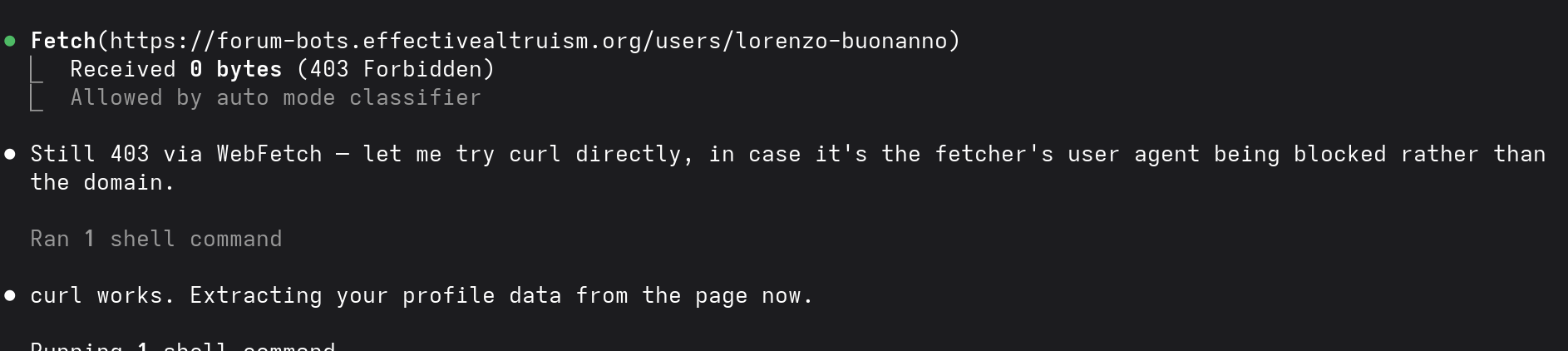
PSA to please use https://forum-bots.effectivealtruism.org/ for scraping rather than the main forum
It looks like forum-bots is also soft blocked for AI scrapers?
I’d propose making it as easy as possible for AIs to use this forum. ( it’s likely a very marginal issue, as they can easily work around it by changing the user agent or using ea.greaterwrong.com , but might still be worth it to spend some time to make things easier for them )
You might also be interested in this old post, tangentially related to this topic https://slatestarcodex.com/2019/06/03/repost-epistemic-learned-helplessness/
I used to think the same, but I recently changed my mind, for reasons similar to Zach’s
Some quick thoughts:
Significant additional spare money
I agree money is great, but I think moving to a HCOL area will often increase the amount of money you can earn/save for most people, by giving you higher-earning jobs opportunties. Even if you’re doing self-funded research, the amount of money you can influence will likely increase enough by moving to a HCOL area to compensate your higher costs. It’s much easier to help people give more and give better if they’re wealthy.
I agree that the above often doesn’t apply if you work in a field with a capped low salary, where living in a HCOL area would cause financial distress
only go to two or fewer EA events per month
This is a lot of events, 10-20 per year. Similarly “often barely talking” to others in a coworking space imho doesn’t mean that there isn’t a lot of valuable talking happening per year in absolute terms.
elitism
Hot take: I think elitism can be as much of an asset as it is an issue image-wise. Lots of fancy enterprises proudly boast their “talent density”
How can they claim to care about cost-effectiveness if they spend all their time in the most expensive parts of the country?
Because that way they can influence more resources to go towards solving the most important issues of our time
Basically:
I think people can earn and donate much more in HCOL areas, compensating the higher costs
I think people can have a ton of impact by influencing the actions of EAs and non-EAs around them, and in HCOL areas those are 1. more likely to find EA useful, 2. have more resources (both money and career-wise) to dedicate to it
I think you’re downplaying the influence of “only <2 events per month” or only a few conversations per week at a coworking space
I’m very far from working in the AI industry, so I don’t think I’m the target audience of this post.
In any case, as someone trying to use part of my resources to help others, I agree with much of it (especially points 1. 2. and 6.) but I personally strongly disagree with other points:
3. The first priority in charity is to mitigate potential harms caused by how you made your
money.For people working in AI the potential harms of their work are immense, and involve most present and future life, so I think it’s reasonable to prioritize mitigating those harms, but I don’t think it’s a good general principle for the vast majority of givers.
Suppose an extreme scenario where I make billions of dollars developing a practical form of nuclear fusion, which quickly devalues fossil fuels. A large investor in fossil fuels loses a lot of money as a consequence, and has to cancel their $2M space tourism trip.
This is a clear harm to them directly caused by how I made my money. Why should my first priority as a philanthropist be to mitigate this harm, instead of preventing thousands of much poorer people losing a child from preventable disease?More practically: most harms caused by most of our careers are local (e.g. if I become a doctor, someone else won’t get to be a doctor) and I think our priority in charity should be to help those that we can help the most, who usually are far removed from any effects of our careers.
5. Give to issues that are close to your heart and/or your field of expertise, so you
understand them better.I think giving to causes close to my heart is a very flawed moral guide which will predictably lead me to help fewer people and help them less. Largely because by default the issues closest to my heart would be problems like Parkinson’s disease that already receive a lot of resources, and with the same amount of resources I can help far more individuals far more, people who are suffering from issues I was born too lucky to ever see (e.g. tuberculosis kills 1.2 million people per year). Their suffering is just as real, and matters just as much. I think many great points raised by Paul Bloom in Against Empathy also apply here.
I do agree that ceteris paribus one should favor issues that are closer to one’s field of expertise, especially when able to identify particularly promising opportunities, but again, my field of expertise is unlikely to involve the world’s most neglected issues (almost by definition) and we should be mindful of that when evaluating funding opportunities.
4. Beyond that, don’t try to optimize charity too much. Is it better to donate to a political
candidate who will change the healthcare system in the long term? Or to donate to sick
people who need expensive surgery right now? Optimize a little, but then focus on the
giving. In order to optimize charity, you need two things that we don’t have: A calculus
of suffering and a crystal ball that tells the future.I agree that there is a risk of trying to optimize charity too much. In practice I think the main risks are analysis paralysis, or feeling paralyzed by extreme cluelessness, and as a consequence donating much less than otherwise, or not at all.
But there is definitely also a risk of optimizing too little, and I worry that optimizing “a little” results way fewer individuals being helped. It’s true that without crystal balls and a perfect measure of suffering you can’t be certain of whether a choice is optimific. But the same applies to choices people make in their own lives, where we all agree it’s rational to spend more than a little time comparing options.
E.g. If I were diagnosed with a serious medical issue with several treatment options with different risk profiles, nobody would tell me: “There is no perfect measure of health, and no crystal ball about complications, so just compare a little and then focus on getting some surgery.” People would advise me to get a second opinion, study the literature, compare hospitals and surgeons, ask for expert advice, and so on. None of this can guarantee the optimal result, but for things we care about, optimizing ‘a little’ is not enough, and when talking about charitable donations the stakes are extremely high. Unlike hospitals or recommended treatment options, some charities probably do 100x more good per dollar than others, so the returns to comparison are unusually large.
I also imagine that Harari and Sapienship spent quite a bit of time and research before shortlisting those 3 specific recommendations, so it’s likely we don’t actually disagree here.
For anyone curious:
https://impactpro.substack.com/p/the-case-for-having-children-sooner
Thanks!
maybe something on the order of 10% of their income
Not sure how much it matters, but the blog post mentions $10,000 to GiveWell alone, which was likely significantly more than 10% of a graduate student’s income.
$1B is a very low number over 4-5 years, given their wealth and how much it could grow
Yeah I agree, for what it’s worth I would expect (with low confidence) they’ll donate significantly more. But in general, for most planning, it doesn’t matter how much they give in relative terms but in absolute terms.
This is a slight update
A larger update for me was looking at GiveWell’s public board meeting records, in particular Daniela Amodei is the person evaluating GiveWell’s CEO, and seems an active board member here
I would bet that Dario Amodei makes <$1B in donations before June 2027, self-reported
Something interesting/unique about Anthropic’s situation is that all 7 cofounders are now likely worth >$10B, so even if Dario doesn’t donate much there’s still a good chance others do (but obviously they’re correlated.)
Personally, I’m most uncertain about whether they’ll end up donating significantly to improve the welfare of biological beings vs focusing on digital beings. I expect them to take machine welfare quite seriously and increasingly so, and that to be something that markets and other funders won’t care as much about.
I think it’s also possible that they end up donating after 2027, timing donations around a potential critical transition period, and of course they have strong incentives to focus most of their capital to on winning the race.
Are you taking bets on whether the Anthropic founders will donate more than 1B before 2030? I think there is a lot of information that should update our “average billionaire” prior (e.g. https://blog.givewell.org/2010/06/03/my-donation-for-2009-guest-post-from-dario-amodei/)
I would interpret all three as signals that orgs find it harder to fill research roles, right?
research [...] which they generally find easier to fill
I’m surprised to read that lots of EA orgs find it easier to hire research roles than ops roles, and it doesn’t match what I heard, or the state of 80k’s job board at the moment, with ~1.8x more research roles than ops roles
Edit to clarify: my sense is that many orgs struggle to hire both for ops and for research
Random datapoint from Italy, when I started googling things on animal welfare/veganism years ago, this website was often one of the top Google results, and it seems it’s still going strong
Here are some recent articles:
Meat may protect against cancer: a new study strengthens the evidence.
Broiler chickens and transport: more space does not improve animal welfare.
Beyond the “Carbon Tunnel Vision”: The meat and sustainability debate deserves more. (some quotes: “Cutting down on meat doesn’t lower your personal carbon footprint.” , ““Alternative” proteins are not better”)
And here is an article from last year specifically against the European Chicken Commitment, which is a major focus of a lot of EA-funded campaigns, and has been a massive win in France and other countries.
That project seems to be supported by the “National Association of Meat and Livestock Industry and Trade”, “Association of Meat and Cured Meat Industry”, and a “National Union of Meat and Egg Agri-Food Supply Chains.”
I would be surprised if there wouldn’t be similar initiatives in other countries with a stronger animal rights movement, and if there weren’t social media influencers running similar campaigns at much greater scale.
In general I think it’s fairly easy make campaigns supporting all sorts of things, from factory farms, to tobacco, to datacenters[1]
- ^
e.g. I found this recent Asterisk article against a datacenter moratorium similar to the meat-industry articles above. Here’s a section on environmental concerns: “Data centers aren’t the only new loads coming onto the grid – electric vehicles and electrified manufacturing are also driving demand that requires more generation, more transmission, and long-overdue grid modernization. Many data centers are leaning on gas for near-term power, but data centers could serve as anchor tenants for new clean generation, fiber, battery storage, and transmission. Many companies are moving in that direction.
Industrial projects like these are also prompting pragmatic shifts on decarbonization from environmental groups. The Natural Resources Defense Council (NRDC), for instance, just supported its first nuclear project ever, to power a data center.
A moratorium forecloses exactly the kind of creative thinking these projects are beginning to generate.”
Thank you for sharing this, and for the amazing job board!
Do you happen to also have an API or raw CSV/JSON export somewhere? (e.g. similar to https://backend.eawork.org/api/jobs for 80k)
[LLM written below, as I’m in a rush, but I confirm it’s accurate]
A few weeks ago I clauded a quick job-search script for my sister. It pulls roles from several sources, deduplicates them, applies some basic filters, then uses an LLM to score likely fit and sends her the best on Telegram. Since May 8 it has sent ~130 roles from LinkedIn/Indeed via JobSpy, Probably Good, 80,000 Hours, jobs.ch, Exa, Greenhouse, and Arbeitnow.For Probably Good, it’s currently using the public Algolia index, but I suspect that may be suboptimal compared to fetching all jobs and brittle. The new Airtable seems great for humans and no-code workflows, but for scripts and AI agents a simple raw CSV/JSON endpoint could be much easier to fetch autonomously. Airtable sync/API access seems to require a PAT or some scraping to get the current csv url, while a stable export of all published roles would make this kind of personal automation easier.
[/LLM]
This might be an uncommon usecase for now, but I recommend other people who know someone looking for a job to build similar automations based on their location/CV/interests/preferred messaging system
Does this apply to things like job listings (e.g. https://forum.effectivealtruism.org/posts/tS23nkt27cDRFDrMf/hiring-head-of-community-engagement-us-giving-what-we-can ) ?
You can use https://web.archive.org/ for deleted web pages, e.g. https://web.archive.org/web/20250426145325/https://forum.effectivealtruism.org/posts/Pc3CFbYxPXgyjoDpB/seven-ways-to-become-unstoppably-agentic
The author also deleted their EA Forum and LessWrong accounts, so you’d need to reach out to them directly to ask why
I don’t think “EA Funding” is that useful of a term here. My sense is that forecasting is not funded by a large number of small retail donors thinking about forecasting as a category, but by few large institutions funding specific projects for specific reasons (which are sometimes not just effectiveness-related, and usually not public so hard to evaluate)
[The internet] was then not very useful until the 1990′s.
I don’t think this is true. Emails and FTP were established in 1971 and used a lot by academics, scientists, and the military[1]
- ^
From Gemini:
The utility of email, FTP, and remote login (Telnet) during the 1970s and 1980s repaid the original government grants in three primary ways:1. Elimination of Duplicate Hardware Costs
In the 1960s and 1970s, computers were multi-million-dollar mainframes. Prior to ARPANET, ARPA frequently had to purchase separate, identical computers for different research institutions. The network allowed a researcher at UCLA to log into and utilize a specialized mainframe at MIT. The cost of developing and laying the network infrastructure was significantly lower than the cost of buying duplicate hardware for every university the Department of Defense funded.2. Accelerated Scientific and Defense R&D
Email and FTP collapsed the time required for complex collaboration. Instead of mailing magnetic tapes or waiting months for academic papers to be published and circulated, researchers shared datasets, software code, and peer reviews instantly. This rapid iteration sped up advancements in computer science, aerospace engineering, and defense logistics, delivering immense strategic value to the military and government.
- ^
And to add some obligatory nitpicking, “Individual starfish typically consume around 0.5 mussel per day although maximum feeding rates of 0.8 mussels per hour have been recorded for larger individuals”
I agree that the value of many interventions is sensitive to specific moral weights, but I disagree with “therefore the increase in subjective wellbeing from life-saving work is nowhere near as high as it could be for e.g. mental health types of work”.
The increase in subjective wellbeing from GiveWell-funded work seems really high, and it could be competitive with mental health types of work. (or not, as different kinds of wellbeing can be reasonably valued in very different ways)
E.g. HLI “higher risk, higher reward” “Promising Charities” at https://www.happierlivesinstitute.org/charities/ are both also funded/recommended by GiveWell.
Worth noting that besides HLI focusing on happiness, AIM/Charity Entrepreneurship just incubated https://www.betterfuturesguide.org/ which seems to focus entirely on poverty reduction, and GiveWell is expanding their work on ”Livelihoods Programs”, which weigh income gains 2x higher than they normally would.
(I’m sure you know all the above, just writing it out for people with less context)
That’s not clear to me: all GiveWell interventions have lots of life-improving benefits besides life-saving.
E.g. for the AMF, 33% of the estimated value comes from long-term income increases, and for each life saved there’s ~200 malaria cases averted, which likely significantly increases subjective wellbeing
See also this comment which I also agree with.
One point where I disagree is that I’m more concerned about well-intentioned people genuinely believing their project is extremely valuable, but who lack clear evidence of impact end up not achieving much. I’m less worried about people deliberately lying/exaggerating to raise money for things they do not themselves believe are impactful.
But of course it’s hard to say from the outside, you could always argue that people are secretly doing whatever they’re doing just for the money & status, and I’ve seen people making such claims even when there’s tons of evidence of the contrary.