Abstract
Several major technology companies have announced plans to operate AI data centers in orbit. Elon Musk recently claimed: “the lowest-cost place to put AI will be space […] within two years, maybe three.” If a meaningful fraction of new AI compute really is placed in space within a few years, that would be a fairly big deal for AI governance and strategy. Here we try to disentangle the hype from reality and provide a sober assessment of the technical and economic feasibility of orbital data centers (ODCs).
The main case for ODCs is the cost of energy: space solar panels in the right orbits receive more constant and intense sunlight compared to Earth. Moreover, ODCs don’t currently face the same permitting and regulatory delays as on Earth, cause fewer ongoing environmental harms compared to grid or onsite natural gas-powered data centers, and may be more secure against data exfiltration. We find that the cost-competitiveness case for ODCs depends almost entirely on Starship achieving reusability comparable with what SpaceX achieved with Falcon: space-based solar reaches cost parity with present-day off-grid terrestrial power continuously at roughly $250/kg to orbit, and becomes cheaper than any current terrestrial energy source at around $50/kg, from the present-day launch cost of roughly $1,500/kg. Radiative cooling, often cited as a fatal obstacle, appears surprisingly manageable — potentially even cheaper than on Earth. However, ODCs may require substantial (perhaps ~38%) extra non-compute hardware (like solar, racks, and cooling) over 5 years to compensate for their inability to swap out failed chips, and inter-satellite bandwidth limitations likely confine ODCs to inference workloads, at least early on.
Assuming no transformative AI,[1] but continued demand for data center buildout, we estimate that ODCs are unlikely to represent a meaningful share of compute before 2030, but become cost-competitive with present-day terrestrial data centers within 3–5 years if Starship development stays on track.
Read on the Forethought website here
Introduction & Takeaways
Some of the world’s largest technology companies continue racing for compute. If progress continues, demand for data centers may more than double by 2030.[2] Increasingly, though, new data center capacity is bottlenecked by multi-year queues to connect to the power grid.[3]
The result has been a scramble for workarounds. Leading AI labs have increasingly adopted a “Bring Your Own Generation” model to source power, deploying onsite gas turbines and engines to bypass grid bottlenecks. xAI, for example, reportedly installed hundreds of megawatts of onsite gas generation in Memphis to accelerate deployment, and OpenAI and Oracle have placed large turbine orders for new Texas campuses.
Some argue that energy will become the binding constraint on AI progress, given grid interconnection delays as gas turbines are themselves facing multi-year manufacturing backlogs. But the constraint does not appear fundamentally binding (as Epoch notes): turbine manufacture may expand to meet more demand and companies could go off-grid using combinations of gas, solar, and batteries, scaling power in parallel with compute, albeit at a cost premium. This raises a natural question: if you’re going off-grid anyway, then what’s the best way to get power and where is the best place to put your data center?
Some think the answer will be in orbit. In November 2025, Google announced Project Suncatcher, a plan to put TPU-equipped satellites in dawn-dusk sun-synchronous orbit. In early 2026, SpaceX filed with the FCC for authorization to launch and operate a constellation of up to one million data center satellites.[4] Other entrants include Blue Origin, Ramon.Space and startups like Starcloud, and Aetherflux while China’s Three-Body Computing Constellation has launched 12 operational satellites and run Alibaba’s Qwen3 model in orbit. Recently, at GTC in March 2026, NVIDIA announced the Space-1 Vera Rubin Module, meant to be a dedicated space-rated GPU platform.
At first glance, it seems very unlikely that any meaningful fraction (say, >10%) of additional data center capacity will be placed in space in the next few years. But if the companies betting on space are right, that would be a fairly big deal, and it could change the landscape of AI governance. For example, terrestrial data centers are subject to national and regional regulations, whereas AI developers could potentially exploit jurisdictional ambiguities around compute in space. Also, the path to low-cost orbital compute likely routes through a single launch company, SpaceX, which also now operates a frontier AI lab since its acquisition of xAI. And that might raise concerns around concentration of power.
We’ve been looking into the technical and economic viability of orbital data centers (ODCs). Our core model gives estimates for the total cost of Earth and space-based data centers across several scenarios.
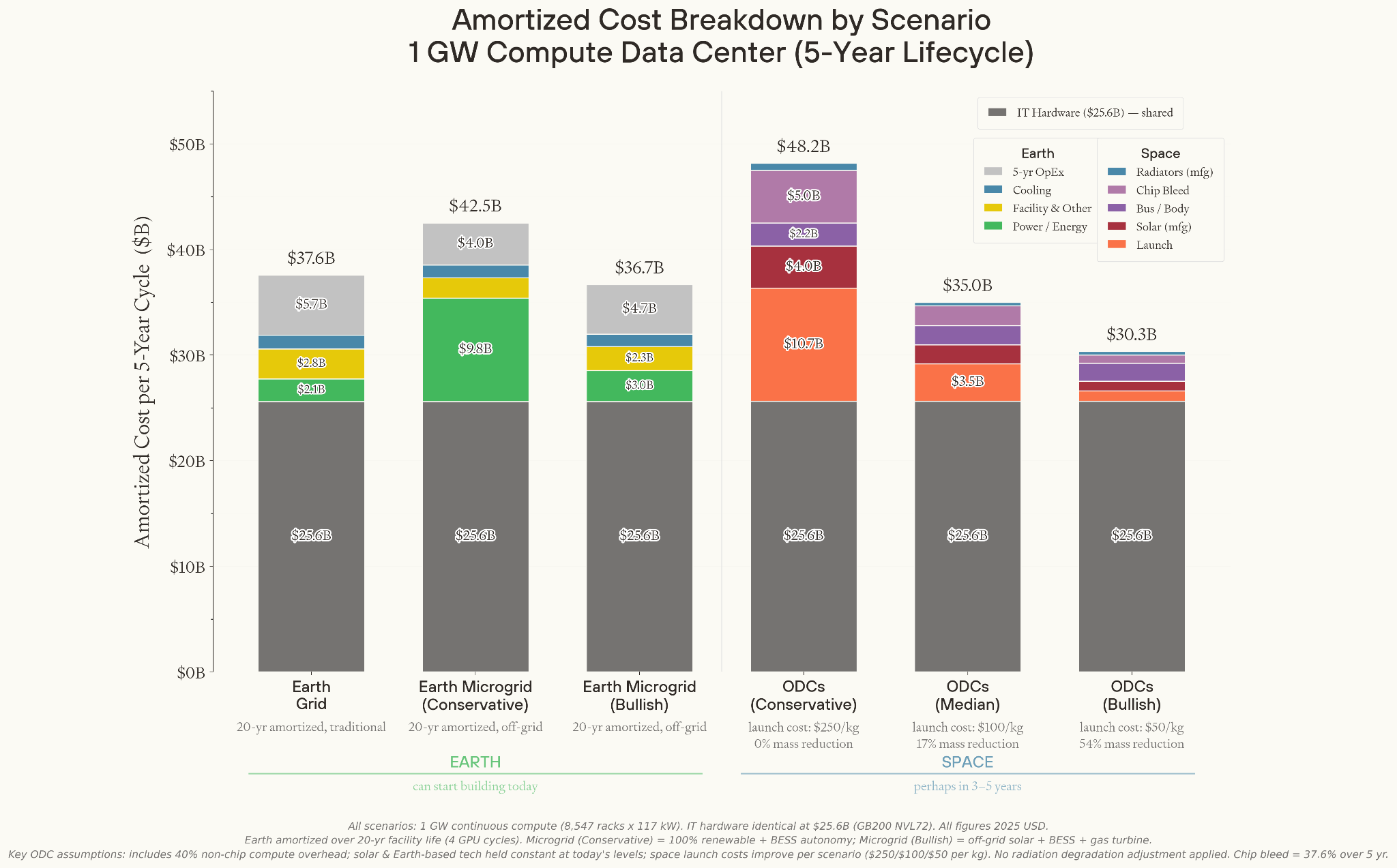
Cost breakdown for three Earth-based and three space-based scenarios building out 1 GW of compute. As best we can determine, orbital data centers could become cost competitive with a bullish terrestrial buildout if launch cost reaches around $100/kg given modest reductions to server and cooling system mass, while a bullish case for orbital data centers with substantial mass reductions and launch at $50/kg may offer cost savings.
The report focuses on three questions. First, what is the basic economic case for a meaningful fraction of AI compute being placed in space? Second, the most obvious physical blocker: can you cheaply cool a data center in orbit? Third: how fast could the shift to space data centers happen, how soon, and what would have to go right?
Here is our provisional assessment:
SpaceX’s Starship is the only vehicle currently on track to deliver the launch costs and cadence that meaningfully scaling orbital data centers would require. Competitors are years behind, making SpaceX’s Starship the only near-term path to large-scale orbital compute. SpaceX aims to complete Starship development by late 2026, with several necessary milestones still ahead. If development stays roughly on track, Starship could plausibly hit the cost and cadence required to scale meaningful orbital compute within 3–5 years. However, chip production may become the limiting factor by this point, rather than launch capacity.
The cooling problem is more tractable than commonly assumed. Passive radiators using selective coatings and lightweight carbon fibre panels could achieve ~163–346 W/kg at system level, a 13-28× improvement over ISS-era radiators (~13 W/kg).[5] No radiator at these performance levels has been deployed at the scale an orbital data center would require, but prototype high-conductivity carbon composite panels have demonstrated the material properties required. At these performance levels, thermal hardware is 2-5% of total data center cost, and actually less than what terrestrial data centers spend on cooling over a comparable lifecycle.
If launch costs fall enough, the unit economics could favor space. Solar panels in dawn-dusk sun-synchronous orbit produce roughly 3–5× the energy of the same panel at a good terrestrial site.[6] Space-based solar becomes cheaper than the best off-grid terrestrial installations once launch costs drop below roughly $250/kg using Starlink-like solar arrays. At a launch cost of $50/kg (corresponding perhaps, to a Starship with full reuse as reliable as Falcon), space solar could fall to between $25–45/MWh, making it cheaper than any current terrestrial option available today.[7] Beyond the symmetric cost of chips, launch cost is the dominant line item for ODCs while power and op-ex dominate terrestrial costs but would be near zero in space.
The inability to do maintenance would be a large cost. Chips often fail and are swapped out in today’s data centers but a dead chip in an ODC would remain dead, wasting the parts of the supporting infrastructure (power, cooling) and diminishing overall compute. We model this below as a 9% annual bleed causing about 40% overbuy of launch and non-chip hardware over the data center’s lifetime.[8] Below $100/kg launch cost this might net out against other savings from ODCs but this is a significant uncertainty since the actual rates of chip failure for ODCs could be higher or lower.
All-things-considered we think that, absent transformative AI, orbital data centers probably won’t make up a meaningful fraction of compute before 2030, but it’s credible that space could house much or even the majority of compute buildout throughout the 2030s.
Read the full report on the Forethought website: Will We Really Put Data Centers in Space?
- ^
We hope to do more analysis on how transformative AI might change this picture in the future. Speculatively, our initial thinking is TAI could accelerate the timeline over which compute transitions to space but this is not necessarily the case. In particular, during an industrial explosion pressure to grow rapidly might be so strong as to incentivize aggressive usage of non-renewables on Earth like oil and gas. If so, transition to space might be delayed for a one time boost on Earth, in which case the picture may look similar to the one we outline here, but with the added prologue of a large-scale terrestrial buildout.
- ^
McKinsey projects demand growing to 171–219 GW by 2030, roughly doubling from today, in a buildout they estimate will require up to $7 trillion in investment.
- ^
See, directing FERC to address large-load interconnection (2025), Reuters, Google says US transmission system is biggest challenge for connecting data centers (2026), Bain & Co., Next phase of data center growth (2025).
- ^
Starcloud subsequently filed for authorization to operate 88,000 satellites and Blue Origin has filed for 51,600.
- ^
The ISS External Active Thermal Control System achieves roughly 13 W/kg. Our improvement comes from three sources: selective coatings (high emissivity, low solar absorptivity, off-the-shelf AZ-93 paint), carbon fibre composite construction (2.4 kg/m² vs ISS’s ~14-17 kg/m²), and optimised operating temperature (40°C vs ISS’s −40°C, exploiting the T⁴ dependence). Each factor is independently demonstrated; their combination at scale is not.
- ^
The solar constant at Earth’s orbit is approximately 1361 Wm-2. A solar panel in a dawn–dusk sun-synchronous orbit receives nearly continuous illumination (capacity factor ≈ 90–95%), yielding an average power of roughly 1220–1290 Wm-2 before panel efficiency losses. By contrast, even excellent terrestrial solar sites typically achieve ~20–30% capacity factors due to night, weather, and atmospheric attenuation, corresponding to an average incident power of roughly 270–410 Wm-2. Thus, a panel in a dawn–dusk orbit produces roughly 3–5× more energy annually than the same panel on Earth.
- ^
This wouldn’t be true if you were then beaming the energy back to Earth, but would apply to orbital compute, where only data needs to be sent to Earth.
- ^
Both terrestrial data centers and ODCs will pay symmetric costs to replace dead chips but ODCs would have to pay the additional cost from lost overhead, i.e. in the earthbound case a technician swaps the dead chips, in the space case you launch entire additional satellites to compensate for chip bleed. We assume you would not send a mission to do maintenance and instead simply let the excess power and cooling go to waste doing no useful compute. Extra power and cooling over fewer chips may increase operating efficiency somewhat but this seems fairly negligible. The figure for chip bleed of ~9% per year is derived from Meta’s The Llama 3 Herd of Models (2024). We cover radiation and other forms of damage in more detail subsequently.
I’m glad to see this rigorous analysis!
I was skeptical of the cooling being cheaper in space. It is true that you can radiate to a much colder temperature in space, about −60°C equivalent. It does look like space cooling would be cheaper with your future launch costs for your constellation model. However, for your modular station model, you would need around 1 m diameter pipes to start, which would weigh a lot and pose a large single source of failure. Also, you would have to pump long distances, increasing the pump mass and energy use.
I think inference would be challenging because the satellite is in view for only a few minutes. I guess most queries take less time than this, but would you keep handing off the session memory?
This is much more reasonable than people claiming that going off grid is cheaper than grid electricity with the same reliability. Still, you note that this capacity factor is reasonable for the desert, but typically there is around a two times seasonal variation. Since 80 hours of storage can’t handle that, you would need to oversize your PV more. But it wouldn’t change the results that much (~10%). And the gas turbine in your Baseline B solves this seasonal problem.
If you want 80 hours of storage for 100 GW, that is 8 TWh, which is years worth of current production, so I think you’d have to pay a premium.
For the longwave radiation coming from the earth, you would get ε absorption, not α absorption. So the equation should be:
P_net = 2εσT⁴ − αS − αF(Al × S) − εF(σT_earth⁴)
Also, the view factor to the Earth is 0.25 for one side of the radiator, but you are counting both sides for the emission, so I think the view factor should be 0.5.
So then at 20°C: emitted 770 W/m², absorbed 248 W/m², net rejected 522 W/m² (not 633 W/m²).
Also note that if your fluid temp is 20°C, the radiator will be lower average temp because of conductive thermal gradient. But with 1 mm of high-modulus pitch-based carbon fibre reinforced polymer, it doesn’t look like too much of a loss.
Footnote 17 seems to end abruptly: “The scenarios in a bit more detail are as follows:”
Hey David, thanks for this excellent comment.
Re: cooling skepticism, actually this has been helpful. On review I think the net rejection will be greater than 633 W/m2. You’re right, we get absorption = ε for longwave radiation from Earth (Kirchhoff would not be pleased).
On view factor, hmm I think this will just vary over the orbital band. Computing the analytic per-face as F = (1/π)[θE − ½sin(2θE)] with sin(θE) = R⊕/(R⊕+h) I get:
Altitude
F per face
F total
550 km
0.258
0.515
1000 km
0.194
0.388
2000 km
0.118
0.236
Maybe we should go worst case and also initial ODCs would prefer to be on the low end of altitude for as long as slots are available (lower cost to orbit, less radiation) You do I think want to go high enough to avoid occasional shading in dawn-dusk-SSO so perhaps ~675km and up. If we correct the absorptivity for Earth IR and take the low end view factor, I get your 522 W/m2. That looks like a ~1% increase in total cost for ODCs if you’re right.
While checking this though it occurs to me you should be able to be have the radiators edge on to the sun while still radiating from both sides, something like this:
Basically a Starlink v3 with panels at 90 degree pivots. Then with shading from direct sunlight I think I get 650 W/m2 for 675 km altitude, F = 0.473, so an improvement on radiator performance overall. I’ll have to think about this a bit more and potentially update the appendix. Certainly we can fix the erroneous use of α in the 3rd term.
Agree loss from averaging over radiator temp looks modest.
Also agree that scaling the plumbing to a massive modular station architecture looks rough. Also there are issues with stresses/strains due to maneuvers for larger orbital platforms and some structural scaling that has to happen to avoid e.g. floppiness. My guess is that the architecture isn’t viable at least near-term.
Re: inference, not my area of expertise and I don’t think the computer architecture totally decided but from looking into it I think it looks like you’d only be handing off the query and response. The routing should be the same as for traditional satellites so this problem is already ~solved (though you may need to scale the satellite mesh as demand/traffic increase). The orbital compute is in a polar orbit so typically not overhead. The trip in a kind of worst case scenario might look something like this:
User → ground station (let’s say 100 Gbps uplink from ground station)
Ground station → uplink satellite(s) (whichever is in view at the moment, can stream seamlessly as multiple pass overhead)
Intersatellite link hop, routing toward wherever the GPUs are, let’s say there is as yet only one cluster in orbit and it takes 15 hops to reach it, each at ~100 Gbps (Starlink v2)
Arrive at cluster → run inference → return output (this is where the KV cache, session memory etc. stays, in the compute cluster)
ISL hops routing back to ground station (say 15 hops at 100 Gbps again, each is maybe 5.5 ms)
Downlink to ground station → serve output to user
For example I think for a 100 GB workload through a 100 Gbps optical ground station, total time is ~8 seconds serialization/transfer, essentially the same ~8 seconds as terrestrial on 100 Gbps direct connect, plus something like 175 ms of constellation overhead.
Re: terrestrial solar and battery. Good points: these make terrestrial microgrids look a good bit worse. For solar on Earth in addition to the seasonality we’re also assuming some of the best solar sites in the world so this should be fairly bullish for terrestrial data centers. We didn’t spot any fundamental blockers to scaling microgrids through some combo of solar overbuy + battery and gas but prices may be at a premium either for turbines or for batteries as you say. In some sense it seems like the data center buildout may have hyperscalers acting like water flowing down hill, pivoting into whichever buildout channel offers least resistance at the moment. Similarly if ODCs start going up en masse there could be lower lying supply chain issues that emerge. The most biting constraint of all is probably chips and memory.
I dug in a little more, and I think your Earth cooling estimate is high at $2.5–3.0B/GW with water chillers. An NREL study was more like $0.7B/GW with water chillers. Also, we may be able to dispense with the water chiller (as you have assumed in space), and then it could be even cheaper. So I doubt it’s actually going to be cheaper to cool in space. However, your point that cooling in space doesn’t wreck the economics still stands.
I’m glad it was helpful!
I was using 550 km, so I agree that higher up, you would have more net radiation leaving the radiator.
As for your bent configuration, that is creative to avoid the sun incidence. However, then you would have radiation from the solar panels to the radiator, and since the solar panels will be warmer than the Earth, I think it will work out worse overall.
Incomplete?
Your other points make sense.
Seems to be a formatting error and it’s supposed to be in the main text, referencing the table.
The full report is definitely one of the better treatments I’ve seen of the subject (and I’ve read quite a few recently as they’re loosely related to my work). A few comments though...
Feels like an unduly favourable assumption to ODCs to amortise hardware over exactly the same schedule as terrestrial ones. Any situation in which inference compute hardware doesn’t become obsolete at exactly the point the ODC reaches end of design life favours terrestrial datacentres.[1] Also feels generous to assume bleed rates in space are no worse than terrestrial bleed[2]
I’m not sure what model you’ve determined your satellite hardware costs on and I know you’ve itemised solar and radiator panels else where, but taking the most feasible approach of thousands of smallsats for your 1GW datacentre, the $4b is buying a lot of propulsion systems, GNC subsystems, intersatellite links, space rated batteries and MAIT work as well as aluminium frames[3]. The article doesn’t really discuss how much more complex satellite buses are than modular buildings...
I think the regulatory arguments actually mostly stack in favour of terrestrial datacentres, because you get to jurisdiction shop. Whilst space isn’t effectively regulated, spectrum and launch licensing is and you basically only have one choice.[4] There’s growing concern over orbital congestion and even the effects of deorbiting on the mesosphere to deal with, and plenty of parts of the world where NIMBYs either don’t live or are less relevant to local regulators than your money.
The cooling estimate for earth may or may not be representative of what people are paying for climate control for racks of servers in a building, but feels a lot easier to improve that than max out the specific power of satellite radiators, especially since for ODCs we’ve already relaxed design principles like “chips should be less than 1km away from each other!”.
So I agree with the overall point it’s going to depend a lot on launch costs but I think there’s still some way to go. And even if the unit economics do work, your “fast takeoff” approach with Starship launches scaling to 10k by 2028 feels very fast assuming no obstacles at all to development, scaling capacity or even launches scrubbed by weather. c.f. industry expectations that Blue Origin losing their only launchpad recently will set them back a full year. SpaceX’s launch cadence being exceptional feels like reason to doubt they’ll 50x it in the next 2 years with an experimental platform...
A couple of further points slightly more favourable to ODCs in the longer run
costs look different if one assumes a architecture where much of the mass doesn’t get deorbited every five years (especially stuff which suffers minimal degradation like radiators) [5] which probably looks a bit more like Starcloud plus orbital refuelling and servicer vehicles to upgrade chips. That sort of modular architecture is still a work in progress and obviously has its own tradeoffs with more expensive components.
the other use case for orbital datacentres is edge compute for military uses, which isn’t fully defined yet and isn’t nearly as price sensitive
Your terrestrial datacentre can keep on running if its 5 year old chips are still useful, or conversely be replaced much earlier if the economics favours keeping the building/microgrid but replacing the chips with much better ones. Obsolete chips potentially have some resale market too. Your ODC needs deorbiting after 5 years regardless; propellant refuelling and in space chip replacement are theoretically possible but orders of magnitude more expensive than keeping a building powered on.
we have some evidence of COTS inference chips surviving 5yr LEO radiation doses without issue, but might be a different matter for the marginal chip whilst running hot over a 5 year duration in that environment. If needed, radiation hardened variants could be delivered… for a price
if I understand correctly that’s supposed to be just $4 per watt bus/subsystem/MAIT costs excluding solar panels, radiators and inference chips which would be two orders of magnitude cheaper than competitive providers in today’s market. Even with the benefits of vertical integration and automation that seems ambitious for the near term...
I suppose you could pin your hopes on Europe or India improving launch cadence and offering less restrictive licensing regimes but that sounds unlikely...
one reason why some people manage to be both sceptical of ODCs and bullish on SBSP (which has similar pros and cons) is that the latter is supposed to amortise its build costs over decades rather than be replaced every 5 years, which offsets transmission efficiency loss. Though yeah, that does mean more expensive solar panels etc...
I don’t know how much very slight latency between different nodes or sporadic disruption affects inference compute, but feels like something that could be more of a problem than precision pointing and tracking (these are solved problems, albeit problems solved with more expensive hardware and mission ops and regulators might not like dense formations)
Interesting analysis! I’m somewhat skeptical that space based cells will perform as well as you find in this model. This seems like a classic case where something that looks good on paper will run into problems in real world applications for something as complicated as putting massive datacenters in space. I don’t think your model is accounting for murphy’s law here.
Also, on a technical note, do you have the source for the starlink solar cell specifications used for the phrase “Back-calculated from Starlink V3 specifications (50,400 W from 554 kg array, 257 m² area)”? This seems like one of the critical figures of your model but I couldn’t find where you linked the source for it.
My impression (not the author):
area is from slide 8 of SpaceX’s FCC Starship Gen2 filing (says V2 in the table but the 2000kg mass is V3-scale)
wattage is Forethought’s guess (257 m² area x 1361 W/m² solar constant x 20% AM0 cell efficiency x 0.721 system derating = 50,400 W), not including 95% capacity factor and 8% annual degradation. It’s 2.5x what Musk claimed FWIW
not sure where array mass comes from
Thanks for this guys, re Murphy’s law, it’s true we can just have system level failures (e.g. cooling unit, unseated connects, flywheel breaks and we lose pointing etc.) Then worst case we lose an entire satellite this way. It’s difficult to say quantitatively what failure rates may be so we bill this as a key uncertainty. ‘Space quals’ would mean every part would undergo extensive testing and many iterations for reliability (tests include e.g. vibe table, acoustic, pyroshock, vacuum testing and EMI/EMC) so a host of possible bugs would be worked out before the data centers get off the ground. Even so, certainly things do fail. One way of getting at this could be again via Starlink which has over 10k active satellites. It looks like failure rates for Starlink V2 have been around 1.1% (3 out of 5 years into their lifecycle) based on this catalog by McDowell. It’s my understand that SpaceX finds it more economical at their scale to actually skimp a bit on space quals and accept higher failure rates since Starlink’s satellites are relatively cheap. This would flip the other way if you have valuable chips on board. On the other hand there are more moving parts and more potential points of failure for ODCs than for Starlink sats so not clear to me which way this swings. You could say for example perhaps 1% of all ODC satellites fail or you could go higher or lower for the reasons I mention and then tac that on at a X% all-cost increase. True failure rates are a significant uncertainty overall.
re: back calculation, the wattage and scale is consistent with SpaceX/Musks V3 specs, we just move them to the dawn-dusk-SSO orbit instead of the typical orbit where they get higher power draw.
I have looked into AI and energy (happy to share my drafts with anyone interested). My impression is that it is not the cost of energy that drives orbital DCs, but instead the availability. It is not only orbital DCs that are being considered, the portfolio includes hopelessly naive stuff like floating DCs powered by ocean waves, restarting Three Mile Island, SMRs and much more. If energy consumed by human-equivalent AI task performed does not drastically reduce, the inference energy demands will far outstrip even the most electrical generation the world as a whole has ever added in a single year, even at low labor replacement rates. If anyone is working or thinking about this I am super interested in talking. I am hoping to publish my initial thoughts soon. The upshot: As with compute, if energy becomes a limiting factor, it might be a good point for interventions. For example, electricity regulating authorities (there are many and strong ones!) can incentivize disclosure of model capabilities in e.g. cyber, which is extremely relevant to cyber attacks on the electric grid and thus plausibly lands under their jurisdiction.
Happy to read a draft! We also looked a sea-based data centers, SMRs, and permitting/buildout arbitrage in other nations. My current thinking is that you’ll see a lot of friction but its possible in principle to scale energy up, perhaps to the tune of hundreds of GW/yr even if only using solar. The more fundamentally binding constraint to me seems to just be chip production but thats not to say that these various bottlenecks don’t at least partially bind or create friction at various points. You’d probably have a situation in hyperscalers are water flowing down hill, pivoting to the next best way to scale compute, then I think that eventually just goes to space. Given the vested interest of SpaceX and SpaceX’s longterm plans for lunar industrial base then Dyson Swarm construction I expect they’ll invest heavily in making them work. Seems to me they will probably successful in making ODCs viable and you’d see this dynamic where space prices are falling while headwinds for terrestrial buildout worsen. Many uncertainties remain however, difficult to forecast Starship scaling timelines. The regulatory environment is also currently favorable but untested at the scales we’re talking about and could change e.g. in a democratic admin.
All in all though, my personal guess is that its better for data centers to be in space but there are arguments to be made for and against. Seems like a hard call.
Sent draft on DM—I prefer to keep this non-public both because my employer needs to review this before it goes out and also because I would like a few people to find my biggest errors before I put it out there. But I aim to get this posted publicly in the next couple of weeks. Thanks!
I mean if you can move DCs and production/mining/etc. to space that’s a solid win for AI safety? We then basically delineate AI and the only human-inhabitable planet we know about. That’s a heavy lift though, but maybe water on that one moon of Uranus (?) and other parts could be assembled off-Earth. This is literally galaxy brain thinking but something I feel might be worth pursuing, or at least showing AIs that it might be cheaper for them to pursue off-Earth living than engage in uncertain and high-cost conflicts on Earth. Maybe they don’t care about time, and would be happy to build towards this over the next 1000 years instead of spending valuable compute and industrial capacity to prepare for AI-human conflict.
Wow that’s crazy I listened to Elon musk being interviewed by Dwarkesh and I came out of that thinking data centers in space at scale seemed a bit absurd. This has updated me a little that maybe it’s more plausible than I thought.